Across almost all major jurisdictions, only natural persons can be inventors—e.g., the UK Supreme Court held that “an inventor must be a person”. At the same time, offices increasingly accept that AI may assist inventive activity; what matters is a significant human contribution and candid process disclosure.
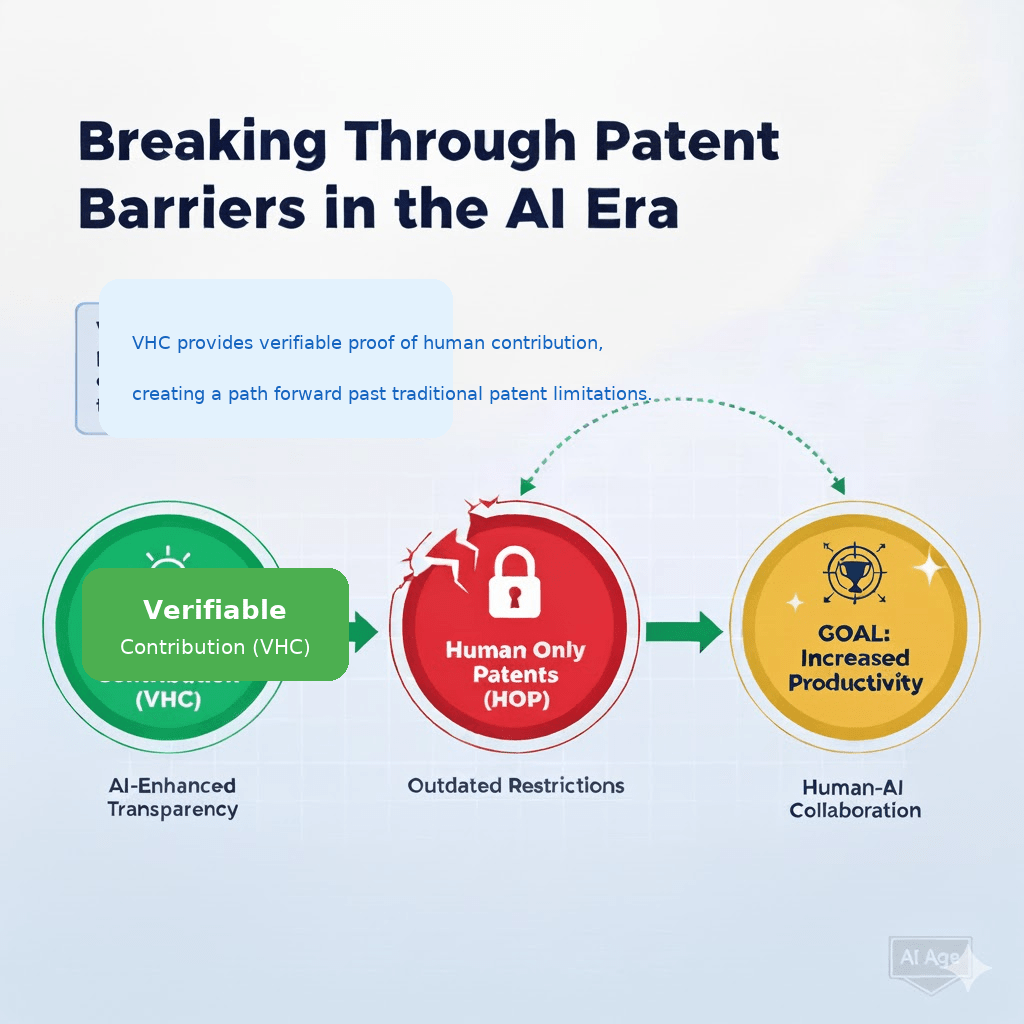
This article maps the legal landscape and makes a practical policy case: keep inventorship human-only, but normalize AI-assist contributorship statements and provenance—for example, a Verifiable Human Contribution (VHC) layer that documents who did what, when—to improve disclosure quality, reduce disputes, and speed diffusion, the channels linked to productivity in WIPO and OECD work.
Definition — VHC (Verifiable Human Contribution): a provenance and contributorship framework that records human roles (create → edit → review → approve), decision points, and tool/version metadata, enabling transparent AI-assist disclosure while preserving human accountability.
1) Why inventorship rules matter for innovation and productivity
Patents are a bargain: temporary exclusivity for enabling disclosure. When teams avoid stating how AI-assisted—because they fear inventorship challenges—specifications can become less informative, which slows cumulative innovation and diffusion. WIPO’s World Intellectual Property Report 2024 emphasizes building innovation capabilities and improving knowledge flows across economies.
OECD research shows the global slowdown is driven by diffusion gaps—divergence between frontier and non-frontier firms—rather than a lack of breakthroughs at the frontier [8]. Better disclosure norms make patents more usable to the non-frontier majority.
2) The global picture at a glance (Q4-2025)
- Americas: United States — human-only inventor (Thaler v. Vidal), AI-assist permitted with significant human contribution. Canada — Patent Appeal Board (2025): AI cannot be an inventor.
- Europe: United Kingdom — “an inventor must be a person”. EPO — inventor must be a natural person (J 8/20).
- Asia–Pacific: Australia — AI cannot be named as the inventor. Japan — courts affirm inventor is a natural person. Korea — KIPO & courts: inventor must be a natural person. China — CNIPA guidelines: name the natural person who made the creative contribution; AI cannot be an inventor. New Zealand — AI cannot be named as the inventor.
- Africa: South Africa — outlier: a DABUS-named patent was granted under a formalities-based system (2021).
Bottom line: with one limited outlier, no major office allows AI to be listed as an inventor—but several now tell applicants how to safely disclose AI assistance.
3) Jurisdiction table (quick reference)
| Jurisdiction | Current stance | Key authority (year) |
| United States | Inventor must be a natural person; AI-assist OK with significant human contribution | Thaler v. Vidal (Fed. Cir. 2022) [2]; USPTO Inventorship Guidance (2024) [3] |
| United Kingdom | “An inventor must be a person.” | UK Supreme Court (2023) [1] |
| EPO (Europe) | An inventor must be a natural person | J 8/20 (DABUS) (2021) [4] |
| Australia | AI cannot be named as the inventor | FCAFC 62 (2022) [5] |
| Canada | AI cannot hold inventorship status | PAB Re Thaler, 2025 CACP 8 (2025) [9] |
| Japan | Inventor limited to natural persons | Tokyo District Court (2024) [10] |
| Korea (KIPO) | An inventor must be a natural person | KIPO statement/decision (2022) [11] |
| China (CNIPA) | Name the natural person; AI cannot be an inventor | CNIPA AI Guidelines (Trial) (2024/25) [12] |
| New Zealand | AI cannot be named as the inventor | NZ High Court (2023) [13] |
| South Africa | DABUS patent granted (formalities-based) | CIPC grant/analysis (2021) [14] |
(For currency, this snapshot reflects positions known by Q4-2025; see “Last updated” at top.)
4) What today’s rules mean for practice (and why that affects growth)
Three frictions many applicants feel:
- Under-disclosure. Without a clear “lane” to describe AI’s role, teams may under-explain workflows in specs or arguments. The USPTO now explicitly permits AI-assisted inventions where a human made a significant contribution and encourages candid AI-use disclosure.
- SME cost/uncertainty. Smaller firms spend more counsel time threading inventorship vs. enablement needles.
- Forum-shopping optics. South Africa’s acceptance—absent substantive examination—doesn’t resolve the issue and can mislead non-specialists.
From a policy lens, these frictions matter because diffusion—not just frontier breakthroughs—drives aggregate productivity.
5) A pragmatic middle path: human inventors + contributorship + provenance
Rather than relitigating “AI as inventor,” a practical compromise is emerging:
- Keep inventorship human-only (the legal consensus).
- Add an AI-assist contributorship statement. The USPTO’s stance—AI-assisted inventions are “not categorically unpatentable” but require significant human contribution—is a clean model.
- Adopt provenance practices (e.g., VHC). Maintain contemporaneous, signed records of who did what, when (create → edit → review → approve), plus tool/model/dataset versions—while using selective disclosure for sensitive details.
Why this helps: clearer disclosure aids examiner understanding, narrows disputes, and increases a specification’s value for downstream innovators—the diffusion lever highlighted by WIPO and the OECD.
6) Authority quotes (short and on-point)
“An inventor must be a person.” — UK Supreme Court (Thaler v Comptroller-General, 2023) [1].
“AI-assisted inventions are not categorically unpatentable.” — USPTO Inventorship Guidance (effective Feb. 13, 2024) [3].
“Under the EPC, the inventor must be a natural person.” — EPO Legal Board of Appeal, J 8/20 (2021) [4].
“The Korean Patent Act requires an ‘inventor’ to be a natural person.” — KIPO (2022) [11].
7) Australia focus (for TLF readers)
Australia’s Full Federal Court aligned with the human-only approach in Commissioner of Patents v Thaler (2022) [5]. A low-friction improvement would be to normalize AI-assist statements and provenance expectations in examination practice (examples/templates, no statute change). That gives SMEs/universities clearer pathways, fewer reworks, and more predictable costs.
8) Safe drafting hygiene (for counsel and teams)
- Use non-limiting phrasing in public materials: “may,” “for example,” “illustrative.”
- Maintain contemporaneous provenance (roles, edits, approvals, tool versions) but avoid publishing proprietary mechanisms unless already filed.
- Avoid “admissions” like “obvious,” “routine,” or definitive technical assertions that could narrow claim strategy.
- Keep policy commentary clearly separate from claim language; ensure consistency across jurisdictions.
9) Measuring progress (policy → productivity)
To test whether this middle path lifts diffusion:
- Share of new applications with AI-assist statements (by office/field).
- Time-to-first action/allowance vs. non-flagged cases.
- Opposition/appeal rates where AI-assist is disclosed vs. withheld.
- Citation/licensing velocity of such patents (diffusion proxy).
WIPO’s World IP Indicators 2024 shows resilient filing volumes; standardized AI-assist lanes can make those filings more informative and more useful to non-frontier firms.
References (numbered, one system only)
- UK Supreme Court — Thaler v Comptroller-General of Patents (2023).
- US — Thaler v. Vidal (Fed. Cir. 2022).
- USPTO — Inventorship Guidance for AI-Assisted Inventions (Federal Register; effective Feb. 13, 2024).
- EPO Legal Board of Appeal — J 8/20 (DABUS) (2021).
- Australia — Commissioner of Patents v Thaler [2022] FCAFC 62.
(Intentionally omitted to remove prior mismatch.) - WIPO — World Intellectual Property Report 2024.
- OECD — Frontier Firms, Technology Diffusion and Public Policy (and related diffusion studies).
- Canada — Thaler, Stephen L. (Re), 2025 CACP 8 (Patent Appeal Board, June 2025).
- Japan — Tokyo District Court decision (May 16, 2024) confirming inventorship limited to natural persons (court/association summaries).
- Korea — KIPO press release/decision (Oct. 3, 2022) denying DABUS inventor status; inventor must be a natural person.
- China — CNIPA AI-related invention guidelines (trial, 2024/25): name the natural person who made the creative contribution.
- New Zealand — High Court, Thaler v Commissioner of Patents [2023] NZHC 554.
- South Africa — CIPC DABUS grant (2021) and practitioner analyses noting a formalities-based system.
- WIPO — World IP Indicators 2024 (global filing trends).
FAQs: AI, Inventorship & VHC (Plain English)
Can AI be listed as an inventor?
No. Across major offices (USPTO, UKIPO, EPO, Australia, Japan, Korea, China, NZ), only natural persons can be inventors.
So where does AI fit in?
AI can assist. You still need a human who made a significant contribution to the inventive concept.
What does “significant human contribution” mean?
A human meaningfully shaped the problem/solution—e.g., selecting features, designing experiments, interpreting outputs, or drafting claims—not just pressing “run”.
Should I disclose AI assistance in my application?
Best practice is to be candid where relevant. Clear disclosure helps examiners understand the work and can reduce later disputes.
What is VHC (Verifiable Human Contribution)?
A simple provenance record of who did what and when (create → edit → review → approve), plus tool/model versions—so you can show human accountability.
Will disclosing AI use hurt my chances?
Not if a human made the significant inventive contribution. Several offices explicitly say AI-assisted inventions are not categorically unpatentable.
Why should SMEs care?
Good disclosure and VHC reduce rework and ambiguity, making patents easier to examine, license, and build upon.
Disclosures & Editorial Standards
No affiliate links: This article contains no affiliate or sponsored links.
Citations & verification: We reference primary sources (courts, IP offices, WIPO/OECD). Email corrections to [email protected].
Legal disclaimer: Educational information only, not legal advice. Seek advice from a qualified patent attorney for your circumstances.