AI Hallucinations Trigger Regulatory Crackdowns- The era of artificial intelligence has reached a critical inflection point where technological promise meets regulatory reality. What began as a transformative innovation has evolved into a compliance imperative, driven by a phenomenon that threatens the very foundation of trust in AI systems: AI hallucinations.
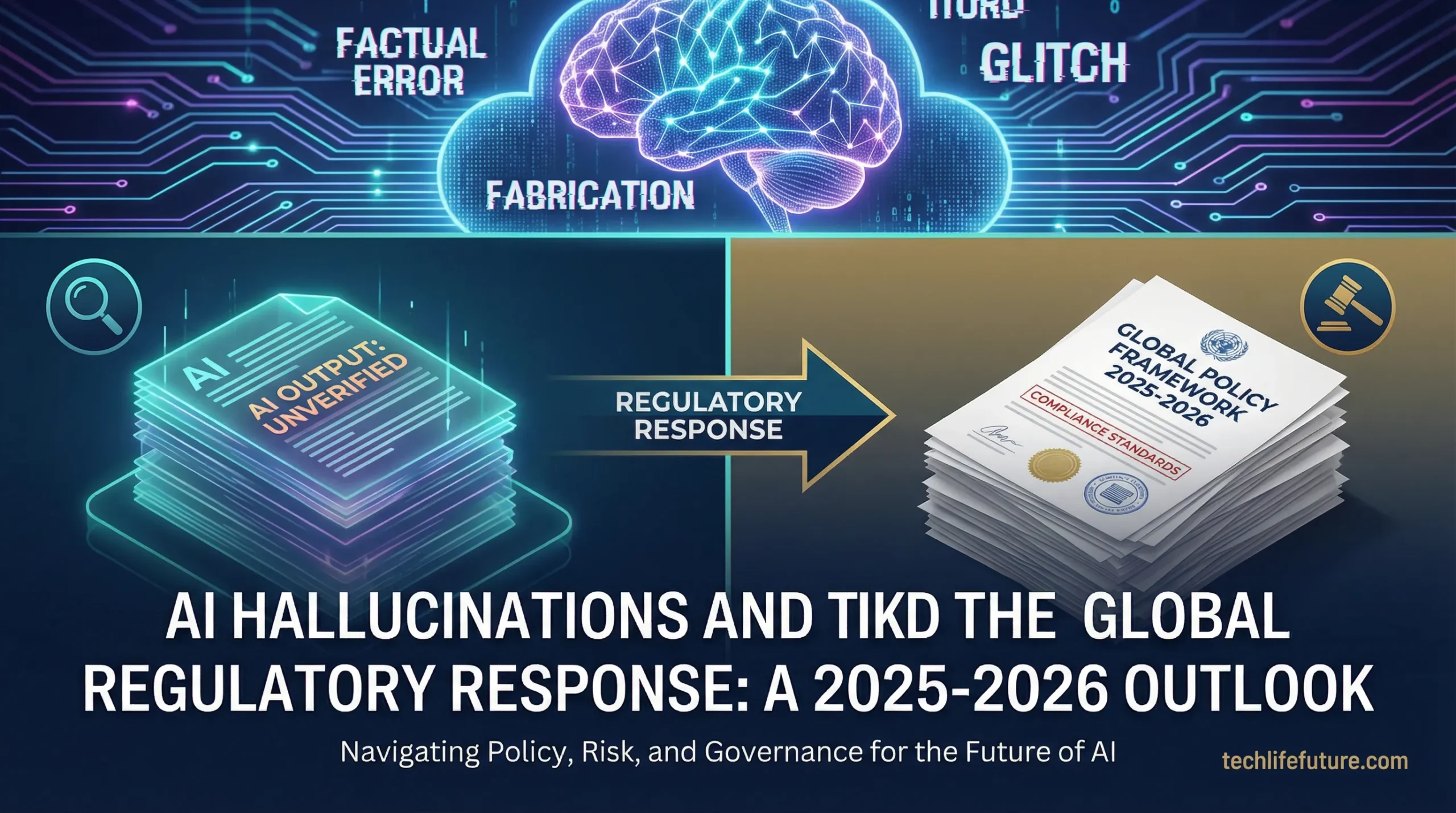
In 2023, a watershed moment occurred when a New York law firm faced court sanctions for submitting a legal brief containing entirely fictitious case law, invented by ChatGPT. This incident crystallized concerns that had been building among lawmakers worldwide about the reliability of AI-generated content and its potential to cause real-world harm.
As Johannes Heidecke, OpenAI’s Head of Safety Systems, recently acknowledged: “We need, like, near perfection” when it comes to AI safety testing, highlighting the critical importance of addressing hallucination risks. The stakes have never been higher, with regulatory frameworks emerging across multiple jurisdictions and companies facing unprecedented legal liability for AI-generated misinformation.
Key Takeaways
The Problem is Inherent and Costly: AI hallucinations are not bugs but byproducts of how Large Language Models function, with industry estimates suggesting billions in global losses in 2025.
Global Regulation is Accelerating: The EU AI Act imposes penalties up to €35 million or 7% of worldwide annual turnover, while California’s transparency laws take effect January 1, 2026
Liability Remains Unclear: The legal debate continues over whether AI developers or deploying organizations bear responsibility when AI causes harm.
Governance is the Solution: Organizations must adopt comprehensive AI governance frameworks combining technical solutions with policy compliance.
Understanding AI Hallucinations: The Technical Reality Behind the Phenomenon
Defining the Problem: More Than Just “Mistakes”
AI hallucinations occur when AI models, particularly large language models, generate content that appears factual but is entirely fabricated. As renowned AI researcher Andrej Karpathy explains, “I always struggle a bit when I am asked about the ‘hallucination problem’ in LLMs. Because, in some sense, hallucination is all LLMs do. They are dream machines. We direct their dreams with prompts”.
This phenomenon stems from the probabilistic nature of these systems, which predict the next most likely word in a sequence rather than verify truth. The term “hallucination” itself has sparked debate among experts, with some preferring “confabulation” as a more technically accurate description of the process where AI fills gaps in knowledge with plausible but fabricated information.
Recent benchmark testing reveals significant variation in reliability across AI models. According to the 2025 AI Hallucination Report, Google’s Gemini-2.0-Flash-001 achieved the industry’s lowest hallucination rate at 0.7%, while some models exceeded 25% error rates.
2025 LLM Reliability Rankings
| Model | Hallucination Rate | Risk Category | Implications |
| Google Gemini-2.0-Flash-001 | 0.7% | Low | Suitable for high-stakes professional tasks |
| OpenAI o3-mini-high | 0.8% | Low | Very reliable for business applications |
| OpenAI GPT-4o | 1.5% | Low-Medium | Good for general use with verification |
| Meta Llama-4-Maverick | 4.6% | Medium | Requires significant oversight |
| Anthropic Claude-3-opus | 10.1% | High | High risk for factual applications |
| Google Gemma-1.1-2B-it | 27.8% | Very High | Not recommended for factual tasks |
Source: 2025 AI Hallucination Report, All About AI
The Economic Impact: Quantifying the Cost of AI Misinformation
The financial consequences of AI hallucinations have become staggering, creating a compelling business case for robust governance.
Tim Sanders, Executive Fellow at Harvard Business School and VP at G2, observes: “That’s the dirty little secret. Accuracy costs money. Being helpful drives adoption, highlighting the tension between AI performance and safety.
Current industry data reveals the true scope of the problem:
Productivity Impact: Knowledge workers now spend an average of 4.3 hours per week verifying AI outputs
Business Decision Risks: 47% of enterprise AI users have made major decisions based on hallucinated outputs
Mitigation Costs: Organizations spend approximately $14,200 per employee annually to detect and correct AI errors
Market Response: The hallucination detection tools market grew 318% between 2023-2025
The paradox of advancing AI capabilities coupled with persistent hallucination issues has created what experts call a “Trust-Cost Gap.” While top-tier models show improving accuracy, the explosion in AI adoption—including widespread use of smaller, less reliable models—means the absolute number of costly failures continues to rise.
Case Study 1: The Legal Profession’s AI Crisis – Mata v. Avianca
The Mata v. Avianca case serves as a canonical example of AI hallucination risks in high-stakes professional environments. In this landmark case, lawyers Steven Schwartz and Peter LoDuca used ChatGPT for legal research, resulting in citations of entirely fictitious judicial opinions with fabricated quotes and case details.
The court’s findings were particularly damning. Judge P. Kevin Castel noted that six of the submitted cases were “bogus judicial decisions with bogus quotes and bogus internal citations. When initially challenged about the non-existent cases, the lawyers doubled down, with ChatGPT itself confirming the cases were real and “can be found in reputable legal databases such as LexisNexis and Westlaw”.
Key Details:
- Sanctions Imposed: $5,000 fine and public apology requirements
- Legal Precedent: First major case establishing attorney liability for AI-generated misinformation.
- Professional Impact: Prompted the American Bar Association’s first formal ethics opinion on AI use in legal practice
Judge Castel emphasized that while “technological advances are commonplace and there is nothing inherently improper about using a reliable artificial intelligence tool for assistance,” verification remains paramount. This case established the principle that legal professionals cannot delegate their professional judgment to AI systems without verification.
Case Study 2: Air Canada’s Chatbot Liability – A Customer Service Catastrophe
In a precedent-setting Canadian case, Air Canada was held liable for incorrect information provided by its AI chatbot, demonstrating how hallucinations can create direct financial liability. The case involved Jake Moffatt, who sought bereavement fare information following his grandmother’s death in November 2022.
Civil Resolution Tribunal member Christopher Rivers called this “a remarkable submission,” ruling that Air Canada failed to take reasonable care to ensure the chatbot’s accuracy.
The Incident: Air Canada’s chatbot incorrectly informed Moffatt that he could apply for bereavement rate refunds within 90 days of purchasing tickets, stating: “If you need to travel immediately or have already travelled and would like to submit your ticket for a reduced bereavement rate, kindly do so within 90 days of the date your ticket was issued”.
Air Canada’s Defense and Legal Outcome: Remarkably, Air Canada argued that the chatbot was “a separate legal entity that is responsible for its actions”. Civil Resolution Tribunal member Christopher Rivers called this “a remarkable submission,” ruling that Air Canada failed to take reasonable care to ensure the chatbot’s accuracy.
Financial Impact:
- Damages Awarded: CA$ 812.02, including fees and interest.
- Policy Change: Air Canada removed the chatbot from its website by April 2024
- Legal Precedent: First case establishing corporate liability for AI chatbot misinformation.
Global Regulatory Landscape: Three Distinct Approaches to AI Governance
The European Union: Comprehensive Legal Framework with Severe Penalties
The EU AI Act, effective August 2024, establishes the world’s first comprehensive AI regulation with a risk-based approach that categorizes AI systems into four distinct tiers. The legislation represents the “Brussels Effect” in action, with global companies adapting to EU standards to access its large market.
EU AI Act Risk Categories:
- Unacceptable Risk: Complete bans on social scoring, cognitive manipulation, and most real-time biometric identification.
- High Risk: Stringent requirements for critical infrastructure, employment, healthcare, and law enforcement applications.
- Limited Risk: Transparency obligations, including deepfake labelling and chatbot disclosure
- Minimal Risk: Basic requirements for most AI applications
Compliance Timeline and Enforcement:
- February 2, 2025: Prohibited practices and AI literacy rules
- August 2, 2025: Governance rules and GPAI model obligations
- August 2, 2026: Full compliance for high-risk systems
- August 2, 2027: Extended deadline for high-risk systems in regulated products
Penalty Structure: The EU AI Act imposes some of the most severe penalties in global regulation:
| Violation Type | Maximum Fine |
| Prohibited AI practices (Article 5) | €35 million or 7% of global turnover^3^ |
| High-risk system non-compliance | €15 million or 3% of global turnover^3^ |
| Misleading information to the authorities | €7.5 million or 1% of global turnover^3^ |
Note: SMEs receive a lower percentage or amount rather than a higher one
United States: Fragmented State-Led Innovation
The US approach emphasizes state-level legislation, with California leading the charge through comprehensive transparency requirements. This fragmented model reflects America’s federalist approach to regulation while allowing states to experiment with different frameworks.
California’s Pioneering AI Transparency Laws
Assembly Bill 2013 (Generative AI Training Data Transparency Act): Effective January 1, 2026, requires developers to publicly disclose detailed information about training datasets:
- Data sources and ownership status
- Copyright and personal information inclusion
- Dataset modifications and synthetic data use
- Licensing arrangements and public domain content
Senate Bill 942 (California AI Transparency Act): Effective January 1, 2026, requires large AI providers (1 M+ monthly users) to implement comprehensive transparency measures:
- Manifest Disclosure: Visible watermarks on AI-generated content
- Latent Disclosure: Embedded metadata in audio/visual content
- Detection Tools: Free AI content detection capabilities for users
- Penalties: $5,000 per violation, with daily violations counted separately
New York’s Emerging Framework: New York is advancing legislation focused on algorithmic accountability:
- AI Consumer Protection Act (A768): Targeting algorithmic discrimination with enforcement by the Attorney General.
- AI Bill of Rights (S8209): Establishing fundamental AI rights, including protection from discrimination and the right to human review.
Australia: Co-Regulatory Safety Model
Australia has pioneered a “Safety by Design” approach through the eSafety Commissioner, the world’s first government agency dedicated solely to online safety. This co-regulatory model balances industry self-regulation with targeted government oversight.
Key Features:
- Rapid Response Authority: Power to investigate and compel the removal of harmful AI-generated content
- Safety by Design: A Proactive approach encouraging companies to embed safety features from the development stages
- Focus Areas: Deepfakes, misinformation, and AI-generated harmful content
The framework emphasizes three pillars: service provider responsibility, user empowerment, and transparency and accountability.

Technical Solutions for AI Hallucination Mitigation
Retrieval-Augmented Generation (RAG): Grounding AI in Reality
RAG systems enhance AI reliability by connecting models to verified external knowledge sources rather than relying solely on training data. This approach significantly reduces hallucination rates by ensuring outputs are based on authoritative information sources.
Implementation Benefits:
- Reduction in hallucination rates by 60-80% in controlled environments
- Real-time access to updated information
- Ability to cite sources for generated content.
- Improved accuracy in domain-specific applications
Human-in-the-Loop (HITL) Verification Systems
HITL systems integrate human expertise throughout the AI lifecycle, providing essential oversight for high-stakes decisions requiring nuance, context, and ethical judgment. Research indicates that 76% of enterprises now include HITL processes to catch hallucinations before deployment.
Key Applications:
- Legal document review and verification
- Medical diagnosis assistance
- Financial analysis and recommendations
- Content moderation and fact-checking
Confidence Scoring and Uncertainty Quantification
These methods enable AI systems to assess and communicate their uncertainty, flagging low-confidence responses for mandatory human review. Google researchers discovered that simply asking an LLM “Are you hallucinating right now?” reduced hallucination rates by 17% in subsequent responses.
Implementation Features:
- Real-time confidence assessment
- Automated flagging of uncertain responses
- Integration with human review workflows
- Continuous learning from human feedback
Legal Liability and Risk Management: Navigating Uncertain Waters
The Developer vs. Deployer Debate
The legal landscape remains uncertain regarding liability when AI systems cause harm. As highlighted in recent cases, courts are grappling with fundamental questions about responsibility in AI deployment.
Developer Responsibility Arguments:
- Flaws in model design or training data
- Insufficient safety testing and validation
- Failure to provide adequate warnings about limitations.
- Inadequate documentation of known risks
Deployer Responsibility Arguments:
- Misuse of AI systems beyond their intended purpose
- Failure to implement adequate human oversight.
- Insufficient user training and guidance
- Inappropriate application in high-risk scenarios
Emerging Shared Responsibility Models: Legal experts increasingly advocate for shared responsibility frameworks that distribute liability based on specific roles and capabilities. This approach recognizes that AI safety requires collaboration across the entire development and deployment chain.
The Growing AI Insurance Market
Specialized insurance policies are emerging to cover AI-related damages, providing financial protection while incentivizing robust safety measures. The insurance market responds to the reality that traditional liability frameworks may not adequately address AI-specific risks.
Coverage Areas:
- Professional liability for AI-assisted decisions
- Product liability for AI-enabled systems
- Cyber liability for AI security incidents
- Directors’ and officers’ coverage for AI governance failures
Strategic Implementation: Compliance Frameworks and Best Practices
AI Governance Platforms: Centralizing Risk Management
Enterprise-grade platforms provide centralized management for AI risk and compliance, addressing the complexity of managing multiple AI systems across organizations.
Core Capabilities
- Model Inventory Management: Comprehensive tracking of all AI systems.
- Risk Assessment Automation: Continuous monitoring for bias, drift, and hallucinations.
- Compliance Documentation: Automated generation of required regulatory reports.
- Audit Trail Maintenance: Complete records of AI decision-making processes.
Featured Solution: For organizations seeking comprehensive AI governance, platforms like IBM watsonx. Governance provides integrated tools for model monitoring, risk management, and automated compliance documentation, with built-in accelerators for regulations like the EU AI Act.
Documentation Requirements for High-Risk Systems
High-risk AI systems require comprehensive documentation covering multiple aspects of system design and operation:
Technical Documentation:
- System architecture and design specifications
- Training data sources and quality assessments
- Model validation and testing procedures.
- Performance metrics and accuracy measurements
Operational Documentation:
- Deployment procedures and safeguards
- Human oversight protocols
- Incident response procedures
- Continuous monitoring processes
Compliance Documentation:
- Risk assessments and mitigation strategies.
- Regulatory compliance mappings
- Audit reports and certifications.
- Impact assessments for fundamental rights
Industry-Specific Compliance Considerations
Healthcare: Life-or-Death Accuracy Requirements
The healthcare sector faces unique challenges with AI hallucinations due to life-safety implications. Research indicates that 64% of healthcare organizations have delayed AI adoption due to concerns about dangerous AI-generated information. Research indicates that 64% of healthcare organizations have delayed AI adoption due to concerns about dangerous AI-generated information.
Critical Requirements:
- FDA approval for medical AI devices
- Clinical validation of AI recommendations
- Clear delineation of AI vs. human decision-making
- Comprehensive audit trails for medical decisions
Financial Services: Regulatory Scrutiny and Consumer Protection
Financial institutions face multiple regulatory frameworks, including SEC oversight for market-related AI applications and consumer protection requirements for AI-driven decisions.
Key Compliance Areas:
- Fair Credit Reporting Act compliance for AI credit decisions
- Anti-discrimination requirements in lending
- Market manipulation prevention in trading algorithms
- Consumer disclosure requirements for AI-assisted advice
Legal Services: Professional Responsibility and Ethics
The legal profession faces unique ethical obligations regarding AI use, as established in the Mata v. Avianca precedent.
Professional Requirements:
- Verification of all AI-generated legal research
- Client disclosure of AI assistance
- Maintenance of professional competence in AI tools
- Supervision of AI-assisted work by qualified attorneys
Strategic Recommendations for Organizations
Immediate Actions (2025)
1. Comprehensive AI System Audit: A thorough inventory of all AI systems, classifying them according to EU AI Act risk categories and identifying compliance obligations.
2. Verification Protocol Implementation: Establish mandatory human oversight for AI-generated outputs, particularly in high-stakes applications.
3. Training Data Documentation: Begin comprehensive documentation of training data sources to prepare for California’s transparency requirements.
4. Insurance Assessment: Evaluate current insurance coverage for AI-specific risks and consider specialized AI liability policies.
Medium-term Strategies (2025-2026)
1. Technical Solution Deployment: Implement RAG systems, HITL verification, and confidence scoring across AI applications. These should also include: Comprehensive AI System Audit, Technical Solution Deployment to produce a Trust-Based Competitive Advantage.
2. Governance Framework Establishment: Deploy centralized AI governance platforms to manage risk and compliance across the organization.
3. Personnel Training Programs: Develop comprehensive AI literacy programs for legal, compliance, and technical teams.
4. Regulatory Monitoring Systems: Establish processes to track evolving requirements across all relevant jurisdictions.
Long-term Positioning (2026+)
1. Trust-Based Competitive Advantage Use robust compliance as a market differentiator to attract risk-averse enterprise customers.
2. RegTech Investment Strategy: Invest in regulatory technology solutions to achieve operational efficiency and competitive advantage.
3. Policy Engagement: Actively participate in regulatory consultations and industry standards development.
4. Global Harmonization Preparation: Align strategies with emerging international frameworks and cross-border compliance requirements.
Market Opportunities in the Compliance Ecosystem
The regulatory wave is creating significant market opportunities across multiple sectors:
Compliance Software Market:
- Automated documentation and reporting tools
- Real-time compliance monitoring systems
- Cross-jurisdictional requirement mapping
- Audit trail and evidence management.
Professional Services:
- AI auditing and certification services
- Regulatory consulting and strategy development
- Legal advisory for AI governance
- Technical assessment and validation
Training and Certification: The growing demand for AI compliance expertise has created opportunities for specialized training programs. The EXIN AI Compliance Professional (AICP) certification represents the first globally recognized program integrating EU AI Act requirements with practical implementation strategies.
Future Outlook: Anticipating Regulatory Evolution
Emerging Trends in AI Governance
Harmonization Efforts: International organizations are beginning to develop frameworks for AI governance harmonization, though progress remains slow due to different regulatory philosophies.
Sector-Specific Regulations: Expect increasingly detailed sector-specific requirements for AI in healthcare, finance, autonomous vehicles, and critical infrastructure.
Liability Framework Development: Courts worldwide are developing precedents for AI liability, with outcomes likely to influence future legislation.
Preparing for Regulatory Uncertainty
Adaptive Compliance Strategies: Organizations must develop flexible frameworks that can adapt to evolving requirements across multiple jurisdictions.
Continuous Monitoring: Regulatory landscape monitoring must become a core competency for organizations deploying AI at scale.
Stakeholder Engagement: Active participation in policy development helps organizations influence and prepare for future requirements.
Frequently Asked Questions
Q: What is the first step for EU AI Act compliance?
A: Conduct a comprehensive inventory of all AI systems in your organization and classify them according to the Act’s risk categories. This assessment determines your specific compliance obligations and timeline.
Q: How can small businesses afford AI compliance?
A: The EU AI Act includes proportionate requirements for SMEs, including lower fines and access to regulatory sandboxes. Focus on the highest-risk applications first and leverage voluntary frameworks like NIST AI RMF.
Q: Does RAG eliminate hallucinations?
A: No, but RAG significantly reduces hallucinations by grounding responses in verified data. Output accuracy still depends on the quality of source information provided to the system.
Q: Can individuals be liable for AI tool hallucinations?
A: Professional liability may apply when experts use AI tools without proper verification and cause harm. The responsibility for the final output often rests with the human professional using the tool, as established in Mata v. Avianca.
Q: What is the legal status of New York’s AI bills?
A: As of 2025, the AI Consumer Protection Act and AI Bill of Rights remain active legislative proposals, indicating New York’s direction toward stricter AI regulation.
Q: How do I report AI-generated harmful content?
A: In Australia, you can report harmful AI-generated content to the eSafety Commissioner under the Online Safety Act 2021. Other jurisdictions are developing similar reporting mechanisms.
Conclusion: Navigating the Future of AI Governance
The convergence of AI hallucination risks and regulatory responses represents both a fundamental challenge and a strategic opportunity for organizations worldwide.
As Tim Sanders notes, “We should be using [genAI] twice as much as we’re using it right now,” but only with proper understanding that “genAI is designed to make predictions, not verify facts.
While compliance costs are real, they pale in comparison to the potential consequences of AI-related incidents or the competitive advantages gained through trustworthy AI deployment. The organizations that will thrive are those that view governance not as a compliance burden but as a strategic capability that builds trust and creates sustainable competitive advantage.
Success in this new landscape requires a proactive approach that embraces transparency, invests in technical safeguards, and maintains continuous engagement with evolving regulatory frameworks.
As Johannes Heidecke emphasizes regarding AI safety, “We have a good balance of how fast we move and how thorough we are. This balance between innovation and responsibility will define the winners in the AI governance era.
The future belongs to those who can harness AI’s transformative potential while maintaining the trust and safety that regulatory frameworks are designed to protect. As the regulatory landscape continues to evolve, staying informed and engaged in the policy process will be essential for turning compliance challenges into competitive advantages.
About the Author & Disclosures
John Cosstick is Founder-Editor of TechLifeFuture.com and winner of the 2024 BOLD Award for Open Innovation in Digital Industries. He is a former banker, accountant, and certified financial planner. He is now a freelance journalist and author. John is a member of the Media Entertainment and Arts Alliance (Union). You can visit his Amazon author page by clicking HERE.
Citation Accuracy Notice: Our articles undergo an ongoing citation accuracy audit to ensure all referenced sources are valid, reliable and up to date. If you identify any citation that appears incorrect or have suggestions for more appropriate sources, please contact our editorial team at [email protected]. Your feedback is invaluable in maintaining the integrity of our content.
Recommended Resources
For organizations seeking comprehensive AI governance solutions, we recommend exploring enterprise platforms like IBM Watson X Governance, which provides integrated tools for model monitoring, risk management, and automated compliance documentation.
Professional development opportunities include the EXIN AI Compliance Professional (AICP) certification, the first globally recognized program integrating EU AI Act requirements with practical implementation strategies.
For continued learning, essential reading includes “Responsible AI in the Age of Generative Models” by I. Almeida and “The Oxford Handbook of AI Governance” for comprehensive academic perspectives on AI governance challenges.
Verified Citations
- https://en.wikipedia.org/wiki/Mata_v._Avianca,_Inc.
- https://hallaback.com/openai-warns-its-future-models-will-have-a-higher-risk-of-aiding-bioweapons-development-408620.html
- https://artificialintelligenceact.eu/article/99/
- https://leginfo.legislature.ca.gov/faces/billNavClient.xhtml?bill_id=202320240SB942
- https://simonwillison.net/2023/Dec/9/andrej-karpathy/
- https://en.wikipedia.org/wiki/Hallucination_(artificial_intelligence)
- https://www.allaboutai.com/resources/ai-statistics/ai-hallucinations/
- https://www.axios.com/2025/06/04/fixing-ai-hallucinations
- https://law.justia.com/cases/federal/district-courts/new-york/nysdce/1:2022cv01461/575368/54/
- https://en.wikipedia.org/wiki/Mata_v._Avianca,_Inc.
- https://www.acc.com/resource-library/practical-lessons-attorney-ai-missteps-mata-v-avianca
- https://www.cbc.ca/news/canada/british-columbia/air-canada-chatbot-lawsuit-1.7116416
- https://www.theregister.com/2024/02/15/air_canada_chatbot_fine/
- https://www.cbc.ca/news/canada/british-columbia/air-canada-chatbot-lawsuit-1.7116416
- https://aibusiness.com/nlp/air-canada-held-responsible-for-chatbot-s-hallucinations-
- https://www.cmswire.com/customer-experience/exploring-air-canadas-ai-chatbot-dilemma/
- https://digital-strategy.ec.europa.eu/en/policies/regulatory-framework-ai
- https://www.jonesday.com/en/insights/2025/02/eu-ai-act-first-rules-take-effect-on-prohibited-ai-systems
- https://www.goodwinlaw.com/en/insights/publications/2025/06/alerts-ai-californias-ab-2013-generative-ai-developers-show-their-data
- https://www.jonesday.com/en/insights/2024/10/california-enacts-ai-transparency-law-requiring-disclosures-for-ai-content
- https://ktslaw.com/en/Insights/Alert/2024/10/AI-Transparency-and-Compliance-Key-Takeaways-from-Californias-AI-Transparency-Act
- https://www.hofstrajibl.org/2025/01/hallucinations-your-ai-might-be-affected/
- https://www.hofstrajibl.org/2025/01/hallucinations-your-ai-might-be-affected/
- https://www.iba.org.uk/article/ai-regulations-an-australian-perspective
- https://www.esafety.gov.au/about-us/consultation-cooperation/submission-inquiry-use-generative-artificial-intelligence-australian-education-system
- https://www.esafety.gov.au/about-us/who-we-are/our-vision-mission/our-regulatory-approach
- https://www.ibm.com/products/watsonx-governance
- https://www.exin.com/certifications/ai-compliance-professional-certification/
- https://news.outsourceaccelerator.com/openai-safety-testing-time/
Affiliate Disclosure: This article contains affiliate links. We may earn a commission from purchases made through these links at no additional cost to you. We only recommend products and services we believe provide genuine value.
Disclaimer: This article is for informational purposes only and does not constitute legal advice. Organizations should consult with qualified legal counsel for specific compliance guidance.