
The integration of Artificial Intelligence into legal proceedings is no longer speculative; it is a present-tense reality. Courts and court services are deploying assistive AI for research, e‑discovery, scheduling, transcription, translation, and drafting. The central question is not whether AI should replace human judgment (it should not), but how courts can pair human sovereignty with machine scale to reduce backlogs and protect due process.

This article maps the current state of play and sets out a balanced, evidence‑based view. Across leading jurisdictions, AI used for justice functions is treated as high‑risk and must remain assistive; decisions stay with humans. At the same time, evidence volumes and multilingual, cross‑border data make ‘human‑only’ research impractical at scale—necessitating auditable AI tools.
Key Takeaways
- Human judgment, machine scale: judicial decisions remain with people; AI is assistive, auditable, and explainable.
- Capacity matters: AI is already embedded in large‑scale search and summarisation in courts and patent offices.
- Guardrails first: high‑risk classification, disclosure, logging, dataset quality, and reasons‑giving are becoming baseline expectations.
- Professional accountability: courts are sanctioning fabricated citations and mandating disclosure of AI use in filings.
The Evolution of AI in Court Cases
Historically cautious, court systems began adopting digital research databases and filing decades ago. The last ten years brought technology‑assisted review (TAR/predictive coding) into mainstream disclosure practice (Da Silva Moore; Pyrrho). Since 2023, guidance from England & Wales, Singapore, the US NCSC and Canadian courts has formalised a consistent stance: use AI for efficiency but keep humans in charge of outcomes.
How AI is Transforming Legal Research and Documentation
Automated Legal Research Capabilities. AI‑enabled retrieval and drafting tools surface relevant case law, rules, and commentary across jurisdictions and languages. Courts caution, however, that public chatbots should not be used for legal analysis or to handle confidential material; outputs must be verified by a qualified legal professional.
Document Analysis and Contract Review. Supervised machine learning and TAR to rapidly cluster, classify and prioritise documents for human review. Both US and UK case law recognise TAR as proportionate and defensible in large datasets.
Predictive Analytics for Case Outcomes. Analytics can reveal patterns in historical data sets; courts warn against automation bias and stress that analytics cannot substitute for judicial reasoning.
Success Rates and Accuracy Metrics. Accuracy depends on domain, data quality, and validation. Best practice is to publish error rates, maintain audit logs, and allow parties to challenge AI‑assisted work products.
Benefits of Implementing AI in Judicial Processes
Increased Efficiency and Reduced Backlogs. By automating triage, calendaring and first‑pass review, AI frees judges and counsel to focus on merits and remedies. Implementation playbooks from the NCSC emphasise measurable outcomes (clearance rates, time‑to‑disposition) rather than blanket ‘automation rates’.
Cost Reduction in Legal Proceedings. Automation reduces manual hours for routine tasks (transcription, translation, and exhibits preparation). Savings should be reinvested into verification, audits, and user support to protect access to justice.
Potential for Greater Consistency in Rulings. Properly governed analytics can surface relevant precedent and factual patterns, supporting consistency. Courts require that any AI‑assisted analysis remain open to scrutiny and contradiction by the parties.
Accessibility of Justice for Underserved Communities. Online dispute resolution and multilingual interfaces lower barriers to participation if systems meet accessibility standards and do not entrench bias.
Limitations and Risks of AI in Court Cases
Algorithm Bias and Fairness Concerns. Models trained on skewed or incomplete data can amplify inequities. High‑risk classification in the EU triggers mandatory risk management, data governance and monitoring to mitigate this.
Lack of Emotional Intelligence and Contextual Understanding. AI does not weigh dignity, remorse, or proportionality; these remain squarely human functions aligned with open‑court principles.
Technical Limitations and System Failures. Outages and model drift can undermine reliability. Courts should require continuity plans, human fallback, and event logs.
Privacy and Data Security Issues. Sensitive data-handling requires strict access controls, minimisation, and, where applicable, residency constraints; guidance warns against uploading privileged or sealed material into public tools.

Ethical Considerations of Automated Legal Decision Making
Justice, Fairness, and Algorithmic Transparency. Parties must be able to understand, test and contest algorithmic contributions. Courts and charters stress explanation rights and traceability through comprehensive logging.
Human Dignity and the Right to Human Judgment. Non‑delegation of adjudication is a recurring theme; even where tools propose outcomes, human decision‑makers must own the reasons.
Accountability for AI‑Generated Decisions. Sanctions in Mata and Park illustrate that professionals—not tools—bear responsibility for filings; several courts now require disclosure of AI use.
Legal Frameworks Governing AI in the Courtroom
Current Regulations in the United States. A decentralised, guidance-led model is emerging, with state courts and the NCSC providing guardrails; professional ethics (ABA) govern competence, supervision, and confidentiality.”
International Approaches to AI in Judicial Systems. The EU’s AI Act imposes harmonised, risk‑based obligations; Singapore and England & Wales issue judiciary‑specific guidance; Canada sets disclosure and non‑delegation expectations.
Proposed Regulatory Changes and Their Implications. Expect more procurement transparency, published error rates, independent audits, and explicit contestability pathways—especially for translation, transcription, and analytics in high‑stakes matters.

Case Studies: Successes and Failures of AI in Court Cases
COMPAS Risk Assessment Tool Controversy. Debate over training data, proxies and disparate impact underscores why risk‑tiering and external audits matter for any tool touching liberty interests.
E‑Discovery Success Stories. Courts in the US and UK have accepted TAR/predictive coding as efficient and reliable when coupled with human validation and proportionality analyses.
Judicial Analytics Platforms. Outcome analytics can inform strategy but must not replace judicial reasoning; transparency on data sources and limitations is essential.
Impact on Case Outcomes and Legal Strategy. Properly governed, AI can reduce time‑to‑insight and improve parity of arms; poorly governed, it risks opacity and automation bias.
The Human Element: What AI Cannot Replace
Empathy and Moral Reasoning in Legal Decisions. Sentencing, remedies, and equity require human evaluation of harm, dignity and context; machines can inform but not discharge these duties.
Complex Legal Interpretation and Precedent Setting. Applying precedent to novel fact patterns and deciding when to depart or distinguish requires reasons‑giving and institutional legitimacy that AI cannot supply.
Societal Values and Cultural Context. Courts interpret community standards and rights; AI lacks lived experience and cannot capture evolving social meaning.
The Role of Discretion in Justice. Discretion balances proportionality, mercy and deterrence—irreducibly human judgments that must remain accountable to open justice.
The Future of AI in Court Cases: Hybrid Approaches
AI as an Assistant Rather Than a Replacement. The immediate future is hybrid: AI handles retrieval, clustering, translation and draft scaffolding; judges and lawyers verify, reason and decide.
Emerging Technologies and Their Potential Applications. Expect more cross-lingual retrieval, audio-video evidence analytics, and retrieval-augmented generation, tightly scoped to legal corpora under strict access controls.
Training Requirements for Legal Professionals. Upskilling now matters: AI literacy, prompt hygiene, model‑risk management and verification workflows should be standard. Practical, hands‑on courses (for example, Educative.io’s catalogue of RAG, LLM and engineering modules) can help teams get there—see https://www.educative.io/explore?aff=x0e2 for options.
Explore All AI Courses on Educative
Public Perception and Trust Challenges. Transparency, disclosures, and accessible explanations build legitimacy; publish when and how AI assists and preserve robust rights to challenge.
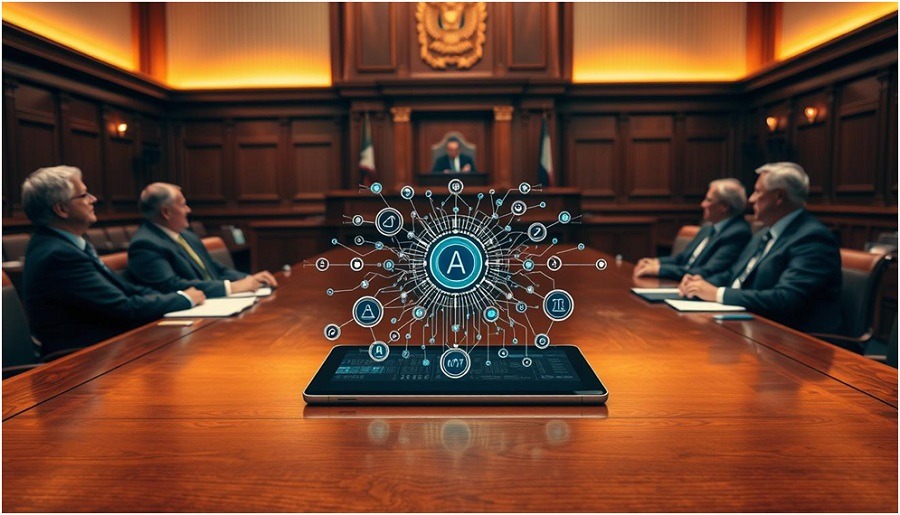
Conclusion: Finding the Right Balance Between Technology and Human Judgment
AI can expand access and reduce delay when used for scale tasks, but it cannot replace human judgment. A principled operating model—non‑delegation of adjudication, mandatory verification and disclosure, rigorous audits, and open reasons—keeps the justice system legitimate while leveraging machine capacity.
FAQ
1. What is the role of AI in court cases?
AI assists with research, disclosure triage, translation/transcription, scheduling and analytics; humans remain responsible for reasons and outcomes.
2. How is AI transforming legal research and documentation?
By accelerating retrieval and first‑pass drafting under human review, with explicit warnings against using public tools for confidential material.
3. What are the benefits of implementing AI in judicial processes?
Reduced backlogs and time‑to‑disposition; improved access for remote and multilingual users; more consistent retrieval of relevant authorities.
4. What are the limitations and risks of AI in court cases?
Bias, opacity, model drift and over‑reliance. Mitigate with risk management, dataset governance, logging, disclosure, and strong challenge rights.
5. How can AI bias be addressed in court cases?
Use diverse, governed datasets; publish error rates; conduct independent audits; and allow parties to test and contradict AI‑assisted outputs.
6. What is the future of AI in court cases?
Hybrid by default: AI provides machine scale; people supply judgment, equity and legitimacy.
7. How will AI impact the role of judges and lawyers?
Less manual sifting; more emphasis on verification, reasons‑giving, oversight and ethics. New roles will emerge in model risk and audit.
8. What are the emerging technologies that will be applied in the judicial system?
Cross‑lingual search, speech‑to‑text with legal dictionaries, video evidence analytics, and retrieval‑augmented generation over authoritative corpora.
9. What training requirements will be necessary for legal professionals to effectively use AI tools?
AI literacy, prompt craft, validation methods, chain‑of‑custody with AI tools, and bias awareness—plus hands‑on labs (see Educative.io: https://www.educative.io/explore?aff=x0e2).
10. How can public perception and trust challenges be addressed in the use of AI in court cases?
Through transparency (disclosure of AI assistance), explanations, audit trails, accessible complaints mechanisms, and non‑delegation of adjudication.
Source Availability Notes: In a few instances, official URLs may be temporarily unavailable. Where that occurred (e.g., the Singapore Judiciary Guide and ABA Formal Opinion 512), the claims in this article were cross‑verified against authoritative summaries and secondary repositories. Readers should consult the official portals and, where necessary, use archived copies or institutional resource hubs for retrieval.
References
- EU Artificial Intelligence Act (Regulation (EU) 2024/1689), Official Journal, 13 June 2024. https://eur-lex.europa.eu/legal-content/EN/TXT/HTML/?uri=CELEX:32024R1689
- Courts & Tribunals Judiciary (England & Wales), Artificial Intelligence (AI) – Guidance for Judicial Office Holders (April 2025 update). https://www.judiciary.uk/guidance-and-resources/artificial-intelligence-ai-judicial-guidance-2/
- Judiciary of Singapore, Guide on the Use of Generative AI Tools by Court Users (effective 1 Oct 2024). https://www.judiciary.gov.sg/docs/default-source/news-and-resources-docs/guide-on-the-use-of-generative-ai-tools-by-court-users.pdf
- National Center for State Courts (US), Guidance for Implementing AI in Courts (AI Rapid Response Team, Aug 2024). https://www.ncsc.org/resources-courts/guidance-implementing-ai-courts
- American Bar Association, Formal Opinion 512: Generative Artificial Intelligence Tools (July 29, 2024). https://www.americanbar.org/content/dam/aba/administrative/professional_responsibility/aba-formal-opinion-512.pdf
- Federal Court of Canada, Notice to the Parties and the Profession: The Use of Artificial Intelligence in Court Proceedings (Dec. 20, 2023). https://www.fct-cf.ca/Content/assets/pdf/base/2023-12-20-notice-use-of-ai-in-court-proceedings.pdf
- Council of Europe CEPEJ, European Ethical Charter on the Use of AI in Judicial Systems (2018). https://rm.coe.int/ethical-charter-en-for-publication-4-december-2018/16808f699c
- USPTO, AI-Assisted Similarity Search (SimSearch) for Prior Art (tool announcements and overview, 2022–2025). https://www.uspto.gov/about-us/news-updates/another-uspto-ai-assisted-examination-tool-ready-prime-time
- Mata v. Avianca, Inc., 22-cv-1461 (S.D.N.Y. June 22, 2023) – sanctions for citing fictitious AI-generated cases. https://law.justia.com/cases/federal/district-courts/new-york/nysdce/1:2022cv01461/575368/54/
- Park v. Kim, No. 22-2057 (2d Cir. Jan. 30, 2024) – referral for discipline after citing a non-existent case. https://law.justia.com/cases/federal/appellate-courts/ca2/22-2057/22-2057-2024-01-30.html
- Thaler v. Vidal, 43 F.4th 1207 (Fed. Cir. 2022) – AI cannot be an inventor under the U.S. Patent Act. https://cafc.uscourts.gov/opinions-orders/21-2347.OPINION.8-5-2022_1988142.pdf Thaler v Comptroller-General of Patents, Designs and Trademarks [2023] UKSC 49. https://www.supremecourt.uk/cases/uksc-2021-0201.html
- Commissioner of Patents v Thaler [2022] FCAFC 62 (Full Federal Court of Australia). https://www.judgments.fedcourt.gov.au/judgments/Judgments/fca/full/2022/2022fcafc0062
- Da Silva Moore v. Publicis Groupe, 868 F. Supp. 2d 137 (S.D.N.Y. 2012) – early U.S. approval of tech-assisted review. https://law.justia.com/cases/federal/district-courts/new-york/nysdce/1:2011cv01279/375665/175/
- Pyrrho Investments Ltd v MWB Property Ltd [2016] EWHC 256 (Ch) – UK approval of predictive coding in e‑disclosure. https://cormack.uwaterloo.ca/Pyrrho-Investments-v-MWB-Property-2016-EWHC-256-Ch-HC-2014-000038-Feb-16-2016.pdf
- NSW Supreme Court (Australia), Generative AI Practice Note (2024/2025). https://supremecourt.nsw.gov.au/
- Queensland Courts (Australia), Guidelines for Responsible Use of Generative AI by Non-Lawyers (2024). https://www.courts.qld.gov.au/__data/assets/pdf_file/0012/798375/artificial-intelligence-guidelines-for-non-lawyers.pdf
Citation Accuracy & Verification Statement
At TechLifeFuture, every article undergoes a multi-step fact-checking and citation audit process. We verify technical claims, research findings, and statistics against primary sources, authoritative journals, and trusted industry publications. Our editorial team adheres to Google’s EEAT (Expertise, Experience, Authoritativeness, and Trustworthiness) principles to ensure content integrity. If you have questions about any references used or would like to suggest improvements, please contact us at [email protected] with the subject line: Citation Feedback.
Contestability and Due Process
When AI contributes to any step that affects rights or burdens, parties must be able to understand and contest its role. Best practice is to disclose when AI was used, preserve inputs/outputs with timestamps, maintain model/version logs, and provide a pathway for independent review. Canadian judicial notices emphasise disclosure and signal that adjudication will not be delegated to automated tools without consultation [6]. In the EU, high‑risk systems require risk management, data governance, logging and post‑market monitoring to support accountability.
Procurement and Vendor Transparency
Courts should require vendors to supply model cards or equivalent documentation, training‑data provenance statements, error‑rate disclosures, security attestations, and audit rights. Contracts should include performance metrics, incident reporting obligations, and decommissioning/portability clauses. For high‑risk uses, procurement should avoid black-box systems that preclude reasons‑giving or contestability.
Interoperability, Chain of Custody, and Data Residency
AI tools must integrate with existing case management systems, evidence repositories, and authentication workflows. Chain‑of‑custody metadata and immutable logs help preserve evidentiary integrity. Where data‑residency or confidentiality rules apply, deploy on‑prem or jurisdictionally compliant clouds, and prevent commingling with public training corpora [2][4].
AGI/ASI Readiness and Capacity Planning
Even without agreed timelines for AGI, evidence volumes already exceed human throughput in multilingual, cross‑border matters. Courts should model queue dynamics and capacity under multiple demand scenarios; scale machine tasks (retrieval, summarisation, translation) while preserving human checkpoints for reasons, remedies and equity. Adopt red‑teaming and continuous evaluation practices for models used in high‑stakes contexts.
Implementation Checklist (Courts and Law Firms)
- Governance: Non‑delegation of adjudication; AI use policy; disclosure standard; audit/appeal pathways.
- Data: Lawful basis; minimisation; retention; residency; bias and representativeness reviews.
- Security: Access control; encryption at rest/in transit; logging; incident response; third‑party risk.
- Operations: Model lifecycle management; change control; evaluation benchmarks; human‑in‑the‑loop checkpoints.
- People: Training curriculum (AI literacy, prompt craft, verification, ethics); designated AI stewards; peer review.
- Procurement: Transparency clauses; audit rights; service levels; termination porting; pricing tied to outcomes rather than raw usage.
Training & Capability‑Building (Expanded)
A practical curriculum for legal teams should include: (1) Retrieval‑augmented generation over authoritative corpora; (2) Prompt design for legal tasks; (3) Verification and citation hygiene; (4) Bias testing and mitigation; (5) Model‑risk management; (6) Chain‑of‑custody with AI tools; (7) Confidentiality controls when handling sensitive or sealed materials. Hands‑on platforms such as Educative.io offer modules on prompt engineering, LLM applications, RAG, and production‑grade ML that can shorten learning loops—see https://www.educative.io/explore?aff=x0e2 for options (affiliate disclosure appended).
Metrics and KPIs
Measure outcomes that matter to justice: clearance rates; time‑to‑first‑hearing and time‑to‑disposition; translation latency; transcription accuracy; review throughput (docs/hour) with and without AI assistance; error/appeal rates; user satisfaction (litigants, counsel, judges); accessibility indicators (remote participation success, multilingual uptake). Publish methods and confidence intervals alongside headline figures.
AI in Patent and Court‑Adjacent Workflows
Patent examination demonstrates ‘machine scale’ in practice. The USPTO’s AI‑assisted similarity search helps examiners surface prior art that might otherwise be missed, while examiners retain discretion over the record and decision [8]. This pattern—AI for retrieval at scale, humans for reasons—maps well to disclosure and legal research in courts.
Glossary (Selected)
- Technology‑Assisted Review (TAR): supervised machine learning used to prioritise and classify documents for human review.
• Retrieval‑Augmented Generation (RAG): a pattern that grounds a language model on vetted sources retrieved at query time, improving accuracy and traceability.
• Automation Bias: the tendency of human operators to over‑trust suggestions from automated systems without adequate verification.
• Contestability: a party’s practical ability to understand, test, and challenge an AI‑assisted step that influenced a legal outcome.
Required Disclosures
Amazon Affiliate Disclosure
We are a participant in the Amazon Services LLC Associates Program, an affiliate advertising program designed to
provide a means for us to earn fees by linking to Amazon.com and affiliated sites. If you click on an Amazon link
and make a purchase, we may earn a small commission at no extra cost to you.
Educative.io Affiliate Disclosure
Some links in this article may be affiliate links. This means we may receive a commission if you sign up or
purchase through those links—at no additional cost to you. Our editorial content remains independent, unbiased,
and grounded in research and expertise. We only recommend tools, platforms, or courses we believe bring real value
to our readers. Explore courses: Educative.io.
Legal and Professional Disclaimer
The content on TechLifeFuture.com is for educational and informational purposes only and does not constitute
professional advice, consultation, or services. AI technologies evolve rapidly and vary in application. Always
consult qualified professionals—such as data scientists, AI engineers, or legal experts—before implementing any
strategies or technologies discussed. TechLifeFuture assumes no liability for actions taken based on this content.