Introduction to AI IP Ownership Certification and the Four-Factor Framework
Artificial intelligence is changing the way we create, invent, and protect intellectual property. Yet the legal question remains: who owns the copyright or patent when multiple AI tools contribute to the final result? This is where the AI IP Ownership Certification concept steps in. Based on a Four-Factor Framework—Research AI, Development AI, Quality Assurance AI, and Deployment AI—this approach documents every stage under human-in-the-loop oversight. By keeping a verifiable record of prompts, data sources, model versions, and human decisions, creators can strengthen their claims in copyright and patent disputes. This article explores how such a framework could be written into law, how it aligns with global IP rules, and whether it could be patented as a process. For innovators, businesses, and policymakers, this may be the missing piece that accelerates innovation while keeping ownership clear.

Key Takeaways
-
AI IP Ownership Certification offers a structured way to prove copyright and patent claims when multiple AI tools contribute to a creation.
-
The Four-Factor Framework — Research AI, Development AI, QA AI, Deployment AI — ensures every stage is logged and overseen by a human.
-
Detailed provenance records (prompts, model IDs, human approvals) can provide prima facie evidence of authorship or inventorship.
-
If legislated, the framework could reduce disputes, speed up legal decisions, and boost national innovation productivity.
-
The certification process itself could be patentable if implemented as a technical solution (e.g., cryptographic logging), not just a policy.
Understanding the Intersection of AI and Intellectual Property Law
The rapid integration of AI into creative and technical work is transforming how intellectual property is conceived, developed, and protected. As AI tools take on roles in research, product design, and content generation, the boundaries of copyright and patent law are being tested like never before.
Key areas where AI intersects with intellectual property include:
Copyright Protection: AI-assisted works challenge the definition of “human authorship.” Courts and copyright offices worldwide are assessing whether — and how — human involvement can be proven in collaborative AI projects.
Patent Inventorship: Patent offices maintain that inventors must be human, yet AI systems are now contributing to patentable ideas. Establishing which contributions are human and which are machine-made is increasingly complex.
Provenance and Verification: Detailed logging of AI prompts, data sources, and human approvals can provide critical evidence in ownership disputes, reinforcing claims of human creativity or conception.
By applying a structured Four-Factor Certification approach, innovators can align with evolving laws while reducing uncertainty and strengthening their IP rights.
How AI Workflows Transform IP Provenance and Dispute Resolution in AI IP Ownership Certification
Machine learning and other AI technologies are reshaping how intellectual property (IP) disputes are resolved by enabling precise tracking of creative and technical contributions. By analyzing detailed project logs, AI can help identify which parts of a work were created by a human versus generated by a machine, strengthening the evidentiary foundation in legal proceedings.
Key advantages of AI in IP provenance include:
Enhanced Accuracy of Attribution in AI IP Ownership Certification: AI can process time-stamped prompts, version histories, and model outputs to accurately map the creation process.
Predictive Legal Risk Assessment for AI IP Ownership Certification: AI can flag potential copyright or patent conflicts before filing, reducing costly disputes.
Automated Documentation & Reporting in AI IP Ownership Certification: AI can maintain a secure, tamper-proof record of the creative process for future verification.
Why Human Oversight Matters in AI IP Ownership Certification:
Such provenance tools are essential for the proposed Four-Factor Certification model, ensuring transparency and trust in ownership claims.
Smart Certification Systems and IP Compliance
Just as cities adopt AI to become “smart,” creators and innovators can adopt smart certification systems to safeguard their IP rights. By integrating compliance monitoring directly into the creation pipeline, these systems make the certification process efficient and resilient.
Examples of AI applications in smart certification:
Automated Compliance Checks: AI verifies that all content or inventions meet jurisdiction-specific IP laws before release.
Licensing Optimization: AI matches works with the correct licenses, ensuring lawful use of third-party materials.
Intelligent Rights Management: AI-powered dashboards can track how a certified work is being used, flagging unauthorized reproductions.
When embedded in the Four-Factor Certification workflow, these smart systems can drastically reduce legal exposure while increasing confidence in commercializing AI-assisted outputs.
AI in Innovation Safeguarding and IP Protection
AI is becoming a powerful ally in protecting innovative work and safeguarding future economic value. By integrating AI into certification and monitoring systems, rights holders can both prevent infringement and reinforce claims of originality.
Applications include:
Innovation Tracking: AI identifies and archives each version of a work or invention, creating a verifiable development trail.
Predictive Infringement Analysis: AI scans patent filings, publications, and online repositories to detect potential infringement risks.
Portfolio Mapping: AI classifies and organizes IP assets, helping businesses prioritize protection strategies.
By combining these tools with a Four-Factor Certification approach, innovators can strengthen both copyright and patent claims, ensuring that human oversight remains central to ownership in the AI era.
Benefits of AI IP Ownership Certification
Implementing a Four-Factor Certification system delivers tangible advantages for creators, businesses, and policymakers navigating the evolving AI-IP landscape.
Clearer Ownership Claims:
A documented certification trail makes it easier to prove human authorship in copyright disputes and human conception in patent filings.
Reduced Legal Ambiguity with IP Ownership Certification:
By embedding compliance checks into each phase, the certification process identifies and addresses potential infringements before they escalate.
Enhanced Market Confidence:
Certified works and inventions carry stronger reputational value, attracting investors and collaborators who prioritize legal security.
Alignment with Global Standards:
The framework mirrors emerging requirements in jurisdictions such as the EU, US, and Japan, making cross-border commercialization smoother.
Challenges and Limitations of the Four-Factor Framework
While the benefits are compelling, the certification model also faces challenges:
Varied Global Laws:
IP definitions and evidentiary rules differ widely, making global harmonization a long-term goal rather than an immediate reality.
Compliance Costs:
Small creators may see the certification process as too resource-intensive without support or subsidies.
Over-Reliance on AI Logs:
Even with robust provenance records, courts will still weigh human judgment and creative contribution heavily.
Rapidly Evolving Technology:
Certification standards must adapt to new AI capabilities, otherwise they risk becoming obsolete.
Why Adopting Four-Factor AI IP Ownership Certification Into IP Law Is Critical for National Productivity
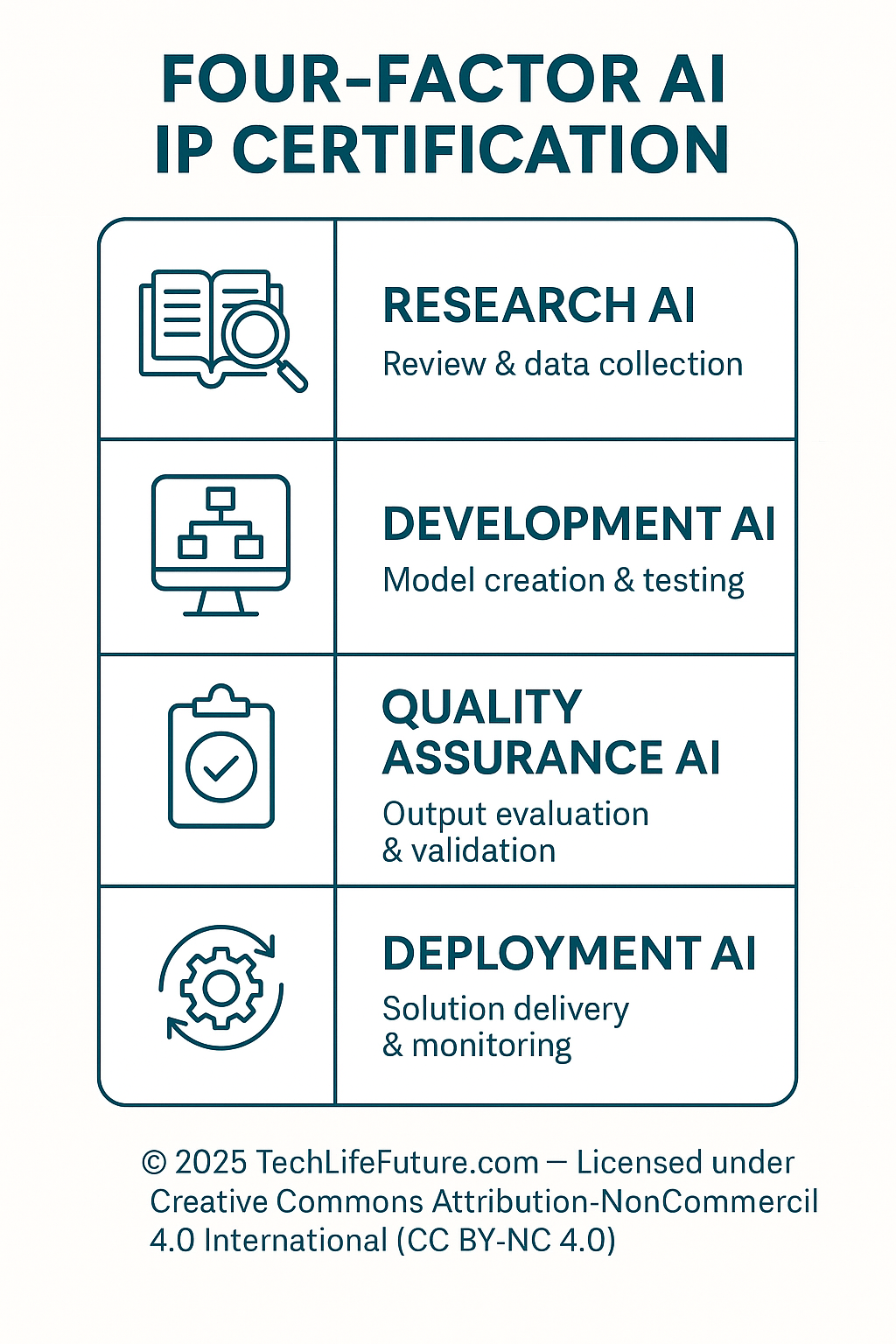
📜 License: This infographic is licensed under a
Creative Commons Attribution-NonCommercial 4.0 International (CC BY-NC 4.0)
.
You are free to share and adapt this work for non-commercial purposes, provided you give appropriate credit and indicate if changes were made.
Four-Factor AI IP Certification Framework – ensuring defensible intellectual property rights through human oversight in AI-assisted creation.
Why AI IP Ownership Certification Is Essential in the Age of AGI and ASI
The urgency for reform grows as Artificial General Intelligence (AGI) and Artificial Superintelligence (ASI) approach operational reality. These systems will not only match but exceed human creativity, innovation, and research output. In such an environment, IP regimes that rigidly require human authorship or inventorship risk throttling breakthrough discoveries, delaying commercialization, and reducing global competitiveness. By embedding the Four-Factor AI IP Ownership Certification into law, governments can preserve the human legal anchor for ownership while allowing AI-driven ingenuity to flourish. This approach ensures that innovation from AGI and ASI can be rapidly integrated into the economy without being trapped in legal uncertainty or denied protection, striking a balance between fostering technological progress and safeguarding legitimate ownership claims. This will help lift national productivity.
Conclusion: Advancing Innovation Through AI IP Ownership Certification
The rapid adoption of artificial intelligence has outpaced the ability of copyright and patent laws to clearly allocate ownership when multiple AI systems contribute to the same output. Without reform, innovators face prolonged disputes, costly legal uncertainty, and missed opportunities to commercialize breakthroughs.
Four-Factor AI IP Certification—which records the roles of Research AI, Development AI, Quality Assurance AI, and Deployment AI under human oversight—offers a scalable, evidence-based framework for proving human authorship and inventorship. By embedding this system into national IP law, governments can:
- Reduce Legal Ambiguity — Clear rules and a documented certification process mean fewer contested claims and faster resolution of disputes.
- Boost Innovation Through Confidence — Creators and companies can invest in AI-assisted projects knowing that ownership rights are secure and defensible.
- Accelerate Commercialization — Reliable IP frameworks shorten time-to-market for AI-assisted products, benefiting both private industry and the public.
- Align with Global Trade and WIPO Standards — Codifying certification supports harmonization with emerging international guidelines, easing cross-border IP enforcement.
- Enhance National Productivity — By removing IP bottlenecks, countries can encourage more AI-assisted R&D, resulting in higher innovation output per dollar invested.
“Strong intellectual property rights are not a brake on innovation—they are the fuel that drives it. Certainty in ownership translates directly to certainty in investment.” — OECD Innovation Policy Review (2024)
To maximize benefits, this framework should be recognized in law as creating a “rebuttable presumption” of human authorship or inventorship. This means that, unless proven otherwise, certified works and inventions are treated as valid human-led IP.
Related Reading: To see how these governance principles fit into the broader economic picture, read our AI Productivity Paradox analysis — explaining why massive AI investment hasn’t yet translated into measurable national productivity gains, and how this might change.
Disclaimer: The information in this article is provided for general informational purposes only and does not constitute legal advice. Intellectual property laws vary by jurisdiction and may change over time. Readers should consult a qualified legal professional for advice on specific circumstances.

This article, including the infographic “Four-Factor AI IP Certification Framework,” is licensed under a
Creative Commons Attribution-NonCommercial 4.0 International License.
© TechLifeFuture.com. Image credit: TechLifeFuture.com.
References & Citations
-
U.S. Copyright Office. Copyright Registration Guidance: Works Containing Material Generated by Artificial Intelligence (2023).
-
United States Patent and Trademark Office. Inventorship Guidance for AI-Assisted Inventions (2024).
-
UK Intellectual Property Office. Consultation on Artificial Intelligence and Intellectual Property (2023).
-
European Union. Artificial Intelligence Act (2024).
-
World Intellectual Property Organization. WIPO Conversation on Intellectual Property and Artificial Intelligence (2023).
-
Japan Agency for Cultural Affairs. Guidelines on Copyright and AI (2024).
-
Beijing Internet Court. Case No. (2023) Jing 0491 Min Chu 10012 — Recognition of copyright in AI-generated works.
-
Australian Government Attorney-General’s Department. Copyright and Emerging Technologies Issues Paper (2023).
Frequently Asked Questions (FAQs)
1. What is AI IP Ownership Certification?
AI IP Ownership Certification is a structured framework for proving human authorship and inventorship in works or inventions created with the help of multiple AI tools. It uses a Four-Factor process: Research AI, Development AI, Quality Assurance AI, and Deployment AI, with human oversight at every stage.
2. Why is human oversight important in AI-assisted creation?
Most copyright and patent laws require a human author or inventor. Documenting the human role helps keep IP claims valid in court and compliant with global legal standards.
3. How does the Four-Factor Framework work?
The process records prompts, model IDs, data sources, human decisions, and verification steps across four phases, creating a clear provenance trail that can be used as evidence in disputes.
4. Can AI-generated works be copyrighted?
Purely AI-generated works are often not eligible for copyright. If a human makes creative choices or significant edits, those human contributions may be protected.
5. Can AI-assisted inventions be patented?
Yes, but the named inventor must be human. AI can assist with conception or development, but the applicant must show human involvement in the inventive step.
6. Could the certification process itself be patented?
Possibly. If the certification system includes a technical innovation such as cryptographic time-stamping or secure logging, it may qualify in some jurisdictions.
7. What global laws affect AI IP Ownership Certification?
Relevant sources include US Copyright Office guidance, USPTO inventorship policy, the UK CDPA section 9(3) rule on computer-generated works, the EU AI Act, Japan Article 30-4, and recent Chinese court decisions.
8. Will certification improve innovation and productivity?
Yes. By reducing disputes and uncertainty, certification can speed up commercialization and collaboration, which supports productivity growth.
9. How can creators start using AI IP Ownership Certification now?
Keep detailed records of AI-assisted work, including prompts, model versions, human edits, approvals, and verification steps. Store logs securely and be ready to share them in contracts or disputes.
10. What is the next step for making certification law?
Governments could adopt legislation that treats Four-Factor Certification as a rebuttable presumption of human authorship or inventorship, aligned with international policy work.
“AI IP Ownership Certification: Four-Factor Framework Explained” (including the infographic “Four-Factor AI IP Certification Framework”).
© TechLifeFuture.com — Creative Commons BY-NC 4.0.
Source: TechLifeFuture.com.
Image credit: TechLifeFuture.com. Indicate changes if you remix.
“AI IP Ownership Certification: Four-Factor Framework Explained,” TechLifeFuture.com, CC BY-NC 4.0. If adapted, indicate changes.
Trademark & non-endorsement:
“Four-Factor Certification” is used as a brand identifier. No trademark rights are granted. Do not state or imply endorsement by TechLifeFuture.com.
No patent license:
This page’s license does not grant any patent rights.
Provenance:
Asset includes Content Credentials (C2PA). Original file hash: [paste SHA-256 here].