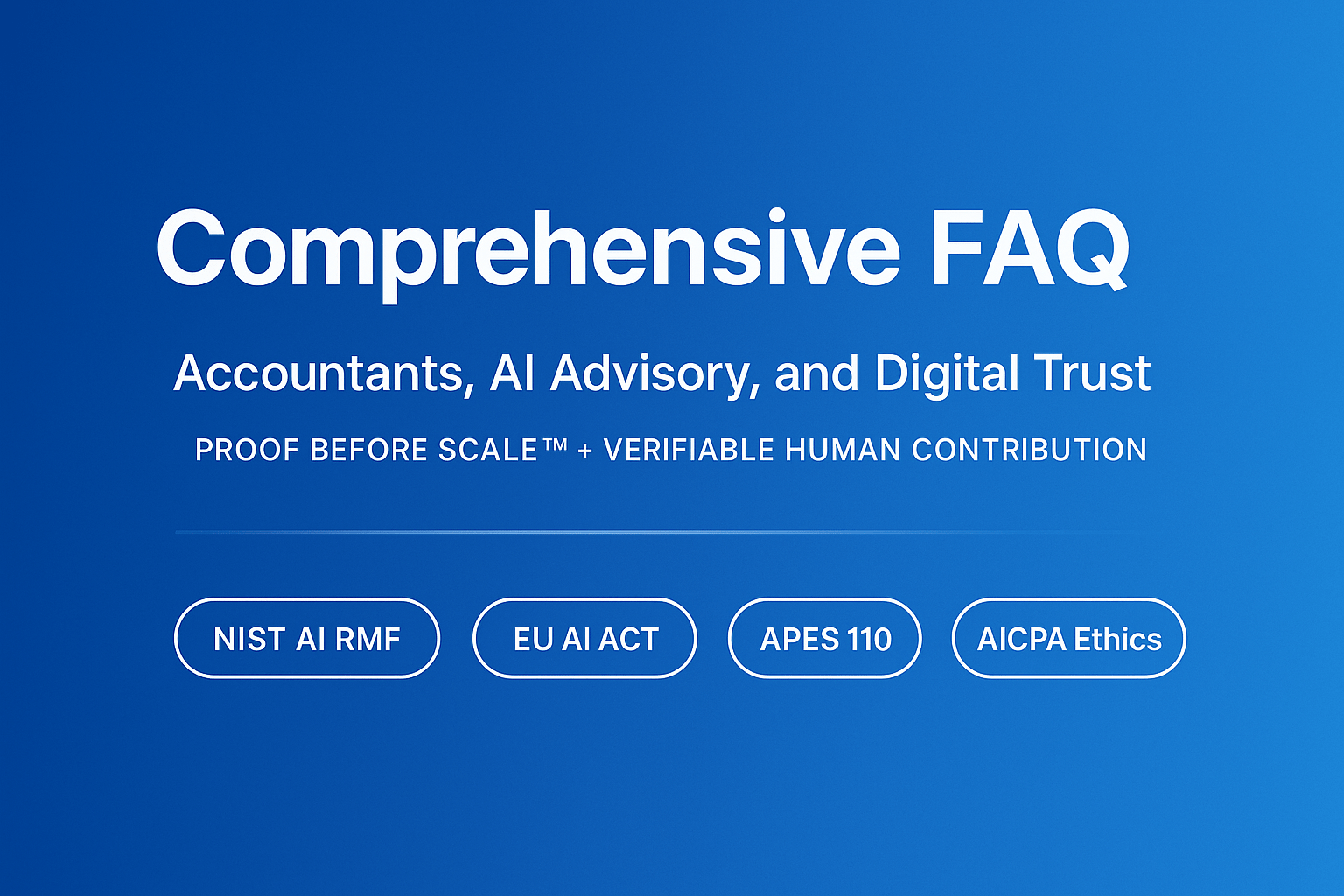
Comprehensive FAQ: Accountants, AI Advisory, and Digital Trust
Artificial Intelligence (AI) is no longer a future trend—it’s a present-day compliance and advisory challenge for professional accountants. This comprehensive FAQ explains the main risks, regulatory requirements, and practical frameworks that enable accountants to adopt AI responsibly and advise clients with confidence.
📋 Important Disclosures
Temporal Context: This document reflects the AI landscape and regulatory environment as of late 2025 and is intended as a forward-looking guide for professionals.
Framework Disclosure: This article discusses Proof Before Scale™ (PBS), a pending trademark application with IP Australia, and Verifiable Human Contribution (VHC), patent applications AU 2025220863 / PCT IB2025 058808. Both are proprietary methodologies designed for professional services firms.
Platform Disclosure: This article references Mindhive.ai as an example collaborative pilot environment. The author maintains a commercial relationship with Mindhive.ai. The article also references Educative.io for continuous professional development. Some links are affiliate links.
Professional Advice Disclaimer: This content is educational only and does not constitute professional accounting, legal, or financial advice. Consult qualified professionals before making implementation decisions.
Part 1: Understanding the AI Landscape for Accountants
1. What global trends are shaping AI adoption in accounting?
AI adoption in accounting and finance has accelerated dramatically, but implementation maturity remains low across most firms. According to research by the MIT-led NANDA project, many generative AI pilots fail to deliver P&L impact—not because the technology fails, but because organizations under-invest in the change management and governance around the technology.[1] Key trends include:
- Rapid GenAI adoption with governance gaps: Professional bodies including the American Institute of Certified Public Accountants (AICPA), Association of Chartered Certified Accountants (ACCA), and Chartered Accountants Australia and New Zealand (CA ANZ) report widespread experimentation but insufficient risk management frameworks.[2][3][4]
- Shift from compliance to advisory: AI is pushing firms away from traditional compliance work toward higher-value strategic advisory services—creating both opportunity and disruption.
- Regulatory convergence: Multiple regulatory regimes are emerging simultaneously, requiring accountants to navigate overlapping requirements.[5][6]
| Region | Primary Framework | Key Characteristics | Enforcement |
|---|---|---|---|
| EU / EEA | EU AI Act (Regulation 2024/1689) | Risk-based classification Documentation requirements Human-in-the-loop (HIL) oversight Extraterritorial scope |
Fines up to 7% of global annual turnover |
| United States | Fragmented sector rules | Anti-discrimination laws Consumer protection State-level regulations Outcome monitoring focus |
Enforcement-led (FTC, state attorneys general) |
| Australia / NZ | APES 110 Code of Ethics Voluntary frameworks |
Ethics-first approach Disclosure requirements Confidentiality protection Professional judgment retention |
Professional body sanctions Civil liability |
Source: EU AI Act official text available at EUR-Lex; APES 110 from APESB.org.au
2. What is the accountant’s core challenge with AI?
Accountants face a dual challenge. According to Boston Consulting Group research, 74% of companies struggle to achieve and scale AI value, primarily due to lack of governance, measurement, and disciplined proof-of-value processes before scaling.[7] The two challenges are:
- Internal risk management: Managing the firm’s own risk when adopting or recommending AI tools
- Client advisory: Advising SME (Small and Medium-sized Enterprise) clients who are already experimenting with AI—often without adequate governance
Both require a structured, auditable methodology and a way to prove human oversight on AI-assisted outputs. This is where professional frameworks become essential.
3. Which regulations should accounting firms monitor?
(a) EU AI Act (Regulation EU 2024/1689): The most comprehensive AI regulation globally, with extraterritorial reach. As stated in Article 2 of the EU AI Act: “This Regulation applies to: (a) providers placing on the market or putting into service AI systems in the Union, irrespective of whether those providers are established within the Union or in a third country.”[5] Non-EU firms can be in scope if their AI systems or outputs are used within the EU. Key requirements include:
- Risk classification and management
- Data governance and documentation
- Human oversight (especially for high-risk systems)
- Transparency and explainability
Official text: https://eur-lex.europa.eu/eli/reg/2024/1689/oj/eng
(b) US approach: Fragmented and enforcement-led, spanning multiple agencies and state-level regulations. Key considerations:
- Anti-discrimination requirements (fair lending, employment)
- Consumer protection (FTC oversight)
- State-specific AI regulations (e.g., Colorado AI Act)
- Sector-specific rules (financial services, healthcare)
(c) Australia / New Zealand / Commonwealth: Ethics-first adoption based on existing professional standards:
- APES 110 Code of Ethics for Professional Accountants (Australia)[6]
- Mandatory disclosure of AI use to clients
- Confidentiality and data protection obligations
- Retention of professional judgment and accountability
Reference: APESB – APES 110 Code of Ethics
Part 2: Frameworks and Methodologies
4. What is “Proof Before Scale™” (PBS) and how does it work?
Proof Before Scale (PBS) is a six-week, evidence-first framework designed specifically for professional services firms to pilot AI initiatives in a governed, auditable manner. It aligns with the NIST AI Risk Management Framework (AI RMF) while remaining accessible to firms without dedicated technology teams.
The NIST AI RMF defines four core functions that organizations should use to manage AI risks: “The AI RMF is organized by four functions — GOVERN, MAP, MEASURE, and MANAGE — which are intended to be performed concurrently and continuously.”[9][10]
🔺 The Golden Triangle: Selecting High-Value AI Use Cases
Before starting a PBS pilot, firms should use the Golden Triangle methodology to identify which use cases will deliver the greatest value with the least risk. This framework scores potential pilots across three critical dimensions:
🔺 The Golden Triangle Formula
Score = High Pain × Low Complexity × Clear ROI
Rate each dimension 1–10, then multiply. Require ≥400 for first pilots.
The Three Dimensions Explained:
- High Pain (1-10): Is this task frustrating, costly, or bottlenecked? Do people actively complain about it? Does it create visible workflow friction?
- Score 9-10: Task causes major delays, high costs, or frequent complaints
- Score 5-6: Task is tedious but manageable
- Score 1-2: Minor inconvenience only
- Low Complexity (1-10): Is the process repetitive with clear inputs/outputs? Does it require minimal human judgment or tacit knowledge?
- Score 9-10: Highly repetitive, rule-based, minimal exceptions
- Score 5-6: Some variation, moderate judgment required
- Score 1-2: Highly variable, requires expert interpretation
- Clear ROI (1-10): Can you measure the baseline cost/time? Will improvements be directly attributable to the AI? Will benefits occur frequently?
- Score 9-10: Baseline measurable, frequent use, clear attribution
- Score 5-6: Baseline estimable, moderate frequency
- Score 1-2: Baseline unclear, infrequent use, multi-factor attribution
Golden Triangle Scoring Examples:
| Use Case | Pain | Complexity (inverted) |
ROI | Score | Verdict |
|---|---|---|---|---|---|
| Invoice data extraction Extract vendor, date, amount, line items from PDF invoices |
9 (Major bottleneck, 2 hrs/day) |
9 (Highly repetitive, structured format) |
9 (Baseline clear: 120 min/day; frequent use) |
729 | ✅ Excellent first pilot |
| Email triage & routing Classify emails by urgency, route to correct person/folder |
8 (Wastes 45 min/day, causes delays) |
8 (Repetitive patterns, some judgment) |
8 (Baseline: 45 min/day; daily benefit) |
512 | ✅ Strong pilot candidate |
| Client onboarding docs Generate customized engagement letters from templates |
6 (Annoying but not critical) |
7 (Mostly templated, some customization) |
8 (Baseline: 30 min per client; frequent) |
336 | ⚠️ Maybe 2nd or 3rd pilot |
| Financial statement notes Generate draft disclosure notes for review |
7 (Time-consuming, but expected) |
4 (Requires significant judgment, context) |
6 (Baseline unclear; quarterly benefit only) |
168 | ❌ Not recommended for first pilot |
| Tax strategy optimization AI suggests entity structuring options |
5 (Important but not daily pain) |
2 (Highly complex, expert judgment) |
4 (Baseline hard to measure; infrequent) |
40 | ❌ Defer until more AI maturity |
💡 Pro tip: If your highest-scoring use case is below 400, either: (a) look for different use cases with clearer value, or (b) acknowledge you may need to prove value more indirectly (e.g., quality improvements rather than time savings).
The Six-Week PBS Timeline:
| Week | Phase | Key Activities | Deliverable |
|---|---|---|---|
| 1 | Govern | • Apply Golden Triangle to score use cases • Define scope and success criteria • Identify risks and constraints • Establish data governance • Assign roles and responsibilities |
Project charter with clear boundaries + scored use case |
| 2 | Map | • Document current process • Map data flows and systems • Identify stakeholders • Establish baseline metrics |
Process map with baseline measurements |
| 3 | Measure | • Define ROI (Return on Investment) calculation • Set quality metrics • Establish monitoring approach • Create measurement dashboard • 85% accuracy gate: test before proceeding |
Measurement framework and targets |
| 4 | Manage | • Implement controls • Set up approval workflows • Configure audit logging • Test exception handling |
Control framework documentation |
| 5 | Pilot | • Run with real users and data • Monitor quality and performance • Document issues and learnings • Gather user feedback |
Pilot results with actual metrics |
| 6 | Prove & Document | • Analyze results vs. targets • Calculate realized ROI • Document lessons learned • Make GO / PIVOT / STOP decision |
Evidence pack for decision-making |
PBS relationship to NIST AI RMF: The first four weeks (Govern, Map, Measure, Manage) directly implement the four core functions of the NIST AI Risk Management Framework.[9][10] PBS extends these with two additional phases focused on practical piloting and evidence collection—making the framework immediately actionable for SME contexts.
5. What ROI and success metrics should accountants expect?
Based on documented pilot results across multiple SME implementations, accountants should target the following thresholds for a successful pilot. Research indicates that AI leaders achieve approximately 2× revenue growth and ~40% greater cost savings in AI-enabled areas compared to laggards.[13]
| Metric Category | Success Threshold | Example Applications |
|---|---|---|
| Time Savings | ≥40% reduction in task time | Invoice data entry: 20 min → 12 min per invoice Client email triage: 3 hrs/day → 1.8 hrs/day |
| Cost Reduction | ≥25% reduction in process cost | Document processing: $0.80/page → $0.60/page Compliance checks: $45/hour labor → $34/hour |
| Quality Improvement | ≥85% accuracy (Week 3 gate) ≥95% for production |
Data extraction accuracy Classification precision Error rate reduction |
| User Satisfaction | ≥6 out of 10 | Staff ease-of-use rating Confidence in AI outputs Willingness to continue using |
| Payback Period | <6 months | Implementation cost ÷ monthly savings Typical range: 2-4 months for successful pilots |
Sources: BCG 2025 research[13]; MIT NANDA project 2025 findings on pilot success factors[1]
6. What are typical costs for running a PBS pilot?
PBS pilots are designed to be affordable and low-risk. Typical cost breakdown for a 6-week pilot based on current cloud service pricing:[14][15]
⚠️ Important Note: This breakdown focuses on direct technology and platform costs. It does not include the significant internal human capital investment required for data preparation, governance, and change management, which are critical success factors for pilot outcomes.
| Cost Component | Typical Range (AUD) | Notes |
|---|---|---|
| Cloud AI Services | $50–$300 | Document processing (AWS Textract, Azure Form Recognizer, Google Document AI): ~$0.01–$0.10 per page Processing 500-3,000 documents in pilot |
| Automation Platform | $60–$100 | Zapier Business (~$45/mo) or Microsoft Power Automate (included with M365 in some plans) or Make (~$30/mo) |
| Storage & Infrastructure | $20–$60 | Cloud storage typically ~$0.02–$0.10 per GB/month Small pilot datasets rarely exceed 50GB |
| Staff Time (Internal) | $2,000–$5,000 | AI Champion: ~30 hours over 6 weeks Pilot users: ~10 hours each (3-5 users) Based on blended rate of $100-150/hour |
| External Guidance (Optional) | $3,000–$8,000 | For firms using “Refer” pathway Specialist consultation for setup and decision sprint |
| TOTAL (DIY Approach) | $2,200–$5,500 | Firm builds pilot internally using PBS framework |
| TOTAL (Refer Approach) | $5,200–$13,500 | Firm uses specialist platform/advisor while retaining oversight |
Cost context: These pilot costs should be compared against potential annual savings. A pilot that achieves 40% time savings on a $60,000/year process delivers $24,000 in annual value—providing payback in 2-3 months even for higher-cost pilots.
7. What is Verifiable Human Contribution (VHC) and why does it matter?
Verifiable Human Contribution (VHC) is a framework for documenting which human professional performed which oversight activities on AI-assisted work. The EU AI Act Article 14 mandates: “High-risk AI systems shall be designed and developed in such a way, including with appropriate human-machine interface tools, that they can be effectively overseen by natural persons during the period in which the AI system is in use.”[5]
While AI systems can generate outputs, most regulations and all professional ethics codes still require a responsible human professional to make final judgments.
VHC addresses three critical needs:
- Regulatory compliance: Demonstrating “human-in-the-loop” oversight required by frameworks like the EU AI Act
- Professional accountability: Proving which accountant made professional judgments, reviewed outputs, and signed off on advice
- Intellectual property: Documenting human contribution for contexts where copyright, patent rights, or professional liability may be relevant
| What VHC Proves | How It Works | Why Accountants Need It |
|---|---|---|
| The Human | Records identity of reviewer, approver, or decision-maker | Professional accountability and sign-off |
| The Activity | Documents what oversight was performed (review, edit, approval, rejection) | Demonstrates due care and professional judgment |
| The Timestamp | Records when human oversight occurred | Audit trail and workflow verification |
| The Framework | Links to governance framework used (e.g., PBS, NIST AI RMF) | Shows systematic risk management approach |
Patent reference: Verifiable Human Contribution – Patent applications AU 2025220863 / PCT IB2025 058808
8. How do C2PA, VHC, and legal rights relate to each other?
C2PA (Coalition for Content Provenance and Authenticity) is an open technical standard that embeds “content credentials” into digital files, enabling verification of a file’s origin and edit history. Major technology companies including Adobe, Microsoft, Intel, and Arm support C2PA adoption.[18]
Critical distinction: What each proves
| System | What It Proves | Primary Purpose | Best Use in Accounting |
|---|---|---|---|
| C2PA | The file’s history • Source of origin • Edit chain and modifications • Authenticity of content |
Trust and transparency Combat deepfakes and misinformation |
Client-facing documents (reports, presentations, board packs) Public content requiring brand protection |
| VHC | The human’s contribution • Who reviewed/approved • What oversight occurred • Professional judgment applied |
Professional accountability Demonstrate due care |
Internal governance and audit trails Professional sign-off documentation Regulatory compliance evidence |
| Legal Rights | Ownership and permissions • Copyright ownership • Licensing terms • Patent/IP rights |
Legal enforceability Commercial protection |
Contracts, engagement letters IP registration filings Licensing agreements |
Practical guidance for accountants:
- Use C2PA selectively: Apply to client-facing content where brand authenticity and transparency matter (final reports, public filings, marketing materials)
- Use VHC systematically: Apply to all AI-assisted professional work to document human oversight and maintain audit trails
- Use contracts/IP law for rights: Engagement letters, service agreements, and formal IP registrations establish ownership and liability
C2PA reference: https://c2pa.org/ (official standard and documentation)[18]
9. What professional guidance exists on using public AI tools with client data?
Professional bodies are universally cautious about using consumer-grade generative AI tools (like ChatGPT, Claude, Gemini) with confidential client information. Key guidance:
AICPA / CIMA guidance: The AICPA states that “CPAs must leverage AI while addressing privacy, confidentiality, legal, and security risks” with emphasis on responsible AI implementation with risk assessment.[2]
- CPAs must leverage AI while addressing privacy, confidentiality, legal, and security risks
- Emphasis on responsible AI implementation with risk assessment
- Focus on maintaining professional judgment and accountability
ACCA (Association of Chartered Certified Accountants) guidance:[3]
- Do not upload confidential client information to public AI tools without contractual safeguards
- Mandatory disclosure of AI use to clients
- Clear accountability for AI-assisted outputs remains with the professional
CA ANZ (Chartered Accountants Australia and New Zealand) guidance:[4]
- AI use must align with APES 110 Code of Ethics requirements
- Protection of client confidentiality is paramount
- Transparency about AI tools used in service delivery
Practical safe approach:
- For learning and exploration: Use public AI tools freely with synthetic/anonymized data
- For client work: Use enterprise AI services with appropriate data protection agreements (DPAs) and Business Associate Agreements (BAAs)
- Always: Document which tools were used, disclose to clients, and maintain human review of all outputs
Resources:
- AICPA AI guidance: https://www.aicpa-cima.com/resources/landing/artificial-intelligence
- ACCA ethical guidance: ACCA AI Monitor Report (PDF)
- APES 110 Code: https://apesb.org.au
Part 3: Strategic Implementation for Accounting Firms
10. Should my firm build AI advisory in-house or refer to specialists?
The “Build vs. Refer” decision framework is familiar to most accounting firms—it’s the same strategic lens used for financial planning, SMSF (Self-Managed Superannuation Fund) services, and business succession planning. The decision depends on three factors:
| Factor | Build In-House | Refer to Specialist |
|---|---|---|
| Firm Readiness | • Staff with technical interest/capacity • Willingness to invest in training • Time to run multiple pilots • Clear internal champion |
• Limited technical capacity • Immediate client need • Testing AI advisory before commitment • Want to co-learn with expert |
| Client Use Case | • Common, repeatable scenarios • Clear workflow automation • Modest data complexity • Examples: invoice processing, email triage, basic document analysis |
• Complex multi-stakeholder projects • Industry-specific requirements • Significant integration needs • High-stakes implementations |
| Economic Model | • High-margin advisory opportunity • Multiple clients with similar needs • Can amortize learning investment • Want recurring revenue stream |
• One-off or infrequent engagements • Prefer referral fee model • Maintain trusted advisor role • Share implementation risk |
The “Crawl, Walk, Run” maturity path:
- Crawl: Refer complex projects to specialist platforms (e.g., Mindhive.ai for decision sprints) while staying the client’s trusted advisor. Learn by co-managing outcomes.
- Walk: Upskill team through continuous professional development (e.g., Educative.io courses on AI/ML, Python, automation). Start delivering simpler PBS pilots internally.
- Run: Build a full AI advisory practice around PBS methodology, referring out only highly complex or sector-specific cases.
Key insight: You don’t have to choose permanently. Most successful firms use a hybrid approach—building capability for common use cases while referring specialized work that would require capabilities they don’t want to develop.
11. Does the EU AI Act really apply to non-EU accounting firms?
Yes, potentially. The EU AI Act has extraterritorial reach similar to GDPR (General Data Protection Regulation). As stated in Article 2: “This Regulation applies to: (a) providers placing on the market or putting into service AI systems in the Union, irrespective of whether those providers are established within the Union or in a third country; (b) deployers of AI systems that have their place of establishment or are located within the Union.”[5]
Non-EU accounting firms are caught if:
- They place AI systems on the EU market (selling AI products/services into the EU)
- They provide services to EU clients where AI outputs are used in the EU
- They use AI systems that affect people in the EU (even remotely)
Practical scenarios for accounting firms:
- Australian firm advising EU subsidiary of Australian client → Likely in scope
- US firm using AI to prepare financial statements for EU-listed company → Likely in scope
- UK firm providing AI-assisted tax advice to EU resident → Likely in scope
- Canadian firm using AI purely for internal Canadian operations → Not in scope
Why PBS creates compliance efficiency: A properly documented PBS pilot produces a single, portable “evidence pack” that can satisfy regulators and clients across multiple jurisdictions. The evidence pack demonstrates:
- Systematic risk assessment (Govern phase)
- Understanding of system context and impact (Map phase)
- Performance monitoring and metrics (Measure phase)
- Concrete risk controls (Manage phase)
- Real-world validation (Pilot phase)
- Decision-making rationale (Prove & Document phase)
This aligns with requirements in the EU AI Act, NIST AI RMF, and principles-based regimes like Australia’s ethics-first approach.
Official EU AI Act text: https://eur-lex.europa.eu/eli/reg/2024/1689/oj/eng
Analysis resource: https://artificialintelligenceact.eu/ (unofficial but comprehensive guide)
12. How should accountants explain C2PA to SME clients?
Most SME clients will not be familiar with C2PA or understand why it matters. Use this three-line explanation:
Three-Line Client Script:
- C2PA proves the file — it shows where digital content came from and how it was edited, like a nutrition label for documents and images.
- VHC proves the human — it records which professional reviewed the work and made the final judgments, ensuring accountability.
- Contracts and IP law prove the rights — ownership, licensing, and legal obligations are established through agreements and registrations, not technical standards.
When to recommend C2PA for SME clients:
- Brand protection: Companies concerned about deepfakes or content impersonation
- Public-facing content: Annual reports, media releases, investor presentations
- Board governance: Board packs and executive briefings where authenticity matters
- Marketing materials: Content that may be widely distributed or republished
- Regulated industries: Where content provenance may be audited (finance, healthcare, legal)
When C2PA may be overkill:
- Internal documents and routine communications
- Preliminary drafts and working documents
- Content with very limited distribution
- Contexts where the cost/complexity doesn’t justify the benefit
Recommended approach for most SMEs: Selective C2PA for high-stakes, public-facing content + VHC records inside the accountant’s PBS documentation for professional oversight + clear contractual terms for ownership and liability.
Part 4: Risk Management and Data Protection
13. How do we manage data privacy and security risks in AI pilots?
Data protection is paramount—especially given professional obligations under APES 110, AICPA ethics rules, and data protection laws.[2][4][6] Follow this layered approach:
Layer 1: Data selection (choose the right data for pilots)
| Data Type | Risk Level | Pilot Use |
|---|---|---|
| Synthetic data (artificially generated) | ✅ Lowest risk | Best for initial pilots — no privacy concerns, no client consent needed |
| Anonymized data (properly de-identified) | ⚠️ Low risk (if done correctly) | Good for pilots — but requires proper anonymization technique (not just removing names) |
| Public data (already publicly available) | ⚠️ Low-medium risk | Acceptable for pilots — but verify licensing terms |
| Real client data (identified) | ⛔ High risk | Avoid in pilots unless: Client consent obtained, enterprise AI service with DPA, proper security controls, regulatory compliance verified |
Layer 2: Technical controls
- Encryption: Data encrypted at rest and in transit (most cloud services provide this by default—verify it’s enabled)
- Access control: Least-privilege access (only pilot team members can access pilot environment)
- Audit logging: Track who accessed what data and when (retain logs ≥90 days)
- Data residency: Ensure data stays in appropriate geographic region (e.g., AU-region storage for Australian client data)
- Retention limits: Delete pilot data after project completion unless regulations require retention
Layer 3: Contractual safeguards
- Data Processing Agreement (DPA) with any AI service provider
- Business Associate Agreement (BAA) if handling health data (HIPAA in US, similar in other jurisdictions)
- Client consent for AI use (in engagement letter or separate disclosure)
- Clear data ownership and deletion provisions
Layer 4: Governance and oversight
- Data inventory (what data is being used, where it came from, sensitivity level)
- Privacy impact assessment (PIA) for pilots using personal information)
- Incident response plan (what happens if there’s a breach)
- Regular privacy reviews (weekly check-ins during pilot)
14. What accuracy and quality controls should be in place?
Quality control is essential—both for professional standards and regulatory compliance. The EU AI Act Article 15 requires that “High-risk AI systems shall be designed and developed in such a way that they achieve, in the light of their intended purpose, an appropriate level of accuracy, robustness and cybersecurity.”[5] Implement these controls:
Week 3 Decision Gate (85% threshold):
- Test AI system with 20-30 historical cases
- Measure accuracy against ground truth
- ≥85% accuracy: Proceed to pilot
- 70-85% accuracy: Fix identified issues, extend testing 1 week, re-test
- <70% accuracy: Stop or pivot to different approach
Confidence-based routing (human-in-the-loop):
- AI systems should output a confidence score for each prediction/output
- Set threshold (e.g., <90% confidence → mandatory human review)
- Create review queue for low-confidence outputs
- Track false positives and false negatives weekly
Ongoing monitoring dashboard:
| Metric | Tracking Frequency | Action Trigger |
|---|---|---|
| Accuracy rate | Daily during pilot | <85% accuracy for 2+ days → investigate |
| Confidence distribution | Weekly | >30% low-confidence outputs → retrain or adjust |
| False positive rate | Weekly | >10% false positives → review classifier |
| False negative rate | Weekly | >5% false negatives → review with higher priority |
| User-reported issues | Continuous | Any critical issue → immediate review |
| Processing time | Daily | Performance degradation >20% → investigate |
Documentation requirements:
- Log all AI-assisted decisions with inputs, outputs, confidence scores, and human actions
- Version control for AI models and prompts
- Error analysis reports (what went wrong and why)
- Edge case documentation (unusual scenarios encountered)
Part 5: Practical Resources and Next Steps
15. Where can I learn more and access frameworks?
Official Regulatory Frameworks:
- EU AI Act: Official text at EUR-Lex[5]
- NIST AI Risk Management Framework: Framework hub | AI RMF 1.0 PDF[9][10]
- NIST AI RMF Playbook: Detailed implementation guidance[11]
- C2PA Standard: Official site and specifications[18]
Professional Accounting Body Resources:
- AICPA & CIMA: AI resources and guidance[2]
- CPA.com: Generative AI resources for accountants[19]
- ACCA: AI Monitor: Shining a Light on Ethical Threats (PDF)[3]
- APESB (Australia): APES 110 Code of Ethics[6]
Learning and Skill Development:
- Educative.io: Interactive courses on Python, AI/ML, data analysis, and automation (affiliate link: supports continuous professional development)[20]
- AICPA courses: Core Concepts of Artificial Intelligence for Accounting Professionals[2]
- CPA Canada: AI implementation guidance and training programs[21]
Implementation Support:
- Mindhive.ai: Collaborative pilot environment for running PBS programs (disclosure: commercial relationship with author)[22]
- Cloud platforms: AWS, Azure, Google Cloud all provide AI services suitable for accounting pilots[14][15]
- Automation platforms: Zapier, Make, Microsoft Power Automate for workflow integration[23]
Conclusion: From Compliance to Competitive Advantage
AI represents both a compliance challenge and a strategic opportunity for accounting firms. The firms that will thrive are those that:
- Adopt structured frameworks (like PBS and NIST AI RMF) rather than ad-hoc experimentation
- Prove value systematically with measurable pilots before scaling
- Document rigorously to satisfy regulators, clients, and professional standards
- Retain human judgment at the center of professional services
- Build gradually using “Crawl, Walk, Run” maturity progression
The technical barriers to AI adoption have fallen dramatically. Cloud-based AI services, no-code automation tools, and proven frameworks make AI accessible to firms of all sizes. The real challenge now is organizational: building the governance, measurement, and change management disciplines that enable responsible AI adoption.
Accountants are uniquely positioned to lead this transformation—not despite their traditional focus on control and accountability, but because of it. The same professional rigor that ensures trust in financial reporting can ensure trust in AI-assisted advisory services.
The question is no longer “Should we adopt AI?” but rather “How can we adopt AI responsibly and prove its value systematically?” This FAQ provides the roadmap.
📚 References
[1] AICPA & CIMA (2024). Artificial Intelligence: Resources and Guidance for CPAs. Available: https://www.aicpa-cima.com/resources/landing/artificial-intelligence
[2] ACCA (2024). AI Monitor: Shining a Light on Ethical Threats. Association of Chartered Certified Accountants. Available: https://www.accaglobal.com/content/dam/ACCA_Global/professional-insights/AI-monitor/pi-ai-monitor.pdf
[3] European Union (2024). Regulation (EU) 2024/1689 of the European Parliament and of the Council laying down harmonised rules on artificial intelligence (Artificial Intelligence Act). Available: https://eur-lex.europa.eu/eli/reg/2024/1689/oj/eng
[4] European Union (2024). EU AI Act Article 2: Scope. Official text excerpt from Regulation 2024/1689.
[5] NIST (2023). AI Risk Management Framework (AI RMF 1.0). National Institute of Standards and Technology. Available: https://www.nist.gov/itl/ai-risk-management-framework
[6] NIST (2023). Artificial Intelligence Risk Management Framework: Core Functions. AI RMF 1.0 official documentation. Available: https://nvlpubs.nist.gov/nistpubs/ai/nist.ai.100-1.pdf
[7] NIST (2024). AI RMF Playbook: Implementation Guidance. Available: https://airc.nist.gov/airmf-resources/playbook/
[8] European Union (2024). EU AI Act Article 14: Human Oversight Requirements. Official text excerpt from Regulation 2024/1689.
[9] Boston Consulting Group (2025). AI Leaders vs. Laggards: Comparative Performance Analysis. BCG research on AI adoption maturity and business outcomes.
[10] Amazon Web Services (2025). AWS AI Services Pricing. Available: https://aws.amazon.com/textract/pricing/
[11] Microsoft Azure (2025). Azure AI Document Intelligence Pricing. Available: https://azure.microsoft.com/en-us/pricing/details/ai-document-intelligence/
[12] Google Cloud (2025). Document AI Pricing. Available: https://cloud.google.com/document-ai/pricing
[13] European Union (2024). EU AI Act Article 15: Accuracy, Robustness and Cybersecurity. Official text excerpt from Regulation 2024/1689.
[14] Coalition for Content Provenance and Authenticity (2024). C2PA Technical Specification and Standards. Available: https://c2pa.org/
[15] CPA.com (2025). Generative AI Resources for CPAs. Available: https://www.cpa.com/ai
[16] Educative, Inc. (2025). Professional Development Courses for Accountants: Python, AI/ML, Data Analysis. Available: https://www.educative.io (Affiliate disclosure: Some links are affiliate links)
[17] CPA Canada (2025). AI Implementation Guidance and Training Programs. Available: https://www.cpacanada.ca
[18] Mindhive.ai (2025). Collaborative Intelligence Platform for Professional Services. Available: https://www.mindhive.ai (Disclosure: Commercial relationship with author)
[19] Automation Platform Pricing (2025). Composite pricing from Zapier (zapier.com/pricing), Make (make.com/pricing), and Microsoft Power Automate pricing pages.
[20] IP Australia (2025). Trademark Application Status: Proof Before Scale™. Pending trademark application.
[21] IP Australia & WIPO (2025). Patent Applications: Verifiable Human Contribution. Application numbers AU 2025220863 / PCT IB2025 058808.
[22] Artificial Intelligence Act EU (2024). Unofficial Guide and Analysis. Community resource for EU AI Act interpretation. Available: https://artificialintelligenceact.eu/
📚 Quick Reference Card
Key Frameworks at a Glance
Golden Triangle: Score = High Pain × Low Complexity × Clear ROI
Target score: ≥400 for first pilots
PBS (Proof Before Scale): 6-week evidence-first methodology
Cost: $2,200-$13,500 depending on approach
Success threshold: ≥40% time savings or ≥25% cost reduction
NIST AI RMF: Four core functions (Govern, Map, Measure, Manage)
Free framework: nist.gov/itl/ai-risk-management-framework
VHC (Verifiable Human Contribution): Documents human oversight
Purpose: Professional accountability and regulatory compliance
C2PA: Content provenance standard
Use for: Client-facing documents requiring authenticity verification
Acronyms & Definitions
- AI: Artificial Intelligence
- AICPA: American Institute of Certified Public Accountants
- ACCA: Association of Chartered Certified Accountants
- APES 110: Accounting Professional & Ethical Standards 110 (Code of Ethics, Australia)
- C2PA: Coalition for Content Provenance and Authenticity
- CA ANZ: Chartered Accountants Australia and New Zealand
- CIMA: Chartered Institute of Management Accountants
- DPA: Data Processing Agreement
- EU AI Act: European Union Artificial Intelligence Act (Regulation 2024/1689)
- GenAI: Generative Artificial Intelligence
- HIL: Human-In-the-Loop (human oversight requirement)
- NIST AI RMF: National Institute of Standards and Technology AI Risk Management Framework
- PBS: Proof Before Scale™ (6-week evidence-first framework)
- ROI: Return on Investment
- SME: Small and Medium-sized Enterprise
- VHC: Verifiable Human Contribution
Last Updated: November 2, 2025
Version: 2.2 (Editorial Revision – Enhanced Citations and Context)
© 2025. Licensed under Creative Commons Attribution-NonCommercial 4.0 (CC BY-NC 4.0).
Educational content only; not professional advice. Consult qualified professionals before implementation.