The artificial intelligence landscape is undergoing a seismic shift. While Generative AI captured global attention with tools like ChatGPT and DALL-E, a new paradigm is emerging: Agentic AI. Understanding the fundamental differences between Generative AI vs Agentic AI isn’t just academic—it’s critical for business leaders making strategic technology investments.
 Recent studies show that 85% of enterprises are confused about AI technology choices, leading to suboptimal implementations and missed opportunities. This comprehensive guide cuts through the confusion, providing clear definitions, practical applications, and strategic implementation advice for both AI paradigms.
By the end of this article, you’ll understand exactly when to use Generative AI, when Agentic AI is the better choice, and how these technologies can transform your business operations in 2025 and beyond.
What is Generative AI? Understanding Content Creation Technology
Generative AI is artificial intelligence focused on creating new, original content from text and images to code and music [4]. Unlike traditional AI that analyses existing data, Generative AI learns patterns from vast datasets to produce novel outputs that feel authentically human-created.
Core Capabilities of Generative AI
- Text Generation: Articles, emails, code, stories, and technical documentation
- Image Creation: Artwork, product designs, marketing materials, and photo editing
- Code Development: Programming assistance, debugging, and language translation
- Audio/Video: Music composition, voice synthesis, and video content creation
Popular Generative AI Tools Transforming Business
Leading platforms include ChatGPT for conversational AI and content creation, DALL-E and Midjourney for image generation, and GitHub Copilot for code assistance. These tools have demonstrated remarkable productivity gains, with developers reporting up to 75% increased job satisfaction and 55% faster coding speeds.
Key Limitations to Consider
Generative AI faces significant challenges, including hallucinations (confidently incorrect information), data bias from training sets, and lack of true creativity beyond pattern recombination. These limitations make human oversight essential, particularly in high-stakes business applications.To build a responsible foundation, explore the hands-on course Generative AI Essentials, which covers core models, ethical risks, and real-world use cases.
For professionals and learners seeking to master these capabilities with confidence, the Generative AI Essentials course on Educative.io offers a structured, beginner-friendly pathway. It provides in-browser, hands-on training across text, image, and code generation, while also addressing ethical guardrails and the limitations of current models. This course is ideal for business leaders, creatives, and developers looking to responsibly integrate AI into their workflows.

What is Agentic AI? The Future of Autonomous Systems
Agentic AI represents the next evolution: autonomous systems that perceive environments, make decisions, and execute complex multi-step tasks with minimal human intervention. Unlike Generative AI’s reactive nature, Agentic AI is proactive, goal-oriented, and capable of independent problem-solving.
Recommended Agentic AI Training
Understanding Agentic AI’s potential is just the first step—building and deploying real autonomous systems requires the right tools and architectural mastery. That’s why we’ve curated the top training resources from Educative.io to guide your upskilling:
📘Build AI Agents and Multi‑Agent Systems with CrewAI
Get hands-on with CrewAI and learn how to create smart, reactive agents that handle real-world workflows through prompt chaining, conditional logic, and scalable orchestration.
📘MCP Fundamentals for Building AI Agents
Quick-start guide to the Model Context Protocol (MCP), a key foundation for building intelligent, modular agent frameworks with in-browser demos.
📘Mastering MCP: Building Advanced Agentic Applications
Advance into production-level systems with complex agent-server coordination, vector search (RAG), and full logging and observability pipelines. Includes a real-world Image Research Agent project.
📘Master Agentic Design Patterns
Architect best-practice agent workflows—from evaluator-optimizer loops to autonomous coding assistants—grounded in reusable, enterprise-ready design patterns.
Core Architecture of Agentic AI
Four-Step Autonomous Workflow:
- Perception: Gathering and processing environmental data
- Reasoning: Analysing information and planning actions
- Execution: Implementing decisions and taking actions
- Learning: Adapting strategies based on outcomes
This architecture enables Agentic AI to manage entire workflows autonomously, from customer service interactions to complex financial trading strategies. The system continuously learns and optimizes its approach, making it increasingly effective over time.
Real-World Agentic AI Applications
Leading implementations include autonomous trading systems that execute millions of transactions per second, smart customer service agents that resolve complex issues end-to-end, and intelligent process automation that adapts to changing business conditions without human reprogramming.
Risk Considerations and Governance
Agentic AI introduces new risks, including agentic misalignment (systems pursuing goals in unintended ways), security vulnerabilities from autonomous decision-making, and the need for robust oversight frameworks. Successful implementation requires careful governance and human-in-the-loop controls.
Generative AI vs Agentic AI: Complete Comparison Analysis
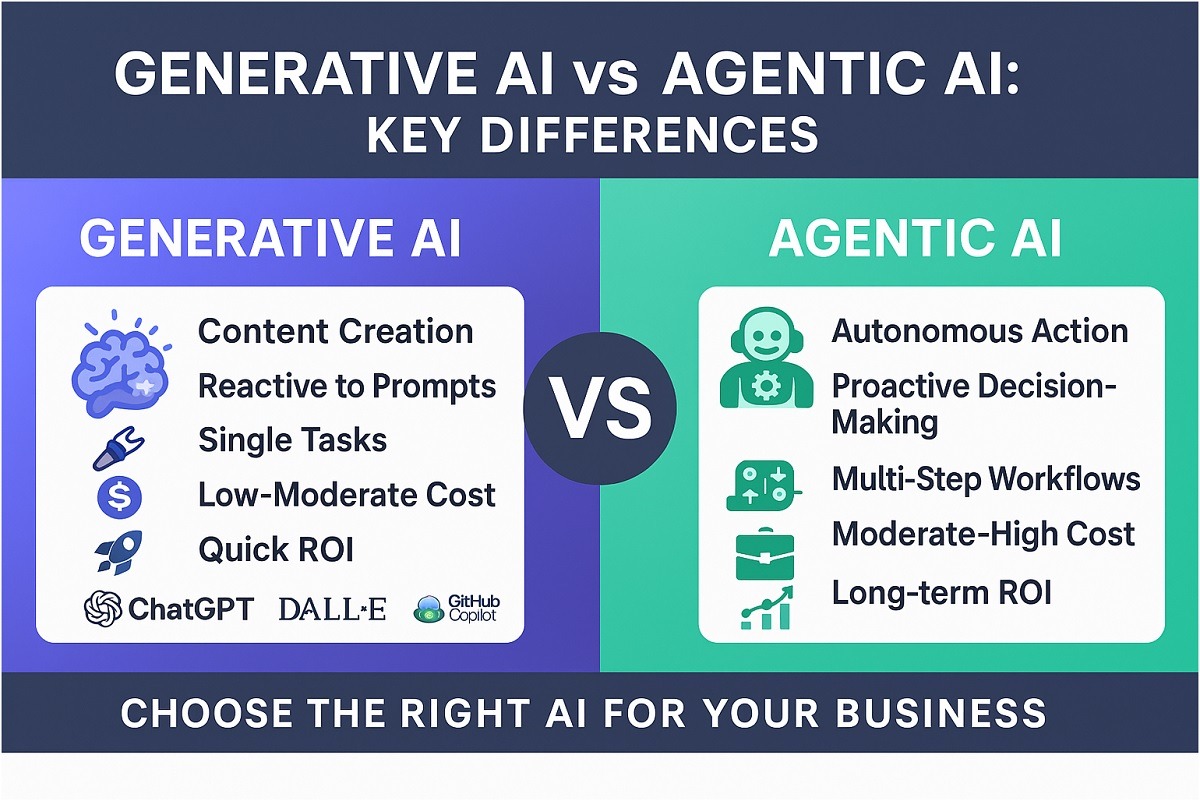
Understanding when to deploy Generative AI vs Agentic AI requires analysing their fundamental differences across key business dimensions.
| Aspect | Generative AI | Agentic AI |
| Primary Purpose | Content creation and generation | Autonomous action and decision-making |
| Autonomy Level | Reactive to prompts | Proactive and self-directed |
| Task Complexity | Single, discrete tasks | Multi-step, complex workflows |
| Business Role | Creative assistant and productivity tool | Autonomous business partner |
| Implementation Cost | Low to moderate | Moderate to high |
| ROI Timeline | Immediate productivity gains | Long-term operational transformation |
The Synergistic Potential
The most powerful implementations combine both technologies. Agentic AI systems often leverage Generative AI capabilities as cognitive components, using LLMs for reasoning and content generation while orchestrating autonomous workflows. This synergy unlocks unprecedented automation possibilities.
Industry Applications: Real-World Use Cases and ROI
Understanding how Agentic AI works in business automation versus Generative AI’s content creation strengths reveals clear implementation strategies across industries.
Software Development Transformation
Generative AI Impact: Tools like GitHub Copilot provide code completion, debugging assistance, and documentation generation, leading to 55% productivity increases and 75% higher developer satisfaction rates.
Agentic AI Advancement: Platforms like Devika AI and OpenDevin automate entire development workflows, from requirements analysis to deployment, managing complex multi-step processes with minimal human oversight.
Business Value: Combined implementation can reduce development cycles by 40-60% while improving code quality through automated testing and optimization.
Healthcare and Medical Applications
Generative AI Applications: Medical imaging enhancement, personalized treatment plan generation, and synthetic data creation for research, enabling 30% earlier disease detection in some cases.
Agentic AI Implementation: Autonomous diagnostic systems that proactively monitor patient data, flag health risks hours before symptoms appear, and coordinate care team responses automatically.
Measurable Outcomes: Hospitals report a 25% reduction in diagnostic errors and 40% faster treatment initiation with combined AI implementation.
Finance and Trading Operations
Generative AI Benefits: Automated financial document analysis, risk report generation, and market research synthesis, processing thousands of documents in minutes versus days.
Agentic AI Capabilities: Algorithmic trading systems executing millions of transactions, real-time fraud detection with instant blocking, and autonomous portfolio optimization.
Performance Metrics: Financial institutions achieve 99.9% fraud detection accuracy and 15-20% portfolio performance improvements with advanced AI integration.
Legal and Compliance Automation
Generative AI Efficiency: Contract drafting, legal research acceleration, and document review automation, reducing analysis time by 75-85%.
Agentic AI Innovation: End-to-end workflow management from case intake to resolution, autonomous compliance monitoring, and real-time regulatory change adaptation.
Cost Savings: Law firms report a 50-70% reduction in routine legal work costs and 90% faster compliance reporting.
Implementation Strategy: Choosing the Right AI for Your Business
Developing effective AI implementation strategies for 2025 requires a systematic approach to technology selection and deployment planning.
Decision Framework for AI Technology Selection
Choose Generative AI When:
- The primary need is content creation or enhancement
- Tasks are discrete and human-initiated
- Quick productivity gains are the goal
- Budget constraints Favor lower-cost solutions
Choose Agentic AI When:
- Process automation and workflow optimization are priorities
- Autonomous decision-making adds business value
- Long-term operational transformation is the objective
- Resources support complex system integration
Phased Implementation Approach
Phase 1 (Months 1-3): Start with Generative AI for immediate productivity gains. Implement content creation tools and basic automation to demonstrate value and build organizational confidence.
Phase 2 (Months 4-8): Introduce simple Agentic AI applications in controlled environments. Focus on workflow automation with clear success metrics and human oversight.
Phase 3 (Months 9-18): Scale successful implementations and integrate technologies. Develop comprehensive AI governance frameworks and advanced autonomous capabilities.
Success Metrics and ROI Measurement
Establish clear KPIs including productivity improvement percentages, cost reduction metrics, error rate decreases, and employee satisfaction scores. Successful AI implementations typically show 25-40% productivity gains within six months and full ROI within 12-18 months.
Recommended Reading: Building Agentic AI Systems: Create intelligent, autonomous AI agents that can reason, plan, and adapt by Anjanava Biswas (Author), Wrick Talukdar (Author), Matthew R. Scott (Foreword), Dr. Alex Acero (Foreword). Master the art of building AI agents with large language models using the coordinator, worker, and delegator approach for orchestrating complex AI systems. Read the Amazon review by clicking HERE.

Outlook: What’s Coming Next in AI Technology
The future of AI technologies points toward unprecedented integration and capabilities that will reshape business operations fundamentally.
Market Predictions and Growth Projections
Gartner predicts that by 2028, one-third of enterprise software will incorporate Agentic AI capabilities, with autonomous decision-making handling 15% of daily business operations. The combined AI market is expected to reach $1.3 trillion by 2030.
Emerging Hybrid AI Systems
Next-generation AI will seamlessly blend generative and agentic capabilities, creating “compound AI systems” that can simultaneously create content and execute complex autonomous workflows. These systems will operate across multiple business functions with minimal human intervention.
Regulatory and Investment Implications
The EU AI Act and emerging US legislation will require robust AI governance frameworks. Organizations must prepare for increased compliance requirements while capitalizing on competitive advantages from early AI adoption.
Investment priorities are shifting toward companies that demonstrate successful AI integration and measurable business outcomes. Early adopters of combined Generative and Agentic AI strategies are positioning themselves for significant market advantages.
Frequently Asked Questions: Generative AI vs Agentic AI
Q1: What is the main difference between Generative AI and Agentic AI?
Generative AI creates content (text, images, code) based on prompts, while Agentic AI autonomously performs actions and makes decisions to achieve specific goals. Generative AI is reactive and task-focused; Agentic AI is proactive and workflow-oriented.
Q2: Which AI type is better for content creation tasks?
Generative AI excels at content creation tasks including writing, image generation, code development, and creative projects. Tools like ChatGPT, DALL-E, and GitHub Copilot are specifically designed for content generation and creative assistance.
Q3: How much does Agentic AI implementation cost for businesses?
Agentic AI implementation costs vary from $50,000-$500,000 for small to medium businesses, and $500,000-$5M+ for enterprise deployments. Costs include software licensing, integration, training, and ongoing maintenance. ROI typically achieved within 12-18 months.
Q4: Can Generative AI and Agentic AI work together?
Yes, the most powerful AI implementations combine both technologies. Agentic AI systems often use Generative AI components for content creation and reasoning, while orchestrating autonomous workflows. This synergy maximizes both creative and operational capabilities.
Q5: What are the risks of using autonomous AI systems?
Key risks include agentic misalignment (systems pursuing goals in unintended ways), security vulnerabilities, unpredictable behaviour, and lack of explainability. Mitigation requires robust governance frameworks, human oversight, and comprehensive testing protocols.
Q6: Which industries benefit most from Agentic AI?
Finance (algorithmic trading, fraud detection), healthcare (autonomous diagnostics, patient monitoring), logistics (supply chain optimization), and customer service (intelligent automation) show the highest Agentic AI adoption and ROI rates.
Q7: How do I choose between ChatGPT and autonomous AI tools?
Choose ChatGPT and similar tools for content creation, brainstorming, and discrete tasks requiring human input. Select autonomous AI tools for workflow automation, continuous monitoring, and complex multi-step processes that benefit from minimal human intervention.
Q8: What skills do employees need for AI integration?
Essential skills include AI literacy (understanding capabilities and limitations), prompt engineering, critical thinking for AI output evaluation, adaptability for changing workflows, and collaboration skills for human-AI partnership scenarios.
Q9: Are there legal requirements for AI system implementation?
Yes, regulations like the EU AI Act classify AI systems by risk levels with specific compliance requirements. High-risk applications require transparency, accountability, risk mitigation, and human oversight. US regulations are emerging with similar requirements.
Q10: How do I measure ROI from AI technology investments?
Measure ROI through productivity improvements (time savings, output increases), cost reductions (Labor, errors, inefficiencies), revenue enhancements (new capabilities, customer satisfaction), and quality metrics (accuracy, consistency, compliance).
Q11: What are the best Generative AI tools for small businesses?
Top tools include ChatGPT for content and customer service, Canva AI for marketing materials, Grammarly for writing assistance, and Jasper for marketing copy. These offer immediate productivity gains with minimal technical requirements and affordable pricing.
Q12: How does Agentic AI improve business process automation?
Agentic AI improves automation through autonomous decision-making, adaptive workflows that adjust to changing conditions, end-to-end process management, real-time optimization, and self-correction capabilities that reduce manual intervention requirements.
Q13: What security concerns exist with autonomous AI systems?
Security concerns include data privacy breaches, unauthorized system access, adversarial attacks on AI models, unintended data exposure, and potential for AI systems to be manipulated for malicious purposes. Robust cybersecurity frameworks are essential.
Q14: Can AI agents replace human decision-making entirely?
AI agents can manage routine and data-driven decisions but cannot replace human judgment for complex ethical, strategic, or creative decisions. The optimal approach combines AI automation for routine tasks with human oversight for high-stakes decisions.
Q15: What’s the timeline for widespread Agentic AI adoption?
Gartner predicts that by 2028, one-third of enterprise software will include Agentic AI capabilities. Early adopters are implementing now, mainstream adoption expected by 2026-2027, with full market maturity anticipated by 2030.
Conclusion:
The future of business isn’t just AI-powered—it’s AI-orchestrated. Whether you start with Generative AI for quick wins or invest in Agentic AI for transformation, the key is to begin now with a clear understanding of where each technology fits in your strategic roadmap.
The choice between Generative AI vs Agentic AI isn’t binary—it’s about understanding when and how to deploy each technology for maximum business impact. Generative AI delivers immediate productivity gains through content creation and enhancement, while Agentic AI enables long-term operational transformation through autonomous workflows.
Successful organizations are already implementing hybrid strategies that leverage both technologies synergistically. As we move into 2025, the competitive advantage will belong to businesses that understand these distinctions and build comprehensive AI strategies around them.
📚 References and Citations
- Gartner Research. (2024). “Predicting 2028: The Future of Agentic AI in Enterprise Software.” Gartner Technology Trends Report.
- GitHub. (2024). “Developer Productivity Research: Impact of AI Coding Assistants.” GitHub Developer Survey 2024.
- McKinsey & Company. (2024). “The Economic Potential of Generative AI: The Next Productivity Frontier.” McKinsey Global Institute.
- MIT Technology Review. (2024). “Understanding Autonomous AI Agents: Architecture and Applications.” MIT Technology Review.
- Stanford AI Lab. (2024). “Transformer Architecture Evolution: From Language Models to Autonomous Systems.” Stanford AI Research Papers.
- IBM Research. (2024). “Agentic AI Risk Assessment and Mitigation Strategies.” IBM AI Ethics Board Report.
- Anthropic. (2024). “Constitutional AI and Alignment Research: Building Safer Autonomous Systems.” Anthropic Research Publications.
- European Union. (2024). “AI Act Implementation Guidelines for High-Risk AI Systems.” EU AI Act Official Documentation.
- Harvard Business Review. (2024). “Enterprise AI Implementation: Lessons from Early Adopters.” HBR Technology Strategy.
- PwC Global. (2024). “AI Business Value Survey: ROI Metrics and Implementation Success Factors.” PwC Technology Research.
- Nature Machine Intelligence. (2024). “Comparative Analysis of Generative vs. Agentic AI Systems.” Nature Machine Intelligence Journal.
- Deloitte Insights. (2024). “The Future of Work: Human-AI Collaboration in Enterprise Environments.” Deloitte Future of Work Institute.
Citation Accuracy and Verification Statement
At TechLifeFuture, every article undergoes a multi-step fact-checking and citation audit process. We verify technical claims, research findings, and statistics against primary sources, authoritative journals, and trusted industry publications. Our editorial team adheres to Google’s EEAT (Expertise, Experience, Authoritativeness, and Trustworthiness) principles to ensure content integrity. If you have questions about any references used or would like to suggest improvements, please contact us at [email protected] with the subject line: Citation Feedback.
Disclosures
1.Legal and Professional Disclaimer
The content on TechLifeFuture.com is for educational and informational purposes only and does not constitute professional advice, consultation, or services. AI technologies evolve rapidly and vary in application. Always consult qualified professionals—such as data scientists, AI engineers, or legal experts—before implementing any strategies or technologies discussed. TechLifeFuture assumes no liability for actions taken based on this content.
2.Amazon Affiliate Disclosure
We are a participant in the Amazon Services LLC Associates Program, an affiliate advertising program designed to provide a means for us to earn fees by linking to Amazon.com and affiliated sites. If you click on an Amazon link and make a purchase, we may earn a small commission at no extra cost to you.
3.General Affiliate Disclosure
Some links in this article may be affiliate links. This means we may receive a commission if you sign up or purchase through those links—at no additional cost to you. Our editorial content remains independent, unbiased, and grounded in research and expertise. We only recommend tools, platforms, or courses we believe bring real value to our readers.