A recent study found that nearly 30% of artificial intelligence (AI) outputs in critical areas have errors or “hallucinations.” This makes people question the trustworthiness of these systems. So, what are AI hallucinations? They happen when AI models, especially those using machine learning, create information that’s not real or based on facts.
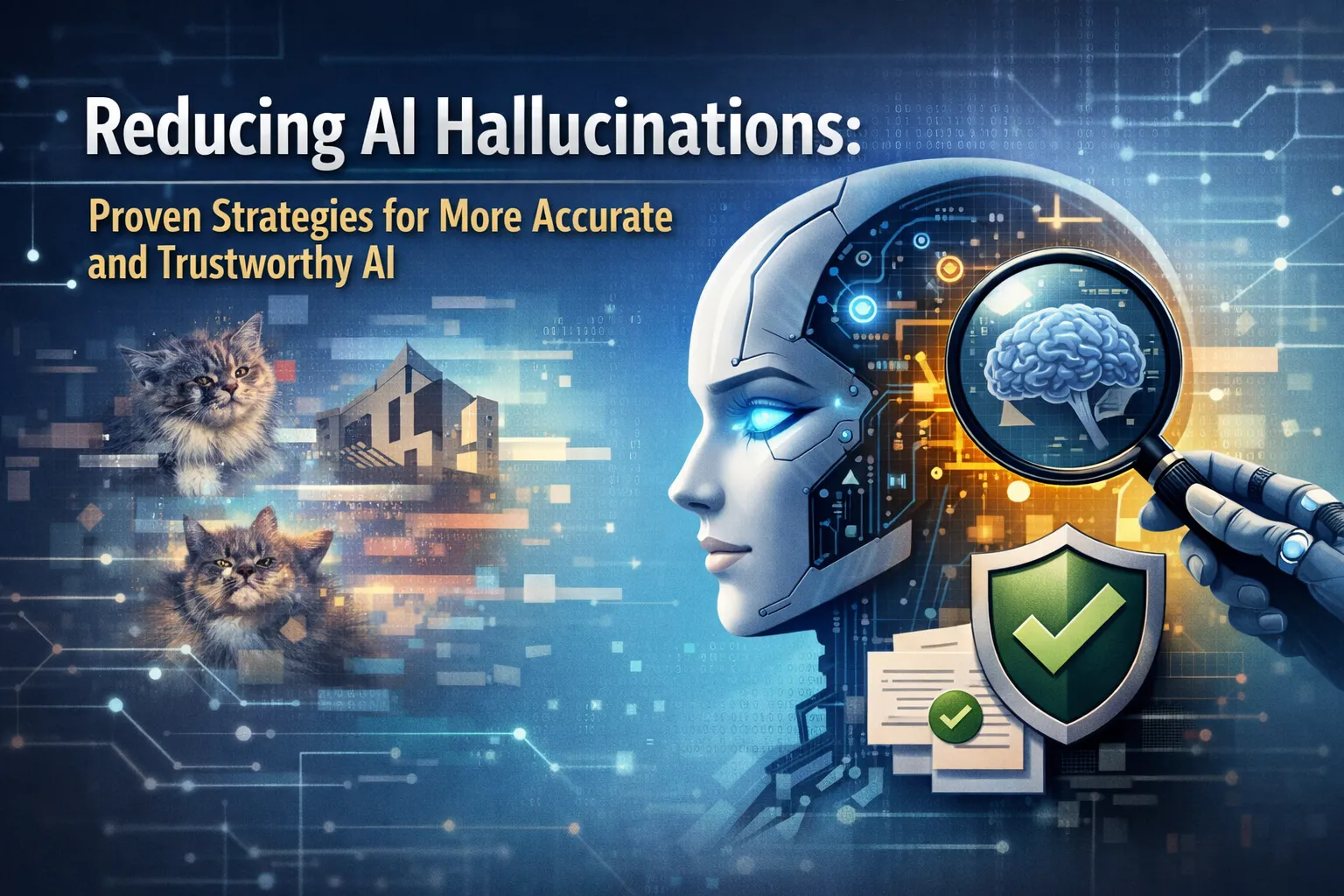
This problem is big, especially in situations where being accurate is crucial. To fix this, we need to know how to reduce AI hallucinations. This article will look at effective ways to make AI more reliable and trustworthy.
What Are AI Hallucinations and Why Do They Matter
It’s key to understand AI hallucinations to make AI safer and more accurate. AI hallucinations happen when AI models, like those using deep learning, create information that’s not real.
Definition of AI Hallucinations
AI hallucinations happen when AI models make things up. This can be because of training data limitations, prompt ambiguity, or model overconfidence. For example, in Large Language Models (LLMs) like ChatGPT, they might create text that’s wrong or out of context.
Common Examples in Generative AI
Generative AI models, like chatbots and content tools, often hallucinate. Here are some examples:
- Chatbots giving false info to users
- LLMs are making text that’s not true
- Image models create images not based on real data
These examples show we need ways to spot and stop AI hallucinations.
Why Hallucinations Are Dangerous in Real-World Use
AI hallucinations can be very harmful in real life, especially in healthcare, law, finance, and education. For example, in healthcare, they could lead to wrong diagnoses or treatments, which is very dangerous.
This shows how vital it is to find ways to lessen AI hallucinations and make AI systems reliable.
Why Reducing AI Hallucinations Is Critical
AI is now a big part of our lives. It’s more important than ever to stop AI hallucinations. These can spread false info, causing harm in many areas.
Risks to Trust and Credibility
AI hallucinations can hurt the trust in AI systems. False or misleading info from AI can make users doubt its reliability. Mitigating AI risks is key to keeping people confident in AI.
A study by Example Research shows users trust AI more when it’s accurate. But, one mistake can make them lose trust fast.
Impact on Healthcare, Law, Finance, and Education
AI hallucinations can be very harmful in important fields like healthcare, law, finance, and education. In healthcare, for example, it could mean wrong diagnoses or treatments, harming patients.
- In healthcare, AI hallucinations can result in incorrect medical diagnoses or treatment plans.
- In law, AI-generated false information can lead to misinformed legal decisions.
- In finance, AI hallucinations can cause inaccurate financial forecasts or advice.
- In education, AI-generated false information can compromise the quality of educational content.
Legal and Ethical Implications
The legal and ethical issues with AI hallucinations are big. As AI gets more independent, we need to think about the effects of its false info. AI ethics is vital for making AI systems that are open, accountable, and reliable.
Experts say we must cut down on AI’s false positives to lessen these risks. This can be done by better training data, stronger testing, and fact-checking.
To build a trustworthy AI world, we need to focus on reducing hallucinations. This means using new tech, thinking about ethics, and having rules in place.
Key Causes of AI Hallucinations
AI hallucinations come from several key factors in AI design and training. Knowing these causes helps us find ways to reduce hallucinations and make AI more reliable.
Training Data Limitations
One main reason for AI hallucinations is limited training data. AI models learn from the data they get. If this data is biased or wrong, the model might hallucinate. For example, if an AI is mostly trained on data from one group, it might not do well with others, leading to hallucinations.
Data quality is key to lower hallucinations. Having diverse, accurate, and complete training data improves model performance. Using data augmentation and synthetic data can also boost the training dataset’s strength.
Prompt Ambiguity
Prompt ambiguity also causes AI hallucinations. Vague or open-ended prompts can confuse AI models, leading to hallucinations. For instance, a vague prompt like “describe a scenario” might result in unrealistic information.
To fix this, prompt engineering is crucial. Clear and specific prompts help AI give more accurate and relevant answers. It’s about setting the context, limiting the output, and giving clear instructions.
Model Overconfidence
Model overconfidence is when AI models are too sure of their wrong answers. This often happens because training focuses on confidence over accuracy. Such overconfidence can cause problems when AI’s answers don’t match facts.
To tackle this, we need to change how we train AI. Using calibration techniques can help match the model’s confidence with its accuracy. This might involve changing the loss function to penalize overconfidence.
Lack of Real-Time Verification
AI hallucinations also come from not checking facts in real-time. AI models often rely on patterns learned during training without checking if the information is correct. This is especially true in changing environments where facts can shift quickly.
Adding real-time fact-checking can help. By using fact-checking APIs or retrieval-augmented generation, AI can check its answers against reliable sources. This reduces hallucinations.
In summary, solving AI hallucinations needs a broad approach. We must improve training data, refine prompts, calibrate model confidence, and add real-time checks. By tackling these issues, we can make AI more accurate and trustworthy, pushing computer science and technology forward.

Proven Techniques for Reducing AI Hallucinations
AI hallucinations can be lessened by using certain methods. These include retrieval-augmented generation and model fine-tuning. These methods help make AI-generated content more reliable and accurate. By applying these strategies, developers can make AI outputs more trustworthy.
Prompt Engineering Best Practices
Prompt engineering is key to reducing AI hallucinations. It’s about creating clear, concise prompts to guide AI. Best practices include using specific language, avoiding ambiguity, and providing contextual information to help the AI understand the task at hand.
For example, a specific prompt can lead to a precise AI response. This method not only cuts down hallucinations but also improves content quality.
Retrieval-Augmented Generation (RAG)
Retrieval-augmented generation uses external data to improve AI responses. This method helps AI generate accurate responses by using verified data. RAG is especially useful in areas like healthcare and finance where accuracy is critical.
By adding RAG to AI systems, developers can ensure content is accurate and based on real data. This boosts the credibility of AI outputs.
Human-in-the-Loop Systems
Human-in-the-loop systems include human oversight in AI generation. This method helps detect and correct hallucinations, ensuring accurate outputs. These systems are great for high-stakes environments where errors can have big consequences.
By using human judgment, AI developers can create systems that are more accurate and trustworthy.
Model Fine-Tuning
Model fine-tuning adjusts AI model parameters for specific tasks or datasets. This technique helps reduce hallucinations by allowing the model to learn from relevant data. Fine-tuning is a powerful tool for improving AI model performance, especially in specialized domains.
Through fine-tuning, developers can enhance AI output accuracy and reliability. This reduces hallucinations and makes AI systems more trustworthy.
Role of Prompt Engineering in Reducing AI Hallucinations
Using well-crafted prompts is key to preventing AI false perceptions. Prompt engineering is vital for AI hallucination management. It affects the quality and relevance of AI-generated content.
Writing Precise and Constrained Prompts
To mitigate machine learning hallucinations, we need to write precise and constrained prompts. Clearly define the task and context. Limit the scope of the AI’s response.
For example, instead of asking “What are the benefits of AI?”, ask “List the benefits of AI in healthcare, focusing on diagnostic accuracy and patient care.” This makes the AI’s output more accurate and reliable.
Using Context and Role-Based Instructions
Using context and role-based instructions is another effective technique. By giving the AI a specific context or role, we can tailor its responses. For example, “As a financial analyst, explain the impact of interest rate changes on the stock market” gives a clear role and context.
This method is great for complex domains. It helps the AI understand nuances by simulating a specific professional context. This reduces hallucinations significantly.
Asking AI to Cite Sources
Asking AI to cite sources is a simple yet effective way to check accuracy. This method helps mitigate machine learning hallucinations and fact-checks information. For example, “Explain the theory of relativity and provide sources” forces the AI to use verifiable references.
This practice makes AI outputs more credible and trustworthy. It’s crucial in academic, legal, and professional settings where accuracy is essential.
Tools and Frameworks That Help Reduce AI Hallucinations
To fight AI hallucinations, new tools and frameworks have been developed. They are key to making AI more reliable and accurate, especially in important tasks.
Fact-Checking APIs
Fact-checking APIs are crucial for checking AI’s accuracy. They help reduce AI hallucinations by verifying information. Some top APIs include:
- Google Fact Check
- NewsGuard
- Media Bias/Fact Check
AI Guardrails and Evaluation Tools
AI guardrails and tools watch AI outputs in real-time. They spot hallucinations and tell the AI to correct itself. Key features are:
- Real-time monitoring of AI outputs
- Automated detection of hallucinations
- Customizable alert systems
AI guardrails are vital for cutting down deep learning hallucinations. They add an extra check. For more on AI safety, see our post on AI safety.
Enterprise AI Safety Platforms
Enterprise AI safety platforms manage AI risks, like hallucinations. They offer tools and services, such as:
- AI model auditing
- Risk assessment and mitigation
- Compliance monitoring
Using these tools, companies can make their AI systems more accurate and reliable. For more on reducing AI hallucinations, check out our articles on LLM hallucinations and prompt engineering.

Future Outlook on Reducing AI Hallucinations
Mitigating AI hallucinations is crucial for AI’s full potential. Several promising developments are on the horizon.
Smarter Models and Hybrid Systems
The next AI models will have smarter architectures. They might use hybrid approaches that mix symbolic and connectionist AI. A study by Gartner shows that by 2025, over 50% of AI models will use hybrid methods. This will improve their accuracy and reliability.
Stronger Regulations
Regulatory bodies are focusing more on AI safety and ethics. For example, the European Union’s proposed AI Act sets strict guidelines for AI development. It stresses transparency and accountability. Dr. Andrew Ng believes that good regulations are key to responsible AI development.
Improved AI-Human Collaboration
Future AI systems will focus more on human-AI collaboration. They will need to understand human input better and have interfaces for humans to correct AI outputs. A whitepaper by Microsoft points out that human-centered AI design is vital for building trust and reducing hallucinations.
By combining these advancements, we can greatly reduce AI hallucinations. This will make AI systems more reliable and trustworthy.
FAQ
As AI keeps getting better, it’s key to understand and fix AI hallucinations. Here are some common questions about this issue.
Q1: What are AI hallucinations, and how do they occur in machine learning models?
AI hallucinations happen when AI models, especially deep learning ones, make up information not based on real data. This can be due to limited training data, unclear prompts, or the model being too sure of itself. As a result, they might share false or misleading info.
Q2: Why are AI hallucinations a significant concern in real-world applications?
AI hallucinations are a big worry in areas like healthcare, finance, and law. These fields need accuracy and reliability. If AI hallucinations occur, it can lead to wrong diagnoses, financial mistakes, or legal misunderstandings. This can damage trust in AI systems.
Q3: How can prompt engineering help reduce AI hallucinations?
Prompt engineering is about making clear, specific prompts for AI. This helps AI give more accurate and relevant answers. By adding context and asking AI to back up its answers, we can make AI outputs more reliable.
Q4: What role do human-in-the-loop systems play in mitigating AI hallucinations?
Human-in-the-loop systems use human oversight to improve AI decisions. They help catch and fix hallucinations. This makes AI outputs more accurate and trustworthy, especially in critical situations.
Q5: Are there any tools or frameworks available to help reduce AI hallucinations?
Yes, there are tools and frameworks to fight AI hallucinations. These include fact-checking APIs, AI guardrails, and evaluation tools. There are also platforms for AI safety. These help spot and fix hallucinations, making AI more reliable.
Q6: How might advancements in AI and regulations impact the issue of AI hallucinations in the future?
As AI gets smarter and regulations get stricter, AI hallucinations should decrease. Better AI and human teamwork, along with hybrid systems, will help. This will lead to more accurate and dependable AI outputs.
Q7: Can AI hallucinations be completely eliminated, and what are the challenges in achieving this goal?
Getting rid of AI hallucinations is tough, but we can make a lot of progress. We need to improve training data, design better models, and use strong checks. Ongoing AI safety research is key to reducing hallucinations to a low level.
Q8: What causes AI hallucinations?
AI hallucinations happen when training data is limited or when prompts are unclear. They also occur when models get too confident, especially with complex neural networks in deep learning.
Q9: How can we reduce AI hallucinations?
We can use techniques like prompt engineering and human oversight. These methods help make machine learning models more accurate.
Q10: What are the effects of AI hallucinations?
They can spread false information, damage trust, and even lead to legal problems. This is especially true in areas like healthcare and finance, where being accurate is crucial.
Q11: Can rules help fix AI hallucinations?
Yes, stronger rules and guidelines are important. They help ensure AI systems are safe and trustworthy, leading to better AI overall.
Conclusion
The aim of reducing AI hallucinations is to make artificial intelligence more accurate and reliable. We’ve looked at how AI hallucinations affect different areas. This is a big problem.
Using methods like prompt engineering and human oversight can help a lot. These approaches make AI more trustworthy. They also build confidence in AI technology.
As AI gets better, using these strategies is key. It helps create AI systems we can rely on.
About the Author & Disclosures
John Cosstick is Founder-Editor of TechLifeFuture.com and winner of the 2024 BOLD Award for Open Innovation in Digital Industries. He is a former banker, accountant, and certified financial planner.
He is now a freelance journalist and author. John is a member of the Media Entertainment and Arts Alliance (Union). You can visit his Amazon author page by clicking HERE.
Reference Links
- https://www.allaboutai.com/resources/ai-statistics/ai-hallucinations/
- https://dho.stanford.edu/wp-content/uploads/Legal_RAG_Hallucinations.pdf
- https://misinforeview.hks.harvard.edu/article/new-sources-of-inaccuracy-a-conceptual-framework-for-studying-ai-hallucinations/
- https://pmc.ncbi.nlm.nih.gov/articles/PMC11681264/
- https://drainpipe.io/the-reality-of-ai-hallucinations-in-2025/
- https://www.tandfonline.com/doi/full/10.1080/10447318.2025.2483858
- https://arxiv.org/html/2504.13777v1
- https://www.scottgraffius.com/blog/files/ai-hallucinations-2026.html
- https://arxiv.org/abs/2005.11401
- https://blogs.nvidia.com/blog/what-is-retrieval-augmented-generation/
- https://www.prompthub.us/blog/three-prompt-engineering-methods-to-reduce-hallucinations
- https://alfapeople.com/importance-of-prompt-engineering-preventing-ai-hallucinations