For small and medium-sized enterprise (SME) owners, investing in artificial intelligence (AI) projects can be daunting. To successfully implement AI solutions, it’s crucial to understand the owner’s perspective and priorities.
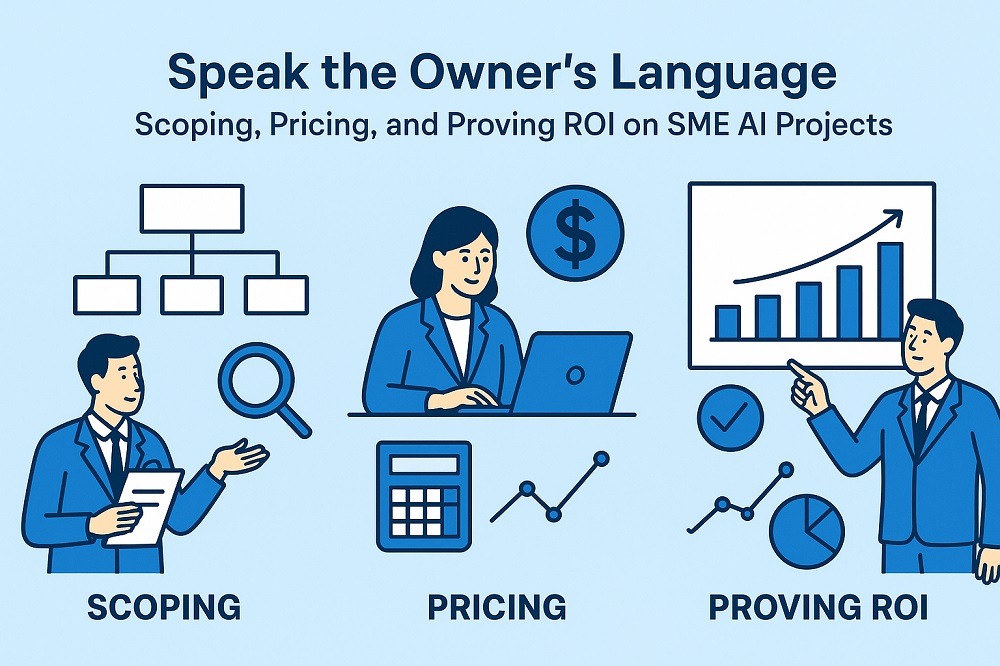
SME owners need confidence that AI projects will drive business value, not just add features. That requires shifting from technical specs to outcomes the business cares about. Effective scoping and pricing are essential.
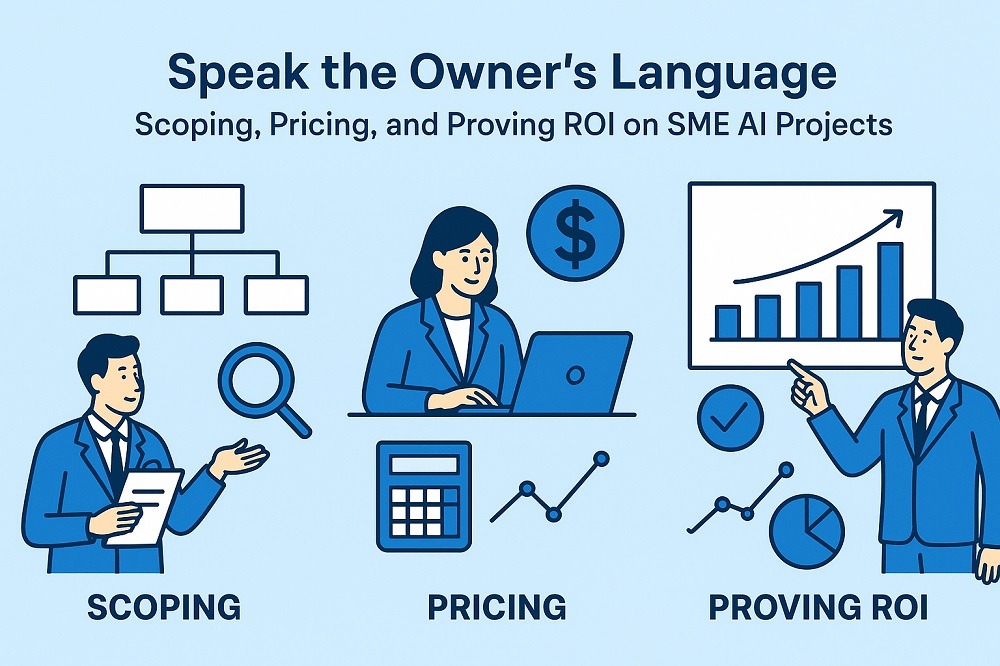
By structuring deals with value-based pricing and proving impact through ROI metrics, providers can demonstrate tangible value and help owners make informed decisions.
Understanding the SME Owner’s Perspective on AI
Understanding the SME owner’s perspective is essential because perceptions are shaped by media noise, mixed vendor claims, and prior tech projects.
Common Misconceptions Among SME Owners
Fear of High Costs and Complex Implementation
Perception: “AI = huge upfront spend + deep technical team.”
Reality: Cloud services and packaged tools make starter pilots affordable and low-risk.
Concerns About Return on Investment
Owners often struggle to quantify benefits, which stalls decisions. A crisp business case with measurable outcomes fixes this.
The Decision-Making Process in SMEs
SMEs usually decide via a small group (owner/MD, finance, operations). Priorities: cash flow, efficiency, risk reduction, and revenue growth.
The Essential Shift: From AI Features to Business Value
Why Technical Specifications Don’t Sell
Specs don’t translate to P&L. Overly technical proposals can alienate potential clients.
Feature-Talk vs Value-Talk (What Owners Hear)
| Feature-talk | Business-value translation |
|---|---|
| “24/7 chatbot uptime” | “Reduce first-response time by 35% and lift CSAT by 8 pts within 60 days.” |
| “Auto-classification model for tickets” | “Deflect 25% of L1 workload; save ~40 agent-hours/month.” |
| “Sales forecasting with ML” | “Improve forecast accuracy from 62% → 78%; cut stock-outs by 30%.” |
| “OCR + extraction pipeline” | “Cut AP processing cost/invoice by 50% and cycle time from 5 days → 24 hours.” |
| “RAG knowledge assistant” | “Reduce time-to-answer for staff by 60%; fewer escalations; faster onboarding.” |
Identifying Pain Points AI Can Solve
Operational Inefficiencies
Prime targets: repetitive admin, reconciliation, compliance checks, and manual data entry.
Automation Opportunities in Admin
Use AI tools for data entry, bookkeeping, and document processing to redeploy time to higher-value work.
Customer Experience Improvements
AI boosts personalisation and response speed, improving satisfaction and retention.
Personalisation & Response Time
Chatbots/assistants deliver personalised service in real-time, improving engagement and outcomes.
Effective Scoping, Pricing, and Proving ROI
Discovery: Ask the Right Questions
Use a business-first discovery to locate value fast (bottlenecks, latency, rework, risk hotspots), then align scope.
Business-Focused Assessment Templates
Templates should capture process maps, current KPIs, data availability/quality, constraints, and stakeholder outcomes.
Setting Realistic Project Boundaries
Define Deliverables & Exclusions
- Deliverables: pilot use-case, data pipeline, model/config, success dashboard, training.
- Exclusions: out-of-scope systems, advanced custom features, and enterprise roll-out (unless included).
Building a Business Case That Resonates
Components of a Compelling Proposal
- Clear problem definition
- Expected business outcomes
- Detailed cost-benefit analysis
- Implementation roadmap
Executive Summary for Non-Technical Audiences
- What outcome we’ll deliver and by when
- How we’ll measure it (KPIs, baselines, targets)
- Commercials and projected payback window
Case Studies & Success Stories
Choose examples close to the client’s sector and size, emphasising starting metrics → ending metrics → lessons learned.
Structuring the Deal: Value-Based Pricing
Beyond Hourly Rates and Fixed Bids
Traditional models don’t map to value delivered or risk shared. Reframe pricing to outcomes (see project costing).
Performance-Based Pricing Models
- Structure: Base fee + success bonus tied to KPI(s) (e.g., ticket deflection %, CSAT lift, cycle-time reduction).
- Measurement window: e.g., 30–90 days post-go-live; bonus capped/floored.
- Governance: Shared “source of truth” dashboard.
Pricing Tiers Aligned to Business Value
| Tier | Scope | Typical timeline | Expected outcomes (examples) |
|---|---|---|---|
| Entry Pilot | Single use-case (e.g., chatbot), light integration, baseline dashboard | 4–6 weeks | −20–30% first-response time; +3–5 CSAT pts; 15% L1 deflection |
| Standard | 2–3 use-cases, analytics, CRM/helpdesk integration, training | 8–12 weeks | −30–50% cycle time; +5–8 CSAT pts; 25–35% deflection |
| Advanced | End-to-end workflow, automations, governance, change enablement | 12–16 weeks | 50%+ cost-to-serve reduction; measurable revenue uplift (cross/upsell) |
Risk Mitigation in Proposals
Addressing Common Concerns
Owners worry about data privacy, system fit, and disruption. Meet that head-on with a concrete plan.
Data Security & Privacy Guarantees
Include encryption at rest/in transit, role-based access, audit logs, data retention/deletion, and regulatory alignment (GDPR, CCPA). See also: security practices and data strategy.
- End-to-end encryption for transmission and storage
- Regular security audits/pen tests
- Privacy by design + DPIA where applicable
Phased Approaches & Pilots
Break work into low-risk phases with clear exit criteria and learning loops before scale-up.
Delivering Proof: ROI Metrics Owners Care About
Financial Metrics
- Cost-to-serve: cost per ticket/order/invoice
- Cycle time: lead-to-cash, case resolution, AP processing
- Error/rework rate: % defects, returns, chargebacks
- Revenue metrics: conversion rate, AOV, retention/churn
Quantifying Intangibles
- Customer satisfaction (CSAT/NPS)
- Employee productivity (tasks/hour, time-to-competency)
- Risk reduction (policy breaches, compliance exceptions)
Establishing KPIs & Success Criteria Before Launch
Collaborative KPI Development
Co-design KPIs in a 60–90 minute workshop with the sponsor, finance, and the process owner.
KPI & Baseline Template
| KPI | Baseline | Target | Source of truth | Cadence | Owner |
|---|---|---|---|---|---|
| First-response time (mins) | 12.4 | ≤ 8.0 in 60 days | Helpdesk analytics | Weekly | Ops lead |
| Ticket deflection (%) | 5% | ≥ 25% in 90 days | Helpdesk + chatbot logs | Weekly | CS manager |
| AP cost/invoice (USD) | $6.20 | ≤ $3.10 in 90 days | Finance system | Monthly | Finance controller |
Measurement Framework
- Freeze baselines pre-pilot; define tracking queries/dashboards
- Agree thresholds for “success” and bonus calculations up front
- Review at 30/60/90 days; lock in scale-up or iterate
Geographical & Sectoral Nuances
Adoption patterns vary by region and sector. Tailor use-cases and change management to local norms and data realities.
Industry-Specific Notes
Retail, Manufacturing, and Service Sector Approaches
Retail: personalisation, inventory optimisation, demand forecasting
Manufacturing: predictive maintenance, quality control, supply chain
Services: chatbots, assistants, analytics for throughput and CX
Managing Expectations Across the Project Lifecycle
Timelines & Visual Roadmaps
Set realistic timeboxes and maintain a simple roadmap visible to all stakeholders.
Communication & Reporting (Impact-first)
Use short, regular updates focused on the business impact achieved and next risks to retire.
Post-Implementation Analysis & Reporting
Executive Dashboards
- Headline KPIs vs baseline/target (RAG status)
- Volume mix (self-serve vs agent-handled)
- Cost-to-serve trend
- Top intents/errors and fixes shipped
- Customer sentiment (CSAT/NPS)
Key Metrics to Include in ROI Reports
- Payback period and ROI%
- Run-rate savings and revenue uplift
- Throughput/capacity gained (hours returned to team)
- Risk reduction/quality (defects, breaches, audit findings)
Continuous Improvement & Expansion
- 30/60/90-day retros with backlog triage
- Identify adjacent automations with proven data
- Codify learnings into internal playbooks
Scaling Success: From Pilot to Enterprise
Leverage Initial Wins
Document quick wins with before/after metrics and stakeholder testimonials.
Internal Case Study Outline
- Problem & impact
- Intervention (people, process, tech)
- Metrics (baseline → result)
- Lessons and risks
- Next opportunities
Build Internal Champions & Train
Nominate champions in each function and run targeted training to embed capability.
Conclusion: Speak in Business Value
Successful SME AI projects hinge on business-first scoping, value-based pricing, and clear proof via KPIs. Establish baselines, measure what matters, communicate impact, and scale what works.
FAQ
Q1: What are common misconceptions about AI among SME owners?
A: Typically, that AI is prohibitively expensive, requires a big in-house data team, or can’t be measured. Start with a small pilot, prove ROI on one workflow, then expand.
Q2: How can proposals be more compelling to SME owners?
A: Lead with outcomes and timelines, not algorithms. Use baselines/targets, a payback estimate, and one relevant case study.
Q3: What is value-based pricing for AI projects?
A: Charging relative to the business value delivered. Use tiers or performance bonuses tied to pre-agreed KPIs.
Q4: How do we measure and prove ROI?
A: Track cost-to-serve, cycle times, accuracy/defects, and revenue metrics; report payback and run-rate gains at 30/60/90 days.
Q5: What risk mitigations should be in the plan?
A: Data security controls, phased pilots with exit criteria, and change-management/training to minimise disruption.
Q6: How are KPIs and success criteria set?
A: Co-design in a workshop; fix baselines, targets, source of truth, cadence, and ownership in a KPI table.
Q7: What geographical/sectoral nuances matter?
A: Adoption pace, data availability, and regulation vary. Tune the use-case and change approach to the region/sector.
Q8: How should we manage expectations?
A: Publish a simple roadmap, update weekly, and report impact first (not activity).
Q9: Why is post-implementation analysis crucial?
A: It proves value, directs improvements, and identifies the next automation opportunities.
Q10: How do we scale from pilot to organisation-wide?
A: Package the win into an internal case study, appoint champions, and fund a sequenced rollout.
Citation & Verification
TechLifeFuture articles undergo multi-step fact-checking aligned with EEAT principles. We verify technical claims against primary sources and authoritative publications.
Feedback: [email protected] (subject “Citation Feedback”).
Legal Disclaimer
Educational content only; not professional advice. Consult qualified engineers or legal experts for implementation decisions.
Financial Advice Disclaimer
This publication does not constitute financial advice. Seek independent financial, tax, or investment guidance.
Affiliate Disclosure: We may earn commissions from partner links (e.g., Educative.io, Mindhive.ai) at no extra cost to you.