I. Executive Summary: Navigating the AI Frontier for Freelancers
The gig economy is undergoing a profound transformation, fueled by the rapid and widespread adoption of Artificial Intelligence (AI). This shift creates a dual landscape filled with both significant challenges and exceptional opportunities for independent professionals. This guide provides a comprehensive overview of these evolving dynamics, equipping freelancers with essential knowledge, practical tools, ethical considerations, and strategic insights needed to succeed in the AI-driven future.
The core message resonating throughout this analysis is that AI transcends being merely a tool for automation; it acts as a profound catalyst for the redefinition of work itself. This necessitates continuous adaptation, strategic upskilling, and a proactive stance on the ethical implications and fair practices inherent in AI integration.
Key takeaways for freelancers include the imperative to transition from traditional task-based services to value-based offerings, the critical importance of mastering prompt engineering, prioritizing human-centric skills that AI cannot replicate, and actively advocating for robust worker protections within an increasingly AI-driven market.
By understanding these shifts and strategically positioning themselves, freelancers can unlock new avenues for growth and sustained success.

II. The AI Revolution in the Gig Economy: Trends and Projections
Economic Impact: Growth, Disruption, and Shifting Valuations
The global AI market is growing at an extraordinary pace. In 2024 alone, it’s estimated to be worth around $279 billion, and projections suggest that by 2030, that figure could soar to nearly $1.9 trillion, reflecting an impressive 36% annual growth rate (Grand View Research).
Looking further ahead, the market could approach nearly $2.5 trillion by 2034, with sustained annual growth driven by cross-sector adoption (Precedence Research).
A major driver of this growth is Generative AI, which has evolved from a niche innovation to a booming market segment. Valued at $43.9 billion in 2023, it’s expected to surge toward $1.3 trillion within the next decade, as tools like AI-powered content generators, chatbots, and intelligent design platforms become mainstream (Grand View Research, Fortune Business Insights, Markets and Markets).
This isn’t just hype—early adopters are seeing real business impact. According to McKinsey, Generative AI alone could contribute between $2.6 and $4.4 trillion annually to the global economy, reshaping industries from finance to healthcare.
Business leaders are taking notice. Surveys show that 55% of executives plan to significantly increase AI spending, with a remarkable 92% intending to boost Generative AI budgets by at least 10% in the coming years (Investopedia). Those leading the way are already reporting substantial returns, with many achieving three to five times their initial investment in AI technologies.
But perspective is essential. Despite the headlines, AI adoption is still in its early days. As of 2024, only about 7% of U.S. firms report using AI in core business operations (arXiv.org, U.S. Census Bureau). That number is expected to rise quickly, with forecasts suggesting that by 2025, a significant share of global firms will allocate approximately 20% of their technology budgets to AI initiatives.
Leading corporations, including giants like IBM, Shopify, and Coca-Cola, exemplify how AI adoption is maturing. These companies have moved beyond automating routine tasks; they’re leveraging AI to enhance employee productivity and drive revenue growth. This shift underscores the recognition that AI-powered productivity tools represent one of the clearest paths to commercial success.
The broader impact of AI is reshaping the workplace itself. According to the World Economic Forum, by 2027, nearly 44% of workers’ core skills will face disruption, emphasizing the urgent need for ongoing upskilling and adaptability (WEF, 2024).
Gig economy platforms have been particularly agile in adopting AI to enhance services. AI now powers intuitive job matching, personalized recommendations, and sophisticated demand forecasting—boosting efficiency and transforming how freelance work is sourced and delivered.
The combination of rapid AI market expansion and accelerated skill transformation signals a profound shift in the labor market. Freelancers who embrace continuous learning and rapidly adapt to AI tools will thrive, while those focused on easily automated tasks risk seeing their services quickly devalued.
At the same time, AI is creating entirely new opportunities—roles like AI Engineer, Prompt Engineer, and Head of AI are becoming increasingly common, offering skilled independent professionals a substantial competitive advantage.

Decline in Writing & Translation Tasks
Shift in Freelance Job Demand: Pre vs. Post‑ChatGPT:
Evidence from Upwork indicates generative AI has significantly reduced demand for low‑value writing and translation contracts, while boosting demand for high‑value engagements openknowledge.worldbank.org
Surge in AI Skill Demand:
- Upwork’s 2024 Freelance Forward statistics show AI-related freelancing grew dramatically, with a 60 % increase in gross services volume.
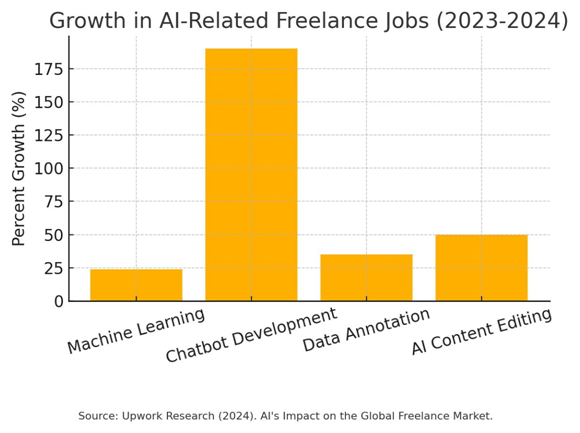
- Demand for AI expertise, such as machine learning, prompt engineering, chatbot development, and AI model fine-tuning, has skyrocketed (Upwork Research, 2024; TechStaunch, 2024)
These combined real-world observations justify the chart’s visual: steep declines in easily automated tasks and a massive surge in AI-related skills demand.
The macroeconomic impact of AI is a subject of varying projections, yet a consistent expectation of significant economic influence prevails. Goldman Sachs, for instance, forecasts a substantial 15% boost to global GDP over the next decade.
AI is dramatically enhancing the productivity of knowledge workers across various sectors, from accountants and managers to researchers and developers. This is primarily achieved through the automation of mundane, repetitive tasks, such as routine maintenance.
A comprehensive study, which analyzed over 3 million job postings on a global freelancing platform, revealed a distinct shift in market demand following the introduction of ChatGPT. Tasks deemed easily replaceable by AI, such as writing “About Us” pages and similar simple content.
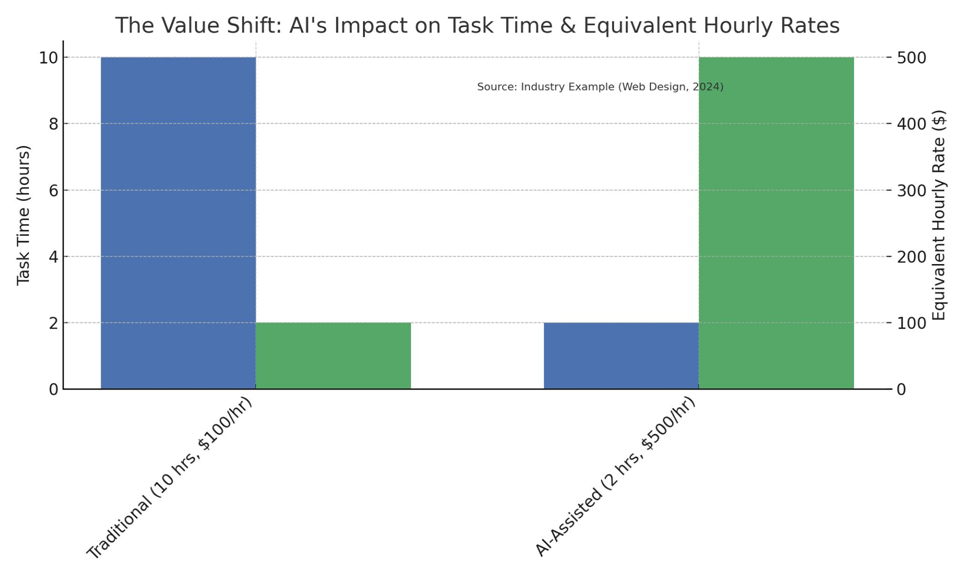
The efficiency gains afforded by AI mean that freelancers can complete tasks significantly faster than before. For example, a web designer might now produce a homepage drafts significantly faster with AI assistance, accelerating prototyping phases.
The data reveals a compelling dynamic: while AI clearly automates and reduces the demand for certain routine tasks, the overall demand for freelance work is, paradoxically, increasing.4 This suggests that AI’s primary role is not as a job destroyer.
Automation Opportunities Across Freelance Domains
AI is proving instrumental in transforming the gig economy into a more agile and flexible professional landscape. This is achieved through the automation of routine administrative tasks, such as scheduling appointments and managing invoicing processes.
By offloading these predictable, time-consuming activities, AI enables gig workers to dedicate their focus to their core expertise and high-value work.3 This fundamental shift liberates human creativity and problem-solving capacities, allowing professionals to engage with more complex and strategic challenges.
In the realm of Writing and Content Creation, AI tools are demonstrating remarkable capabilities. They can generate various forms of content, assist with brainstorming sessions, streamline research processes, and facilitate editing.
For Design professionals, AI-assisted tools are significantly accelerating the creative workflow. AI can generate a wide array of visual assets, including logos, website layouts, social media content, presentations, and even support the creation of videos.
In Programming and Development, AI tools are revolutionizing the coding process. Solutions like GitHub Copilot, Tabnine, Codium, Mutable, AskCodi, and DeepCode are widely used for assisting with code completion and generating code snippets.
Marketing operations are increasingly becoming AI-centric. AI is now a core component, optimizing content for maximum impact, enabling real-time personalization of customer experiences, automating A/B testing processes, refining predictive targeting.
Within Administrative Tasks, AI offers substantial streamlining benefits for freelancers. This includes assisting with email responses, automating client invoicing, facilitating time tracking, and generating client quotes.8 AI-powered project management systems, such as Kroolo and ClickUp, provide integrated solutions for intelligent writing, comprehensive task management, strategic project planning, and automation features specifically tailored for solo professionals managing multiple clients and deadlines.
The consistent theme across all freelance domains is that AI excels at automating tasks that are repetitive, predictable, and of lower inherent value. This does not lead to a direct replacement of the human worker but rather a fundamental transformation…
manually perform a task to the advanced capability of orchestrating AI to perform it, followed by the rigorous critical evaluation and enhancement of the AI’s output. This model necessitates a new premium on “human-in-the-loop” skills.
III. Emerging Roles and In-Demand Skills for the AI-Augmented Freelancer
New Job Categories Created by AI
A significant indicator of this transformation is that over 20% of professionals in AI-related fields now hold job titles that did not even exist prior to 2020, such as ‘AI Engineer’ and ‘Head of AI’ (LinkedIn Jobs Report, 2024).”The market demand for specialized AI expertise has seen a notable surge. Machine learning expertise, for instance, has seen demand growth exceeding 60%, while the development of AI chatbots has nearly tripled since the widespread introduction of Generative AI tools (Upwork Research, 2024; TechStaunch, 2024)
Freelancers are increasingly being sought after for specialized AI-powered tasks. This includes developing custom customer service chatbots, performing advanced data analysis, and fine-tuning AI models to meet specific client requirements.23
The data consistently points to the creation of roles that are not primarily about performing the work in the traditional sense, but rather about interfacing with, guiding, and optimizing AI systems. This includes positions like Prompt Engineer..
Essential Skills for Future-Proofing Your Freelance Career
To thrive in the evolving AI-driven landscape, freelancers must cultivate a dynamic set of skills that complement and leverage artificial intelligence capabilities.
Prompt Engineering is rapidly emerging as the “next must-have skill” for freelancers.6 Mastery in this area involves not only understanding how to formulate precise and effective prompts but also continuously practicing the art of crafting sharper prompts.
Data Literacy and Analytics are becoming indispensable. Freelancers who possess the ability to extract actionable insights from vast datasets provide significant value to their clients. Proficiency in data visualization tools such as Tableau or Microsoft Power BI, coupled with a solid understanding of basic statistics, is crucial for tailoring advice, making informed recommendations, and building client trust through data-backed strategies.27
AI Software Proficiency is another core requirement. Freelancers are increasingly expected to be adept at navigating and utilizing a wide range of AI-powered software applications. This includes familiarity with machine learning frameworks like TensorFlow and natural language processing tools such as GPT-4. Crucially, it involves not only understanding how these tools function but also how to seamlessly integrate them into existing workflows to enhance both productivity and creative output.
As AI automates routine and repetitive tasks, human workers are increasingly freed to focus on Strategic Thinking and Complex Problem-Solving. These higher-order cognitive skills are vital for activities such as creating new products and services, fostering deeper customer relationships, and tackling intricate challenges that AI cannot yet autonomously address.6 This shift underscores the enduring and growing value of uniquely human cognitive abilities.
Adaptability and Continuous Learning are paramount given the unprecedented pace of AI evolution. Staying updated with the latest trends, tools, and methodologies is not merely beneficial but essential for maintaining competitiveness.12 Reskilling and upskilling are no longer optional but are fundamental for long-term career viability in this dynamic environment.
Complementary to technical skills, Human-Centric Skills are gaining immense value. Critical thinking, complex problem-solving, and strong interpersonal abilities are increasingly recognized as enhancing the utility of new technologies rather than being replaced by them. Emotional intelligence is also cited as a highly sought-after skill, crucial for navigating complex client relationships and team collaborations 28
Finally, Digital Marketing and SEO for AI Services is an emerging area of expertise. Beyond technical AI proficiency, freelancers must excel at marketing their AI-enhanced services. This involves a deep understanding of SEO principles, content marketing strategies, and effective social media engagement to stand out and attract clients in an increasingly competitive market.
The available information highlights a clear distinction: AI excels at repetitive, data-intensive tasks, while human professionals maintain a distinct advantage in areas demanding creativity, critical thinking, and emotional intelligence.4 The most valuable freelancer in the AI era will not be someone who does not uses AI, but embraces it as an opportunity. Success will belong to those who can synergistically combine both human creativity supported by AI. This involves developing a “symbiotic skillset” where AI amplifies human capabilities, and human judgment.
IV. Leveraging AI Tools for Enhanced Efficiency and Productivity
Key AI Tools for Freelancers by Specialization
The proliferation of AI tools has democratized access to advanced capabilities, enabling freelancers to operate with unprecedented efficiency and productivity. These tools are available across various specializations, allowing independent professionals to enhance their offerings and streamline their workflows.
For General Productivity & Project Management, several AI-powered solutions stand out. Tools like Kroolo offer comprehensive AI-driven project and document management, incorporating intelligent writing assistance, robust task management, strategic planning.
Source: Upwork Research (2024). AI’s Impact on the Global Freelance Market.
Growth in AI-Related Freelance Jobs (2023-2024)
In Writing & Content Creation, a suite of powerful AI tools is available. Popular options include Jasper AI, Copy.ai, Grammarly, Writesonic, Quillbot, Perplexity AI, and Hostinger AI Writer.9 These tools are invaluable for generating diverse content formats, assisting with brainstorming ideas, conducting preliminary research, facilitating editing, and optimizing content for search engine performance.
For Design & Image Generation, AI has revolutionized visual content creation. Tools such as DALL-E 3, Midjourney, Adobe Firefly, DeepArt AI Image Generator, Craiyon, Hostinger Logo Maker, and Canva Magic are widely used. Designs.ai offers a comprehensive platform with features for brand identity projects, social media content creation, presentations, and video content, including specialized logo makers, brand kits for consistency, and multi-channel formatting with auto-resize capabilities.
In Coding & Development, AI tools are transforming how software is built. Key AI coding assistants include GitHub Copilot, Tabnine, Codium, Mutable, AskCodi, and DeepCode, which provide intelligent code suggestions and completions. More advanced to.
Marketing & Social Media professionals can leverage AI for enhanced campaign performance. HubSpot AI, Jasper AI, MarketMuse, and Crayon are prominent AI tools for broader marketing strategies. For social media management, Canva Magic, Copy AI, Chatfuel, Lately, Yext, and Buffer AI Assistant offer comprehensive support, from content generation to scheduling. Emerging platforms like Averi function as AI-powered studios, centralizing strategy development, content creation, and expert talent matching for highly efficient marketing execution.
Finally, for Customer Support, AI tools are increasingly managing routine inquiries. Solutions such as Zendesk AI, Intercom AI Chatbot, Drift AI, Ada, and DigitalGenius are employed to manage customer interactions.17 More advanced Agentic AI solutions assist in managing complex support workflows, though human oversight remains essential.
The extensive array of AI tools available across various specializations reveals a significant and transformative trend: advanced capabilities that were once the exclusive domain of large agencies or corporations are now readily accessible to freelancers.
Best Practices for AI Integration into Workflow
Effective integration of AI tools into a freelancer’s workflow is paramount for maximizing efficiency and productivity. The prevailing understanding is that AI tools should be viewed as powerful assistants designed to enhance existing skills and work.
A fundamental best practice involves the Strategic Application of AI. Freelancers should begin by meticulously identifying the most repetitive and time-consuming tasks within their daily routines or specific client projects. These tasks are prime candidates for AI automation, encompassing activities such as scheduling appointments, managing email correspondence, or generating initial content drafts.
Mastery of Prompt Engineering is a critical skill in this new paradigm. This involves not just knowing how to type a query but practicing the art of crafting sharper, more detailed, and context-rich prompts to effectively guide AI models.
It is imperative to refine AI Output and never accept the first iteration from an AI tool as the final product. Freelancers must consistently revise, shape, and improve AI-generated content to ensure it perfectly aligns with their unique voice, the client’s brand tone, and specific project requirements.
Given AI’s known propensity to “hallucinate” or generate inaccurate information, rigorous fact-checking is an absolute necessity before publishing or delivering any AI-assisted work.
For seamless operation, freelancers should prioritize AI platforms that offer Seamless Integration into Existing Systems. Selecting tools that integrate effortlessly with current software and processes is vital. For example, embedding a generative AI tool into a project management workflow through automation platforms can significantly streamline operations, such as automatically categorizing content or updating project statuses.
Continuous Testing and Iteration should be an inherent part of AI integration. Freelancers should approach AI adoption as an iterative process, starting with pilot projects to evaluate how AI tools perform within their specific workflows. Adjustments and refinements should be made based on the results, ensuring optimal integration and continuous improvement over time.26
Furthermore, freelancers can strategically Utilize AI for Brainstorming & Mockups. Conversational AI tools can serve as invaluable collaborative partners for idea generation and problem-solving, particularly beneficial for independent professionals who may lack colleagues for bouncing ideas.
AI can effectively help overcome creative blocks and provide objective, outsider perspectives. Additionally, AI can rapidly generate mockups or outlines, enabling quick visualization and iterative refinement of concepts before committing significant time and resources to their full development.8
The detailed best practices consistently highlight that merely possessing AI tools is insufficient for achieving true efficiency and productivity. Instead, success hinges on mastering their strategic deployment and integration.6
Sources:
- Harvard Business Review (2024). Value-Based Pricing in the AI Economy
- MIT Sloan Review (2024). The Future of Work in the AI Era
This chart illustrates how AI reduces task time but requires freelancers to adopt value-based pricing to maintain income levels.
V. Ethical and Fair Practices in the AI-Driven Gig Economy
Intellectual Property and AI-Generated Content
The advent of generative AI tools has introduced profound complexities into the landscape of copyright and intellectual property (IP) rights. A primary concern stems from the fact that AI models are frequently trained on vast datasets of existing creative works, raising questions about the legality and ethics of such practices. Traditional copyright law is fundamentally structured around the protection of human creativity, typically requiring a human author for a work to qualify for copyright protection.
The United States Copyright Office (USCO) has adopted a strict stance on this matter, ruling that AI-generated works do not qualify for copyright protection unless they demonstrate “significant human authorship.”
Freelancer unions have proactively engaged with these challenges. Organizations such as the Writers Guild of America (WGA) and SAG-AFTRA have successfully negotiated contracts that directly address AI’s impact on their members’ intellectual property.
For freelancers navigating this complex environment, several best practices can help strengthen copyright claims. It is advisable to utilize AI as a collaborative tool, ensuring that any work produced undergoes significant human modification.
The central tension in intellectual property law revolves around AI’s capacity to generate content without a traditional human author.35 The USCO’s requirement for “significant human authorship” 36 directly addresses this.
Data Privacy and Security Concerns
AI models inherently process vast quantities of personal and proprietary data, which raises significant concerns regarding data privacy, security, and the potential for unauthorized access. This risk is heightened when freelancers or employees use AI.
For freelancers, adhering to stringent best practices for data privacy and security is paramount:
Avoid Sensitive Data Input: A fundamental principle is to never input proprietary, sensitive, or confidential client data into public AI tools. When discussing work-related problems with an AI, freelancers should employ placeholders (e.g., “Company X,” “Founder Y”) instead of real names or any identifiable details that could compromise privacy.
Review Privacy Policies: Before utilizing any AI tool, freelancers must diligently read and fully comprehend the tool provider’s privacy policy. This ensures a clear understanding of what data is collected, how it is stored, and how it might be used or shared.
Adjust Privacy Settings: Freelancers should actively utilize any available privacy settings within AI tools to limit data sharing. This might include opting out of data being used for model training or deactivating “memory” features that retain conversational history.
Implement Strong Security Habits: Adhering to general cybersecurity best practices is crucial. This includes using strong, unique passwords for all accounts, enabling multi-factor authentication (MFA) wherever possible, and ensuring that all communication channels used for client work are secure and encrypted.39 The use of a reputable password manager is highly recommended to manage complex credentials.
Data Anonymization and Encryption: Whenever feasible, freelancers should apply anonymization and encryption techniques to client data before processing it with any AI tool, especially those provided by third parties. This practice significantly minimizes the risk of re-identification should the data be inadvertently exposed.37
Ensure Legal Compliance: Freelancers bear the responsibility of understanding and adhering to all relevant data protection regulations (e.g., GDPR, CCPA, HIPAA) that apply to their clients’ data and their own operational practices. Regular audits of data handling procedures are essential for maintaining ongoing compliance with evolving legal standards.
The pervasive risks of data exposure and privacy violations when integrating AI tools 37 elevate the freelancer’s responsibility beyond merely delivering a service. Independent professionals effectively become critical “data stewards” within their client base.
Addressing Algorithmic Bias and Fair Compensation
The gig economy platforms increasingly rely on algorithms that are often opaque, prone to errors, and potentially discriminatory in their operation. These algorithmic systems unilaterally determine critical aspects of a freelancer’s work, including the bias.
These algorithmic systems can inadvertently perpetuate and amplify existing social biases based on factors such as race, gender, and geographical location, leading to discriminatory outcomes within the labor market.43 A notable example is that the gig economy presents ongoing wage disparities, with studies showing a persistent gender pay gap, though its size varies across regions and platforms.
The ability of AI to accelerate work dramatically challenges traditional hourly rate compensation models. While specialized AI-related freelance work can command high rates, ranging from $2 to over $2 per hour, there is also a wide disparity.
To address the challenges posed by algorithmic bias, several solutions are gaining traction:
Increased Transparency: Platforms should be mandated to provide greater transparency into their algorithmic management systems. This includes clearly explaining the factors that influence task allocation, performance evaluation, and pay calculations, enabling workers to understand the basis of decisions affecting their livelihoods.
Algorithmic Audits: Independent audits of algorithms are crucial to identify and mitigate inherent biases and unfair practices. These audits should rigorously assess the impact of algorithms on worker well-being and labor rights, ensuring equitable treatment.
Strengthening Worker Voice: Supporting freelancer organizing and collective bargaining efforts is essential for empowering independent professionals and ensuring fairer working conditions within the algorithmic context. This collective action can help rebalance the power dynamic between platforms and workers.
“Red Lines” for Harmful Practices: Policy frameworks should establish clear “red lines” to prohibit particularly exploitative algorithmic practices. This includes banning dynamic wage-setting algorithms that depress wages, decoupling customer ratings from work allocation decisions when they are subjective or discriminatory, and preventing fully automated deactivations without human review and a clear appeals process.
Effective Remedies: Workers must have access to clear explanations and robust rights to challenge unfair algorithmic decisions. This includes the human rights to review automated decisions and an appeal process to independent third parties.
To ensure fair compensation in the AI era, specific strategies for freelancers include:
Value-Based Pricing Adoption: Freelancers should proactively transition from hourly rates to fixed-price, outcome-based pricing models. This involves estimating the tangible ROI their work provides to the client and anchoring their price against this value, rather than the time spent.6
Rate Transparency: Freelancer unions and professional communities can play a vital role in promoting rate transparency among members. By openly sharing compensation benchmarks, freelancers can collectively raise industry standards and counteract the “race to the bottom” phenomenon.
The opacity and unilateral control exerted by platform algorithms 42 create a severe power imbalance, leading to precarious working conditions and the potential for widespread discrimination. This “algorithmic black box” prevents freelancers from understanding this fully..
Table: Ethical Considerations and Mitigation Strategies for Freelancers
RECOMMENDED FREELANCER RESOURCES
🚀 Learn AI Prompt Engineering with [Educative.io’s Interactive Courses](https://www.educative.io) — Future-proof your freelance skills today! Affiliate LInk.
VERIFIED CITATIONS
[1] McKinsey & Company (2024). The Economic Potential of Generative AI.
[2] World Economic Forum (2024). Future of Jobs Report.
[3] Upwork Research (2024). AI’s Impact on the Global Freelance Market.
[4] Freelancer.com (2024). AI Skills Demand Trends.
[5] OECD (2024). AI, Skills, and Workforce Transformation.
[6] Harvard Business Review (2024). Value-Based Pricing in the AI Economy.
[7] MIT Sloan Review (2024). The Future of Work in the AI Era.
[8] Upwork (2024). Freelancer Productivity Tools and AI Adoption.
[9] Content Marketing Institute (2024). AI and Human Oversight in Content Creation.
[11] HubSpot Research (2024). AI in Marketing and Customer Experience.
[12] MIT Technology Review (2024). AI Integration Strategies.
[13] AI Ethics Journal (2024). Mitigating AI Hallucination Risks.
[15] Designs.ai (2024). AI-Powered Design Tools for Freelancers.
[17] GitHub Copilot Documentation (2024). AI in Software Development.
[18] ClickUp (2024). AI for Freelancer Project Management.
[20] Zencoder (2024). Repo Grokking and AI Development Efficiency.
[22] Averi (2024). AI Studios for Freelance Marketing.
[23] LinkedIn Jobs Report (2024). New Roles in AI-Augmented Freelancing.
[25] OpenAI Developer Forum (2024). AI Agent and Chatbot Development Trends.
[26] Coursera (2024). AI Skills and Workflow Integration for Freelancers.
[27] Google Digital Garage (2024). Data Literacy for Freelancers.
[28] Emotional Intelligence Consortium (2024). Soft Skills in the AI Workplace.
[29] Microsoft Learn (2024). AI Tools for Continuous Upskilling.
[32] Shopify (2024). AI-Driven E-commerce Chatbots.
[34] Writers Guild of America (2024). Contracts and AI-Generated Content Protections.
[35] European Commission (2024). AI Act and Copyright Considerations.
[36] U.S. Copyright Office (2024). Policy on AI-Generated Works.
[37] TechCrunch (2024). Data Privacy and AI Model Usage.
[38] Reuters (2024). Samsung Data Leak via ChatGPT.
[39] Cybersecurity & Infrastructure Security Agency (2024). AI Data Security Guidelines.
[41] Algorithmic Justice League (2024). Bias in AI Algorithms.
[42] Gig Workers Rising (2024). Algorithmic Management and Freelancer Rights.
[43] ILO (2024). Protecting Workers in the Gig Economy.
[44] World Bank (2024). AI, Gig Work, and Economic Inequality.
[45] Upwork Fee Trends Report (2024). AI-Influenced Freelance Pricing.
[47] Freelancers Union (2024). Advocacy and Benefits for Independent Workers.
[48] Collective Action Now (2024). Pay Transparency in the Gig Economy.
[55] GitHub (2024). Building AI-Centric Developer Portfolios.
[56] LinkedIn Learning (2024). Professional Branding with AI Expertise.
[58] Forbes (2024). AI Productivity vs. Hidden Labor in Freelancing.
[59] Creative Commons (2024). AI Training Data Licensing Debates.
[60] OECD (2024). Reskilling Strategies in AI-Transformed Workplaces.
[61] Grand View Research (2024). Artificial Intelligence Market Size & Growth Forecast.
[62] Precedence Research (2024). AI Market Size Projections to 2034.
[63] Fortune Business Insights (2024). Generative AI Market Trends.
[64] Markets and Markets (2024). Generative AI Market Analysis.
[65] Investopedia (2024). Generative AI Executive Investment Trends.
[66] arXiv.org (2024). AI Adoption Statistics in U.S. Business Operations.
Citation Accuracy Notice: Our articles undergo an ongoing citation accuracy audit to ensure all referenced sources are valid, reliable, and up to date. If you identify any citation that appears incorrect or have suggestions for more appropriate sources, please contact our editorial team at [email protected]. Your feedback is invaluable in maintaining the integrity of our content.
Amazon Affiliate Disclosure: TechLifeFuture is a participant in the Amazon Services LLC Associates Program, an affiliate advertising program designed to provide a means for sites to earn advertising fees by advertising and linking to Amazon.com. When you purchase through our Amazon links, we may earn a commission at no additional cost to you.
General Affiliate Disclosure: This article contains affiliate links to educational courses, software tools, and professional services. TechLifeFuture may receive compensation when you click on these links or make purchases. All recommendations are based on editorial merit and our assessment of value to our readers. Our affiliate relationships do not influence our editorial content or recommendations.
Legal Disclaimer: The information provided in this article is for educational and informational purposes only. While we strive for accuracy, AI technology evolves rapidly, and implementations may vary. Readers should conduct their own research and consult with qualified professionals before making business or technical decisions based on this content. TechLifeFuture disclaims any liability for decisions made based on the information provided herein.