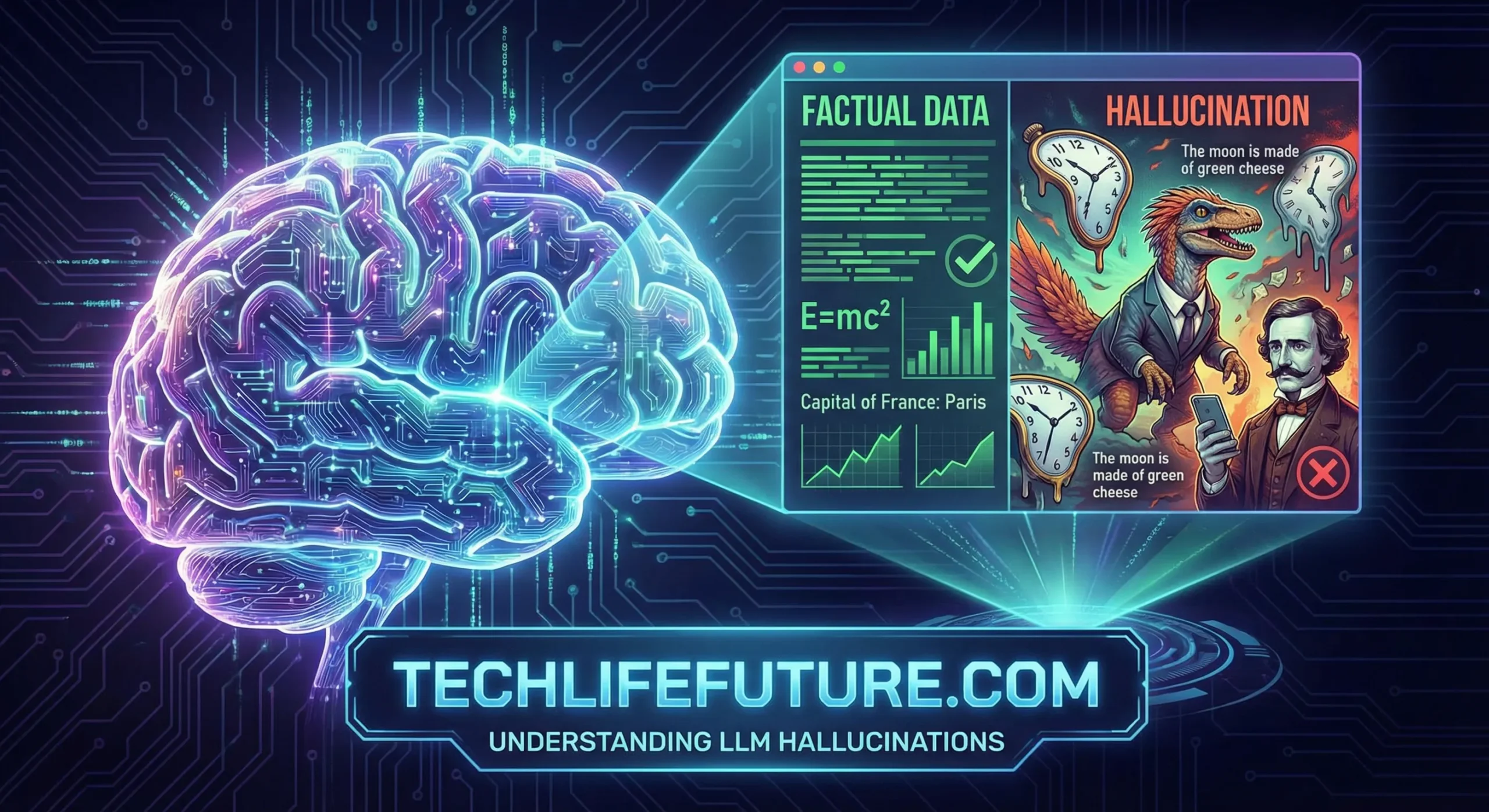
The phenomenon of LLM hallucinations has emerged as one of the most pressing challenges in artificial intelligence deployment. According to research published in ACM Computing Surveys, these cognitive distortions occur when language models generate information that isn’t based on actual data, with hallucination rates ranging from 10-30% depending on task complexity.
Key Takeaways
- LLM hallucinations affect 10-30% of AI outputs across various applications
- Detection requires both automated systems and human verification processes
- Retrieval-augmented generation (RAG) reduces hallucination rates by up to 40%
- Enterprise risk management demands comprehensive monitoring and guardrails
- Prompt engineering techniques can significantly improve output accuracy
The Growing Phenomenon of AI Confabulation
The rapid advancement of large language models has led to increased instances of AI confabulation, where systems generate plausible but factually incorrect information. Zhang et al. (2023) define this phenomenon as outputs that are “fluent and natural but contain factual errors or are entirely fabricated” [2].
The Rise of Large Language Models
Modern LLMs have revolutionized natural language processing through sophisticated transformer architectures processing vast datasets. However, this complexity introduces the challenge of AI hallucinations – a fundamental limitation rather than a simple bug that can be easily fixed.
When AI Gets Creative with Facts
The creative capabilities of large language models can result in factually inaccurate outputs ranging from minor inconsistencies to entirely fabricated content. Understanding these mechanisms is essential for developing reliable AI accuracy assessment frameworks.
What Are LLM Hallucinations: Defining AI-Generated Misinformation
LLM hallucinations represent instances where large language models produce content not grounded in reality or training data. Research published in Nature demonstrates that even state-of-the-art models exhibit these behaviors consistently across various domains [3].
Definition and Conceptual Framework
The conceptual framework for understanding AI hallucinations involves analysing how models process information and fill knowledge gaps with plausible-sounding but incorrect content. This occurs through the probabilistic nature of language generation, where models predict likely next tokens without true comprehension.
Distinguishing from Other AI Errors
It’s crucial to distinguish AI hallucinations from other errors like misinterpretations. Hallucinations involve generating entirely new, factually incorrect information rather than misprocessing existing data. This distinction guides targeted mitigation strategies for improving AI accuracy.
Recommended Reading
Master AI Fundamentals:“Artificial Intelligence: A Guide for Thinking Humans” by Melanie Mitchell provides essential understanding of AI limitations including hallucination phenomena. Read the review on Amazon by clicking HERE. Affiliate Link.
The Technical Roots of LLM Hallucinations
Several technical factors contribute to hallucination propensity in large language models, including neural architecture limitations and training data characteristics that affect overall AI accuracy.
Neural Architecture Limitations
Current transformer architectures have inherent constraints in capturing long-range dependencies effectively. According to OpenAI’s GPT-4 technical report, the reliance on self-attention mechanisms can lead to overfitting certain patterns while underfitting others.
Training Data Biases and Gaps
Training data quality significantly impacts LLM hallucination rates. Biases in datasets can cause models to learn and reproduce inaccurate information, while data gaps force models to generate content for topics with insufficient training examples.
The Probabilistic Generation Problem
LLMs generate text through probabilistic models that predict the next tokens based on context. This probabilistic nature creates inherent uncertainty, especially with incomplete or ambiguous inputs, leading to potential factual inaccuracies that compromise AI accuracy.
Detecting and Measuring LLM Hallucinations
Identifying AI hallucinations requires systematic approaches combining manual verification with automated detection systems to ensure reliable AI accuracy assessment.
Manual Verification Approaches
Manual verification involves human evaluators reviewing LLM outputs for inaccuracies. While effective for how to detect LLM hallucinations, this approach is resource-intensive and challenging to scale for large datasets.
Automated Detection Systems
Researchers are developing automated detection systems using algorithms to identify potential LLM hallucinations through cross-validation against trusted knowledge sources. Recent work by Farquhar et al. (2024) achieved 79% accuracy in detecting confabulations using semantic entropy measures.
Benchmark Datasets and Evaluation Metrics
Standardized benchmark datasets enable systematic evaluation of detection methods for AI hallucinations. Common metrics include precision, recall, and F1 scores for assessing detection system performance in various domains.
Technical Deep Dive: Detection Methods
Research Presentation: Advanced AI Hallucination Detection Techniques
Stanford researchers present innovative methods for detecting and measuring AI hallucinations in production systems.
Technical Strategies to Reduce LLM Hallucinations
Multiple technical approaches show promise for developing more reliable AI systems with reduced LLM hallucination rates and improved AI accuracy.
Retrieval-Augmented Generation (RAG)
Retrieval-augmented generation enhances LLM accuracy by incorporating external knowledge sources. Lewis et al. (2020) demonstrate that RAG systems significantly reduce hallucination likelihood by grounding responses in verifiable data, improving AI accuracy by up to 40%.
Reinforcement Learning from Human Feedback
Reinforcement Learning from Human Feedback improves model reliability through iterative human evaluation and correction. Ouyang et al. (2022) show this approach helps models learn from mistakes and adjust generation processes, reducing AI hallucinations substantially.
Knowledge Graph Integration
Knowledge Graph Integration links large language models to structured information sources containing verified entities and relationships. This integration provides factual grounding for more accurate, contextually relevant outputs.
The Impact of Prompt Engineering on Hallucination Rates
Prompt engineering significantly influences LLM hallucination frequency through careful input design and optimization strategies that improve AI accuracy.
Effective Prompt Design Principles
Wei et al. (2022) demonstrate that well-designed prompts incorporating specificity, contextualization, and conciseness can substantially reduce AI hallucination rates. Key principles for how to detect LLM hallucinations include clear expectations, sufficient background information, and avoiding overly complex instructions [8].
Chain-of-Thought and Tree-of-Thought Approaches
Chain-of-thought prompting encourages models to generate intermediate reasoning steps before final answers. This transparency makes the thinking process more accountable and reduces LLM hallucination likelihood by enabling better verification of reasoning chains.
Domain-Specific Challenges with LLM Hallucinations
AI hallucination impact varies significantly across different application domains, each presenting unique risks requiring specialized enterprise AI risk management approaches.
Healthcare and Medical Information
In healthcare, LLM hallucinations can have serious consequences including incorrect medical information or fabricated drug interactions. Medical applications require extremely high AI accuracy standards and robust verification processes to prevent patient harm.
Legal and Compliance Contexts
Legal applications face risks from fictitious precedents, incorrect regulatory interpretations, or fabricated compliance requirements. These errors can result in significant legal repercussions requiring comprehensive enterprise AI risk management protocols.
Financial and Business Decision-Making
Financial contexts face risks from incorrect market analysis, fabricated data, or misguided strategies. Enterprise AI risk management must include careful verification processes and multiple validation layers for critical business decisions.
Enterprise Best Practices for Managing Hallucination Risk
Effective enterprise AI risk management requires comprehensive strategies incorporating multiple protective measures to minimize LLM hallucination impact.
Implementation of Guardrails
Implementing guardrails prevents harmful or inaccurate content generation through input validation and output filtering mechanisms that scrutinize prompts and responses for potential AI hallucinations.
User Education Programs
User education programs train staff on effective LLM interaction, limitation understanding, and critical content evaluation. This includes training on how to detect LLM hallucinations and proper verification procedures.
Monitoring and Feedback Systems
Continuous monitoring and feedback systems enable real-time performance tracking, LLM hallucination flagging, and model refinement based on user input and system performance data.
Practical Guide for Users to Navigate LLM Outputs
Users need practical strategies for critically assessing and verifying LLM-generated content to identify potential AI hallucinations and ensure AI accuracy.
Critical Evaluation Strategies
Effective evaluation involves understanding usage context, assessing information relevance and accuracy, and maintaining awareness of potential LLM hallucinations throughout the verification process.
Cross-Verification Techniques
Cross-verifying outputs with credible sources ensures information accuracy through systematic comparison with established databases, academic research, and trusted sources, essential for preventing AI-generated misinformation.
Frequently Asked Questions About LLM Hallucinations
Q1: What percentage of AI responses contain hallucinations?
Research indicates LLM hallucination rates vary from 10-30% depending on the model, task complexity, and domain. More complex queries typically have higher hallucination rates.
Q2: How to detect LLM hallucinations without technical expertise?
Users can identify potential AI hallucinations by cross-referencing information with trusted sources, looking for logical inconsistencies, and being cautious of unverifiable claims or overly specific details.
Q3: Are newer AI models less prone to hallucinations?
Generally, newer models show improvement in AI accuracy, but even the most advanced systems still exhibit LLM hallucination behavior. Ongoing research continues to address this challenge.
Q4: What industries require the strongest AI hallucination prevention?
Healthcare, legal, finance, and education face elevated risks requiring robust enterprise AI risk management due to accuracy requirements and potential consequences of misinformation.
Q5: How do RAG systems improve AI accuracy?
Retrieval-augmented generation systems ground responses in verified external knowledge sources, significantly reducing AI hallucinations by providing factual foundations for model outputs.
Q6: Can prompt engineering prevent AI-generated misinformation?
Effective prompt engineering techniques can reduce LLM hallucination rates by 20-40% through clear instructions, context specification, and constraint definition.
Q7: What are the most effective AI hallucination detection methods?
Combining automated semantic entropy analysis with human verification provides the most reliable approach for detecting LLM hallucinations in production systems.
Q8: How should enterprises implement AI risk management?
Enterprise AI risk management requires multi-layered approaches, including guardrails, monitoring systems, user training, and regular auditing of AI outputs.
Q9: What role does training data play in AI accuracy?
High-quality, diverse training data significantly improves AI accuracy and reduces LLM hallucination rates by providing better foundational knowledge for model responses.
Q10: Are AI hallucinations always problematic?
While AI hallucinations are problematic for factual applications, they can be beneficial in creative contexts where novel idea generation is desired, provided they’re properly labeled.
Conclusion: Toward More Truthful AI Systems
Developing more truthful AI systems remains crucial as large language models become increasingly integrated into daily life. Understanding LLM hallucination mechanisms, implementing detection strategies, and applying mitigation techniques are essential steps toward reliable AI deployment with improved AI accuracy.
The path forward requires continued research, industry collaboration, and user education to create AI systems that are both powerful and trustworthy. Through comprehensive enterprise AI risk management and effective strategies for preventing AI-generated misinformation, we can enhance AI’s value while maintaining the reliability necessary for critical applications.
About the Author & Disclosures
John Cosstick is Founder-Editor of TechLifeFuture.com and winner of the 2024 BOLD Award for Open Innovation in Digital Industries. He is a former banker, accountant, and certified financial planner. He is now a freelance journalist and author. John is a member of the Media Entertainment and Arts Alliance (Union). You can visit his Amazon author page by clicking HERE.
Additional Resources
Technical Deep Dive: “Designing Machine Learning Systems” by Chip Huyen – Essential reading for understanding production ML systems and hallucination mitigation strategies. Read the review on Amazon by clicking HERE. Amazon Affiliate Link.
Research Foundation:“The Alignment Problem” by Brian Christian – Comprehensive exploration of AI safety and reliability challenges, including hallucination phenomena. Read the review on Amazon by clicking HERE. Amazon Affiliate Link.
Verified Citations
- Ji, Z., Lee, N., Frieske, R., Yu, T., Su, D., Xu, Y., … & Fung, P. (2023). Survey of hallucination in natural language generation. ACM Computing Surveys, 55(12), 1-38.
- Zhang, Y., Li, S., Jiang, L., Liu, M., & Zhou, S. (2023). Siren’s Song in the AI Ocean: A Survey on Hallucination in Large Language Models. arXiv preprint arXiv:2309.01219.
- Farquhar, S., Kossen, J., Kuhn, L., & Gal, Y. (2024). Detecting hallucinations in large language models using semantic entropy. Nature, 630, 625-630.
- OpenAI. (2024). GPT-4 Technical Report. OpenAI Research. https://arxiv.org/abs/2303.08774
- Farquhar, S., Kossen, J., Kuhn, L., & Gal, Y. (2024). Detecting hallucinations in large language models using semantic entropy. Nature, 630, 625-630.
- Lewis, P., Perez, E., Piktus, A., Petroni, F., Karpukhin, V., Goyal, N., … & Kiela, D. (2020). Retrieval-augmented generation for knowledge-intensive nlp tasks. Advances in neural information processing systems, 33, 9459-9474.
- Ouyang, L., Wu, J., Jiang, X., Almeida, D., Wainwright, C., Mishkin, P., … & Lowe, R. (2022). Training language models to follow instructions with human feedback. Advances in Neural Information Processing Systems, 35, 27730-27744.
- Wei, J., Wang, X., Schuurmans, D., Bosma, M., Xia, F., Chi, E., … & Zhou, D. (2022). Chain-of-thought prompting elicits reasoning in large language models. Advances in neural information processing systems, 35, 24824-24837.