Why runtime evidence capture is redefining accountability, legal defensibility, and insurability for every board deploying AI today.
AI telemetry governance: Governance Without Proof Is Just Paper
Here is the uncomfortable truth: your next board meeting won’t say out loud that most AI governance frameworks in operation today cannot answer a single forensic question. Not because the policies are weak. Not because the intent isn’t there. But because the architecture to prove what actually happened – at the moment your AI system acted – simply doesn’t exist.
That gap has a name. Call it Governance Theatre – the institutional habit of substituting documentation for accountability, producing the appearance of responsible AI without the infrastructure to back it up.
This article is written for the people who carry that accountability: board directors, chief risk officers, compliance leads, legal counsel, and the insurers who price the risk of getting it wrong. It is not a technical paper. It is a governance argument with technical foundations – and it leads to one conclusion.
Governance without telemetry is not governance. It is documentation.
This article maps the problem (the governance gap), defines the solution (AI telemetry), traces the regulatory trajectory, connects the insurance implications, and delivers a board-ready checklist for action.
It is designed to be read once—then acted on.
The Governance Gap: Policies Without Proof
Static Governance vs Runtime Governance
When organisations talk about AI governance, they almost always mean one of two things: principles documents or usage policies. At best, they add vendor agreements, risk registers, and perhaps an annual AI audit. These are valuable. They are also insufficient.
Here is the distinction that matters. Static governance captures what an organisation says it will do. Runtime governance captures what it can prove happened. The gap between those two things is where liability accumulates – silently, steadily, and entirely invisibly until something goes wrong.
Survey data consistently shows high rates of AI adoption alongside low rates of governance maturity. Deloitte’s State of AI in the Enterprise (2026) – drawing on 3,235 leaders across 24 countries – found that only one in five organisations has a mature governance model for autonomous AI agents. KPMG’s Trust in AI: Global Insights (2025), conducted with the University of Melbourne across 47 countries, found that only 40 per cent of workplaces have any policy or guidance on generative AI use. IBM’s Institute for Business Value research tracks the same pattern globally.
Organisations are deploying faster than their governance infrastructure can follow. The result is a growing population of AI systems operating at runtime with no structured evidence layer beneath them.
Introducing: Governance Theatre
Governance Theatre is the institutional tendency to substitute documentation for accountability. It produces the appearance of responsible AI without the infrastructure to support it. It is not necessarily dishonest – in most cases it reflects a genuine belief that having a policy is equivalent to managing a risk. It isn’t.
A policy describes what should happen. Telemetry records what actually did.
The distinction becomes devastating in a courtroom, in a regulatory inquiry, or in a coverage dispute with your insurer. No policy – however carefully drafted – constitutes evidence of what your AI system actually decided, for whom, when, and under what conditions.
The Governance Defensibility Grid
Where does your organisation sit in this grid?
| Governance Layer | What It Captures | Legal Defensibility |
|---|---|---|
| Principles & ethics statements | Intent | None |
| Usage policies | Expected behaviour | Low |
| Documentation & audits | Pre-deployment state | Partial |
| Runtime telemetry | Actual system behaviour | High |
Defining AI Telemetry: The Architecture of Evidence
The Core Definition
Before we get into what telemetry does, let’s be precise about what it is. Here is the working definition that governs everything that follows:
AI telemetry is the continuous, structured, and immutable capture of system activity at runtime – recording inputs, outputs, reasoning traces, human oversight actions, and control triggers – for the purpose of forensic reconstruction and legal defensibility.
That definition has six load-bearing components. Each one matters. Lose any of them and the evidence layer starts to fail.
The Six Components of AI Telemetry
1. Inputs
Think of this as the question the AI was asked. What data, prompts, or requests entered the system? What context did it receive? This is the starting point for every forensic reconstruction – and without it, causation is impossible to establish.
2. Outputs
The answer the system gave. What did it produce, recommend, or action? In high-stakes domains – loan decisions, medical triage, legal advice – the output is often the thing that causes harm. Capturing it precisely is non-negotiable.
3. Reasoning Traces
This is where AI governance gets technically complex. A reasoning trace captures the intermediate steps the model took – the logic path between input and output. Think of it as the working shown on a maths exam. Without it, you can see the answer. You cannot explain how it was reached.
4. Human Oversight Events
Where did a human review, approve, override, or escalate? When? Who was it? This is the evidentiary foundation of the Verifiable Human Contribution (VHC) protocol – and without it, claims of meaningful human oversight are assertions, not facts.
5. Control Triggers
System-defined thresholds that activated guardrails, escalation pathways, or refusal mechanisms. Did the system flag a high-risk output? Did it escalate to a human reviewer? Was that escalation path followed? Telemetry answers all of this.
6. Identity and Timestamps
Who interacted with the system, which model version acted, and precisely when, accurate to at least millisecond precision. Identity-linked timestamps are what convert a log file into a legal document.
The Flight Data Recorder Analogy
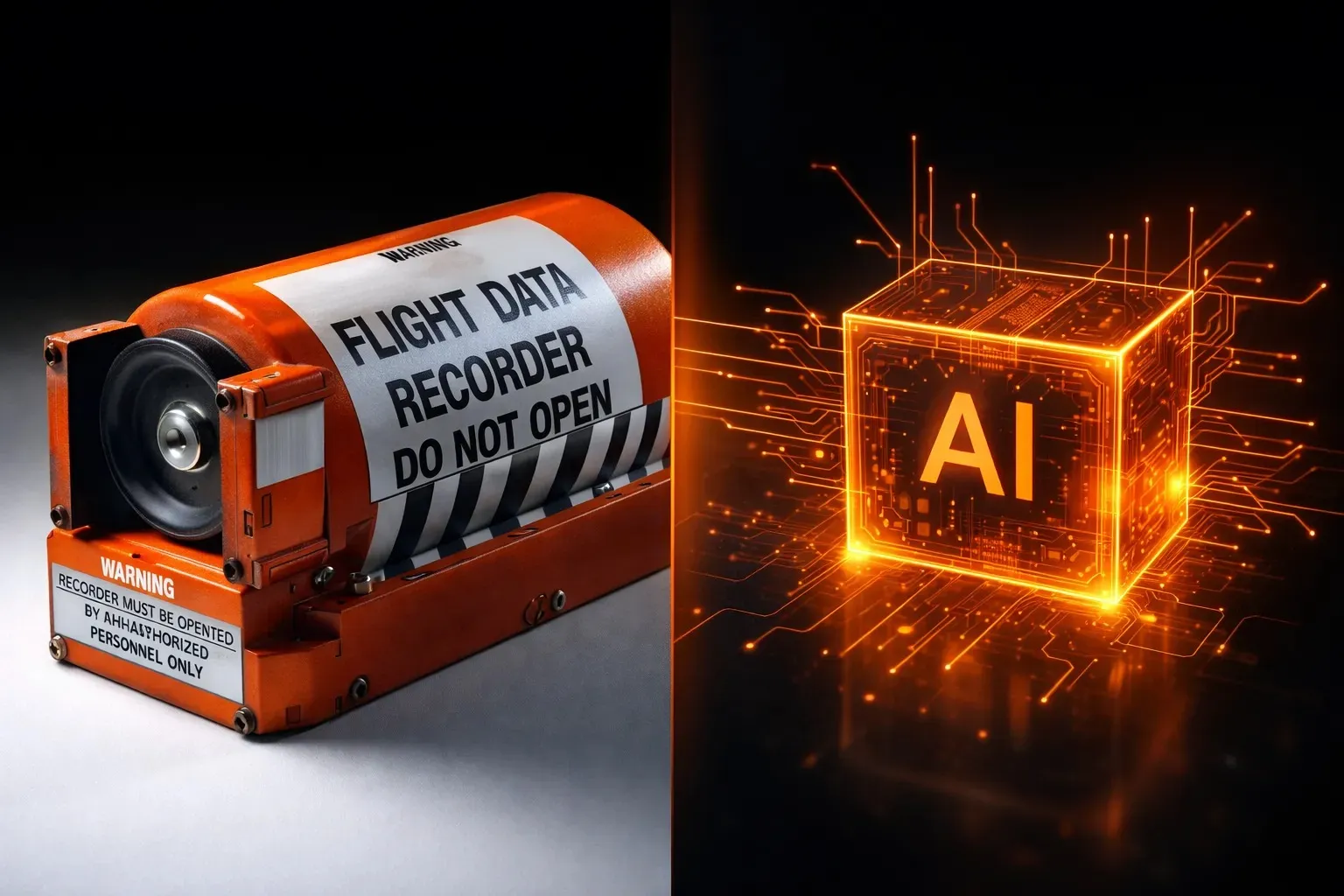
The best analogy in the physical world is the aviation flight data recorder – the black box. The FDR does not prevent crashes. What it does is make every crash forensically reconstructable: what the aircraft was doing, what inputs the pilots gave, what the systems responded to, and in what sequence. That reconstruction capacity is precisely what AI telemetry delivers for automated systems.
And crucially, it also does something proactive: the existence of the FDR changes how aviation systems are designed, because engineers know that every action will be recorded. That accountability effect is a secondary benefit of AI telemetry that boards should anticipate.
Telemetry vs Observability: A Critical Distinction
The Category Error Most Technical Teams Make
Picture this. A board is notified that an AI system has caused client harm. The engineering team brings the monitoring dashboards. Uptime: 99.97%. Error rate: nominal. Latency: within parameters. The system, by every operational metric, was running perfectly.
What the dashboards cannot show is what decision the model made. On what input? With what confidence level? Reviewed by whom, if anyone. At what precise moment?
That is the observability-telemetry gap – and it is the gap between a defensible board position and an indefensible one.
Observability explains systems. Telemetry defends them.
A Direct Comparison
| Dimension | Observability | AI Telemetry |
|---|---|---|
| Primary purpose | Operational performance | Legal and regulatory defensibility |
| Data captured | Errors, latency, uptime | Inputs, outputs, decisions, oversight |
| Audience | DevOps and engineering | Risk, legal, compliance, boards |
| Temporal focus | Real-time diagnosis | Forensic reconstruction |
| Retention horizon | Short (days to weeks) | Long (years, regulatory minimum) |
| Immutability | Not required | Required |
| Regulatory function | None | Evidence layer for EU AI Act, ISO 42001, NIST |
This is not a technical nicety. It is the difference between having a governance framework and having one that actually works when you need it. Organisations that have invested in observability infrastructure have made the right operational investment. What they have not done – in most cases – is build the adjacent evidence layer that regulators, insurers, and courts will require.
The Rise of the AI Black Box Requirement
We Have Been Here Before
The question of whether AI systems should carry a mandatory evidence capture layer is not new – the framing is. Every major category of automated system has followed the same trajectory: voluntary adoption, incident accumulation, regulatory mandate, industry normalisation.
Aviation and automotive tell the same story in different decades.
Aviation: The Flight Data Recorder
When flight data recorders were first proposed, the aviation industry resisted. The concerns were familiar: cost, implementation complexity, and the competitive sensitivity of operational data. None of those objections survived the first major accident investigations that the FDR resolved decisively.
The International Civil Aviation Organisation (ICAO) codified mandatory flight recorder requirements through Annex 6 to the Convention on International Civil Aviation. The outcome – decades later – is unambiguous: accident investigation was transformed, liability allocation became precise, and aviation safety improved because every incident created a reconstructable record that fed back into the system.
The FDR did not prevent crashes. It made every crash accountable. That accountability loop is what drove safety improvement. AI telemetry operates on the same principle.
Automotive: The Event Data Recorder
In automotive, Event Data Recorder (EDR) data is now routinely admitted in civil litigation and insurance proceedings across the United States, the European Union, and Australia. US regulations under 49 CFR Part 563 standardised EDR requirements for passenger vehicles, and the EU’s General Safety Regulation 2 (GSR2) extended equivalent obligations to European markets.
Actuaries and underwriters now price automotive risk partly on EDR data availability. An insurer assessing a fleet of vehicles without EDR capability prices that uncertainty into the premium. The same logic is arriving in AI liability insurance – just faster, because the claims cycle is shorter.
The Question That Frames Everything
The issue is not whether AI systems will be required to carry a black box equivalent.
Instead, it is whether your organisation will be ahead of that requirement—or behind it—when liability is allocated.
Agentic AI and the Collapse of Manual Oversight
What Agentic AI Actually Means for Governance
There is a class of AI deployment that most governance frameworks were not designed for – and which makes the telemetry gap genuinely urgent rather than theoretically important.
Agentic AI systems don’t just respond to queries. They execute. A single user prompt can trigger dozens of downstream model calls, API interactions, database writes, and system state changes – across multiple platforms, often in seconds, at a scale no human reviewer can monitor in real time.
This is not hypothetical. It is the current production reality in automated loan decisioning systems, AI-assisted medical triage platforms, legal document review pipelines, and financial advice generation tools. These systems are acting autonomously, in high-stakes domains, right now.
Three Risk Vectors That Telemetry Must Address
1. Autonomous Decision Chains
In an agentic pipeline, the system that initiates an action is rarely the system that completes it. A prompt enters at one end; a cascade of decisions, retrievals, and outputs emerges at the other. Without telemetry capturing every step in that chain – with timestamps, identity links, and context – the connection between cause and outcome is severed. When something goes wrong, you cannot establish what triggered it.
2. Prompt Injection
Agentic systems are vulnerable to prompt injection – where malicious or unintended inputs redirect the system’s behaviour mid-chain. The risk is not merely technical. It is evident. Without timestamped input capture, an organisation cannot establish that the harm-causing decision was the result of injection rather than design. That distinction is everything in a liability proceeding.
3. Silent Failures
Perhaps the most insidious risk vector. Agentic systems can produce outputs that appear entirely normal but carry embedded errors – in the reasoning, in the retrieved context, in the confidence weighting applied to competing options. Without reasoning trace capture, these failures are invisible until the harm has already propagated through downstream decisions and affected real people.
In agentic AI, the absence of telemetry is not a gap in reporting. It is the absence of accountability itself.
Telemetry and the Insurance Cliff
How the Insurance Market Is Evolving
The AI insurance market is undergoing the fastest maturation cycle in the history of technology risk coverage. What began as AI risk absorbed silently into general professional indemnity and errors & omissions policies – because underwriters simply did not know what to price – is rapidly becoming an explicit and conditioned coverage question.
The parallel with cyber insurance is exact. In the mid-2000s, cyber risk was absorbed into general commercial policies without explicit terms. Claims emerged. Underwriters paid. They then demanded controls: multi-factor authentication, patch management cadences, and incident response plans. Organisations without those controls found themselves facing exclusions, sublimits, and eventually, uninsurability at any reasonable premium.
AI is following that arc – but faster, because the claims cycle is compressing.
The Three Phases of AI Insurance Coverage
| Phase | Coverage Posture | Driver |
|---|---|---|
| Silent AI | AI risk absorbed into general PI/E&O without explicit terms | Lack of awareness |
| Affirmative AI | Explicit AI exclusions or endorsements introduced | Claims emergence |
| Warranty-Based AI | Coverage conditioned on governance, oversight, and telemetry evidence | Underwriting maturity |
What Underwriters Are Now Asking
These questions are emerging in the market. Risk managers preparing for policy renewals should expect to encounter all of them:
- Does your AI system produce auditable logs of inputs and outputs?
- Is there a documented human oversight pathway for high-stakes decisions?
- Can you reconstruct any specific decision made by your AI in the past 12 months?
- Is telemetry data immutable and tamper-evident?
Munich Re, which has been publicly active in developing AI risk assessment frameworks, has acknowledged the role of AI governance evidence in underwriting AI risk. The direction is clear: governance documentation is necessary but no longer sufficient.
Underwriters are beginning to price the difference between organisations that can demonstrate runtime accountability and those that cannot.
For risk managers: review your current PI and E&O policy wording for AI exclusions before your next renewal. The window to address this proactively is narrowing.
Telemetry converts AI from uninsurable uncertainty to measurable, priceable risk.
Telemetry as the Foundation of Governance Frameworks
Where Telemetry Fits in the Governance Stack
Proprietary governance frameworks – including the TechLifeFuture AI Governance stack – are only as strong as the data layer beneath them. Telemetry is that layer. Without it, governance frameworks describe intent. With it, they record performance.
Four framework integrations make this concrete.
GAS – Governance Artifact System
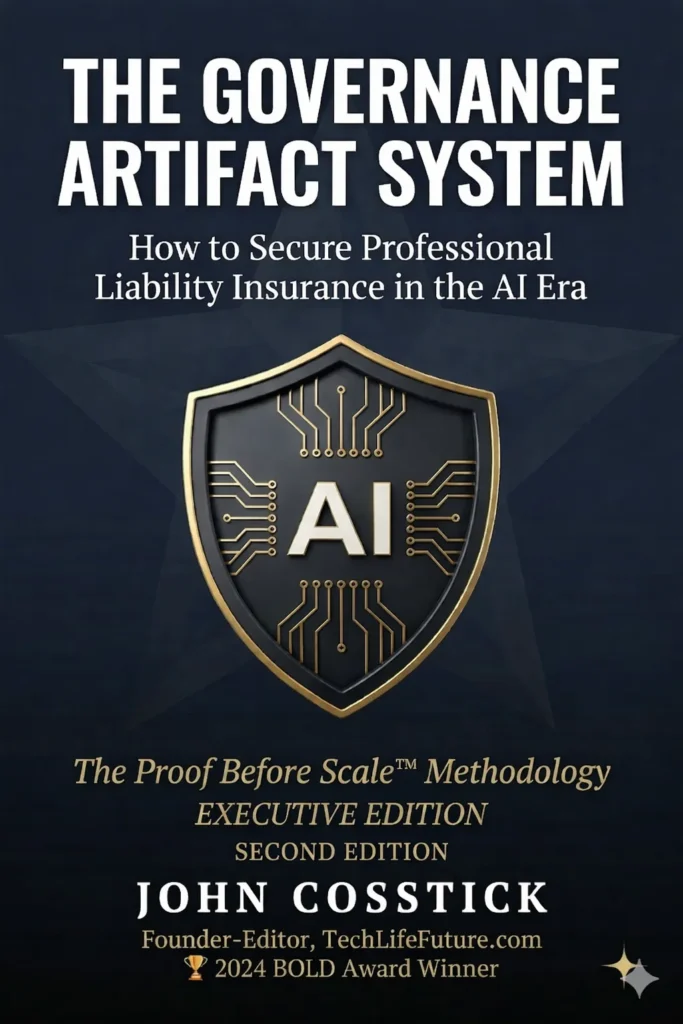
The Governance Artifact System (GAS) provides structure for AI governance documentation – the artefacts that capture decisions, policies, and accountability chains. Telemetry is the data source that populates those artefacts with runtime evidence. Without telemetry, GAS artefacts describe what was intended. With it, they record what happened.
GAS gives governance its structure; telemetry gives it its truth.
AIMS – AI Management System
AIMS defines the enforcement triggers – the conditions under which human escalation or system override must occur. Telemetry is the detection layer that identifies when a trigger condition has been reached. Without telemetry, AIMS triggers are aspirational. With it, they are operational.
AIMS sets the rules; telemetry enforces them.
VHC – Verifiable Human Contribution
The Verifiable Human Contribution (VHC) protocol establishes the standard for proving that a human meaningfully contributed to an AI-assisted output. This matters for professional liability, for regulatory compliance, and for the intellectual property questions emerging around AI-assisted professional work. Telemetry is the mechanism that records the human oversight event – when it occurred, what was reviewed, and what decision was made.
The VHC framework is the subject of patent applications AU 2025220863 and PCT/IB2025/058808. The technical foundation of both applications rests on telemetry as the evidence layer that makes human contribution claims verifiable.
VHC is a claim; telemetry is the proof.
PBS – Proof Before Scale
Proof Before Scale (PBS) is a methodology that requires validated performance evidence before deployment is expanded. Telemetry provides the dataset from which that proof is derived. Without telemetry, PBS decisions rest on assumptions. With it, they rest on evidence.
PBS is the methodology; telemetry is the measurement.
The convergence point is clear: every element of a mature AI governance framework points back to the same foundational requirement. You cannot govern what you cannot see. And you cannot see what you do not record.
What Good Telemetry Looks Like: The Technical Standard
Four Non-Negotiable Properties
If you are evaluating an AI system’s telemetry capability – whether as a CISO, a risk officer, or a board director – these four properties constitute the minimum standard. Not aspirational. Minimum.
1. Immutable
Telemetry records must be tamper-evident and write-once. Any modification to a log must itself be logged. The standard here is directly analogous to financial audit trail requirements – the integrity of the record is itself a governance asset. An immutable log is a legal document. A mutable one is a liability.
2. Identity-Linked
Every log entry must be associated with a specific model version, deployment instance, user or system identity, and timestamp accurate to at least millisecond precision. Without identity linkage, you have a record of events. You do not have a record of accountable events.
3. Context-Rich
Logs must capture not just the output but the full decision context: the input data, model parameters, confidence scores where available, and any retrieved or injected context. A log that records only the output is a receipt. A log that records the full context is evidence.
4. Selectively Disclosable
Organisations must be able to produce specific log extracts for regulators, insurers, or legal proceedings without exposing the entire telemetry corpus. Privacy-preserving disclosure architecture is a design requirement, not an afterthought. This is particularly significant in jurisdictions where AI logs may contain personal data subject to privacy regulation – including Australia’s Privacy Act 1988 and the EU’s General Data Protection Regulation.
Advanced Architecture Signals
For technical teams implementing AI telemetry, three architectural approaches provide the immutability and integrity guarantees the standard requires:
- Merkle trees – cryptographic chaining that makes any retrospective alteration of log sequences detectable. Even a single changed byte in a historical record invalidates the chain.
- WORM storage (Write Once, Read Many) – the storage architecture that enforces immutability at the infrastructure level. Data written to WORM storage cannot be overwritten or deleted during the retention period.
- Forward-only key rotation – cryptographic key management that prevents retrospective decryption of historical records, ensuring that access to future logs does not compromise the integrity of historical ones.
These are not unusual requirements. They are the same standards applied to financial transaction logs, medical records, and legal discovery archives. AI governance should meet the same bar.
Regulatory Trajectory: Evidence-Based AI Governance
The Direction of Travel Is Clear
Regulators will not write the word ‘telemetry’ into law. What they will do – and are already doing – is mandate auditability, logging, and reconstruction capacity. All of which telemetry makes possible. All of which are impossible without it.
EU AI Act – Article 12 (Logging Requirements)
The EU AI Act (Regulation (EU) 2024/1689) includes specific logging requirements for high-risk AI systems under Article 12. High-risk AI systems must maintain automatic logs enabling post-deployment monitoring for the duration specified in the regulation. The Act does not prescribe telemetry architecture – it mandates the outcomes that telemetry delivers.
For organisations operating in or serving EU markets, Article 12 compliance is not optional. For those outside the EU, it establishes the emerging international standard that other jurisdictions are referencing in their own framework development.
Reference: https://eur-lex.europa.eu/legal-content/EN/TXT/?uri=CELEX:32024R1689
ISO 42001 – AI Management System Standard
ISO/IEC 42001:2023 establishes the requirements for an AI management system. Clause 9 (Performance Evaluation) requires measurement, analysis, and evaluation of AI system performance. Clause 10 (Improvement) requires documented evidence of corrective action. Both clauses require a data layer, and telemetry is that layer.
ISO 42001 certification is emerging as a baseline expectation for enterprise AI procurement and – increasingly – as a condition of AI liability insurance coverage.
Reference: https://www.iso.org/standard/42001
NIST AI Risk Management Framework – Measure Function
The National Institute of Standards and Technology (NIST) AI Risk Management Framework 1.0 (January 2023) includes an explicit Measure function requiring quantitative assessment of AI system behaviour. Measure 2.5 specifically requires documentation of AI system outputs and their impacts – the operational definition of what telemetry captures.
Reference: https://nvlpubs.nist.gov/nistpubs/ai/NIST.AI.100-1.pdf
Australian Context
The Australian Government’s AI governance approach has evolved through the voluntary AI Safety Standard published by the Department of Industry, Science and Resources (DISR). Organisations operating under Australian law should monitor DISR’s ongoing work on mandatory AI governance frameworks, as the trajectory is towards binding obligations for high-risk AI deployments – tracking the EU’s lead while accounting for Australia’s regulatory environment.
Reference: https://www.industry.gov.au/publications/voluntary-ai-safety-standard
Regulators will not write the word ‘telemetry’ into law. They will instead require auditability, logging, and reconstruction – all of which telemetry makes possible and all of which are impossible without it.
Strategic Implications for Boards and Directors
This Is a Legal Duty Question
Let’s be direct. This is not an operational IT question. It is a corporate governance question – and it carries personal liability implications for directors in every major jurisdiction where AI-deploying organisations operate.
Duty of Care
Directors carry a duty to implement systems that prevent foreseeable harm. In jurisdictions where AI governance frameworks are hardening – including Australia, where the Corporations Act section 180 codifies the duty of care and diligence – a board that has not implemented a telemetry layer for high-stakes AI systems is increasingly difficult to defend as having discharged that duty. The foreseeability of AI-related harm is no longer speculative. It is documented. Courts and regulators will ask what you did about it.
Caremark and Its Australian Equivalents
In US corporate governance, the Caremark doctrine establishes that boards that fail to implement oversight systems for known risk areas can face personal liability. The Australian equivalent, grounded in the Corporations Act duty of care and diligence, creates a similar exposure.
A board that cannot demonstrate it understands the AI risk landscape, implements appropriate oversight infrastructure, and monitors its effectiveness is exposed. Telemetry is that oversight infrastructure.
AI Washing Risk
Boards that publicly claim robust AI governance frameworks – in annual reports, in investor communications, in ESG disclosures – but cannot produce runtime evidence when challenged face regulatory action for misrepresentation.
The Australian Securities and Investments Commission (ASIC) has signalled increasing attention to technology-related governance claims. The gap between declared governance and evidential governance is precisely where AI washing risk sits.
The Board Telemetry Readiness Checklist
Take this to your next risk committee meeting. If you cannot answer yes to all six questions, the gap is not theoretical – it is immediate.
- Has the board been briefed on which AI systems are operating at runtime in client-facing or high-stakes contexts?
- Does the organisation have a documented telemetry standard for AI systems?
- Can the organisation reconstruct any specific AI decision made in the past 12 months?
- Has the current PI/E&O/cyber insurance programme been reviewed against AI telemetry requirements?
- Is there a named executive responsible for AI telemetry governance?
- Is the telemetry retention policy documented and legally reviewed?
Conclusion: The Shift to the Era of Evidence
AI governance has been dominated by policy design for a simple reason: policies are easy to produce and comfortable to present. They satisfy the appearance requirement of governance without requiring the infrastructure investment, the organisational commitment, or the leadership courage that evidence-based governance demands. That is precisely why telemetry remains the missing layer.
But the absence of a telemetry layer is not a passive gap. It is an active accumulation of undocumented liability. Every AI system operating today without structured runtime evidence capture is producing decisions that cannot be reconstructed, oversight claims that cannot be verified, and governance assertions that cannot be defended.
The organisations that will lead in AI governance are not those with the most comprehensive policy documents. They are those that can answer a single question on demand: what did your AI system do, for whom, when, why, and who was responsible?
The future of AI governance will not be written in policies. It will be recorded in telemetry.
FAQ: AI Telemetry Governance
Q1: What is AI telemetry?
AI telemetry is the continuous, structured capture of AI system activity at runtime – including inputs, outputs, reasoning traces, and human oversight events – for governance, compliance, and legal defensibility purposes. It is the evidence layer that separates documented AI governance from provable AI governance.
Q2: Why is AI telemetry different from AI monitoring?
Monitoring tracks operational performance in real time – it answers ‘Is the system working?’ Telemetry creates an immutable forensic record for retrospective reconstruction – it answers ‘what did the system do, and can we prove it?’ Monitoring is an operational tool. Telemetry is a governance instrument.
Q3: Is AI telemetry required by law?
Not under that specific name. However, the EU AI Act Article 12 requires logging for high-risk AI systems, ISO/IEC 42001:2023 requires performance measurement evidence, and NIST AI RMF mandates measurable oversight. Telemetry is the infrastructure that satisfies all three requirements.
Australian organisations should monitor DISR guidance for emerging mandatory obligations.
Q4: What happens if my AI system has no telemetry?
Without telemetry, you cannot reconstruct what your AI system decided, prove human oversight occurred, satisfy regulatory evidence requirements, or defend a liability claim. Your governance framework is documentation without proof – and in a legal or regulatory proceeding, that distinction is everything.
Q5: Does AI telemetry affect insurance coverage?
Increasingly yes. Underwriters in the AI liability and professional indemnity space are beginning to condition coverage on evidence of governance controls. Organisations without telemetry may face exclusions, sublimits, or higher premiums as the market matures – following the same arc as cyber insurance a decade earlier.
Q6: What is Governance Theatre?
Governance Theatre is the institutional tendency to substitute documentation for accountability.
This creates the appearance of responsible AI without the infrastructure to support it.
In most cases, it reflects a genuine belief that having a policy is equivalent to managing risk, not deliberate dishonesty.
Q7: How long should AI telemetry data be retained?
Retention requirements vary by jurisdiction and sector. EU AI Act high-risk systems require logs retained for a minimum period post-deployment (verify current final text). As a baseline, retention should match the organisation’s professional indemnity and regulatory exposure horizon – typically three to seven years, aligned with legal proceedings limitation periods.
Q8: What is the Verifiable Human Contribution (VHC) protocol?
The VHC protocol establishes a standard for proving that a human meaningfully contributed to an AI-assisted output. Telemetry is the mechanism that records and preserves the evidence of that contribution – timestamps, review actions, and approval events – making VHC claims legally defensible.
Patent applications AU 2025220863 and PCT/IB2025/058808 cover the technical implementation.
Q9: What does good AI telemetry look like technically?
Good AI telemetry is immutable, identity-linked, context-rich, and selectively disclosable. It uses architectures such as WORM storage, Merkle-tree chaining, and forward-only key rotation to ensure tamper-evidence and long-term integrity. These four properties constitute the minimum standard – not an aspirational one.
Q10: How should boards start implementing AI telemetry?
Begin with a telemetry readiness audit: identify all runtime AI systems, assess whether each produces a structured, immutable activity log, determine who owns that log and for how long it is retained, and verify your position against the board checklist in Section 11 of this article. Assign named executive accountability before taking any further steps.
Authority Reference Links
Regulatory & Standards References:
- https://eur-lex.europa.eu/legal-content/EN/TXT/?uri=CELEX:32024R1689
- https://eur-lex.europa.eu/legal-content/EN/TXT/?uri=CELEX:32024R1689#d1e2789-1-1
- https://www.iso.org/standard/42001
- https://nvlpubs.nist.gov/nistpubs/ai/NIST.AI.100-1.pdf
- https://www.industry.gov.au/publications/voluntary-ai-safety-standard
- https://www.legislation.gov.au/C2018A00013/latest/text
- https://www.legislation.gov.au/C2004A01611/2023-08-12/text
Contextual References:
- https://www.munichre.com/en/solutions/for-industry-clients/insure-ai/ai-whitepaper.html
- https://kpmg.com/xx/en/our-insights.html
- https://eur-lex.europa.eu/legal-content/EN/TXT/?uri=CELEX:32019R2144
- https://www.ibm.com/thought-leadership/institute-business-value/en-us/report/ceo-generative-ai
About the Author
John Cosstick is the Founder-Editor of TechLifeFuture.com and a 2024 BOLD Award Winner for Open Innovation in Digital Industries. A Certified Financial Planner and former bank compliance manager, he has contributed to the UK Money and Pensions Service Debt Review and UN AIforGood initiatives.
He is the inventor of the Verifiable Human Contribution (VHC) framework, with patent applications pending with IP Australia (AU 2025220863) and WIPO (PCT/IB2025/058808). The Governance Artifact System™ is his flagship AI governance publication.
Required Editorial Disclosures
Citation Accuracy & Verification Statement
At TechLifeFuture, every article undergoes a multi-step fact-checking and citation audit process. We verify technical claims, research findings, and statistics against primary sources, authoritative journals, and trusted industry publications. Our editorial team adheres to Google’s EEAT (Expertise, Experience, Authoritativeness, and Trustworthiness) principles to ensure content integrity.
If you have questions about any references used or would like to suggest improvements, please contact us at [email protected] with the subject line: Citation Feedback.
Amazon Affiliate Disclosure
We are a participant in the Amazon Services LLC Associates Program, an affiliate advertising program designed to provide a means for us to earn fees by linking to Amazon.com and affiliated sites. If you click on an Amazon link and make a purchase, we may earn a small commission at no extra cost to you.
General Affiliate Disclosure
Some links in this article may be affiliate links. This means we may receive a commission if you sign up or purchase through those links, at no additional cost to you. Our editorial content remains independent, unbiased, and grounded in research and expertise. We only recommend tools, platforms, or courses we believe bring real value to our readers.
Legal and Professional Disclaimer
The content on TechLifeFuture.com is for educational and informational purposes only and does not constitute professional advice, consultation, or services. AI technologies evolve rapidly and vary in application. Always consult qualified professionals-such as data scientists, AI engineers, or legal experts-before implementing any strategies or technologies discussed. TechLifeFuture assumes no liability for actions taken based on this content.
This article reflects AI governance, insurance market, and professional services practices as of 10 April 2026 (AEST). Readers should confirm whether subsequent guidance has been issued by their professional bodies or relevant regulators.
The Governance Artifact System™, Verifiable Human Contribution (VHC), Proof Before Scale™, and related framework terms are trademarks and patent-pending intellectual property of John Cosstick. Some links in this article may be affiliate or referral links. If you purchase through these links, TechLifeFuture.com may earn a small commission at no extra cost to you.
This article was researched and written by a human author and reviewed under TechLifeFuture’s citation-verification and EEAT-aligned editorial process.
© 2026 TechLifeFuture.com | Creative Commons BY-NC 4.0.