AI telemetry professional indemnity
Here is the question worth sitting with before the next professional indemnity (PI) renewal lands on your desk: when an underwriter investigates a claim involving AI-assisted advice, what will your file actually prove?
That question became considerably more urgent on 1 January 2026. Two insurance forms — ISO Form CG 40 47 and Berkley Form PC 51380 — moved AI exposure from soft implication to explicit contractual reality. In many policy configurations, the exclusion is now absolute. The conversation about whether AI creates professional risk is finished. The conversation about what you can prove about how you governed it has barely begun.
Telemetry, in this context, is not a technology term. It is the structured, timestamped, tamper-evident record of how humans governed the AI outputs delivered to clients. Think of it as the audit trail that either supports or undermines every professional oversight warranty your firm has made — or is about to make — to its insurer.
This article is written for principals and sole practitioners of accounting firms, financial planning practices, law firms, tax agencies, audit shops and consulting firms. If your practice is an APRA-regulated entity or a licensee under the Financial Accountability Regime (FAR), the stakes are compounded — and that is addressed directly in Reason 20.
What follows are twenty reasons, organised across six themes: the regulatory cliff edge, what case law has already decided, how underwriters actually think, the operational architecture of usable telemetry, the evidence standard of verifiable human contribution, and the financial and fiduciary consequences of getting this wrong.
Each reason is self-contained — a reader scanning the numbered headers should grasp the full argument without reading the supporting paragraphs.
The Regulatory Cliff Edge — Reasons 1 to 4
The insurance market did not drift into AI exclusions gradually. It arrived at them by design, and the effective date — January 2026 — has passed. What feels, for many practices, like an approaching risk is already inside the building.
Reason 1 — The Insurance Cliff Is Not a Forecast; It Is Live
ISO Form CG 40 47, effective January 2026, excludes bodily injury, property damage, and personal and advertising injury arising out of generative AI under Commercial General Liability policies. The phrase ‘arising out of’ carries a deliberately broad causal standard — it does not require that AI was the direct cause of a loss, only that the loss has a meaningful connection to AI output.
Critically, CG 40 47 is an optional ISO endorsement that carriers are deploying to eliminate ‘silent AI’ exposure at renewal — not an automatic baseline. Its commercial effect is nevertheless decisive, because ISO forms underpin a substantial share of the U.S. P&C market and are increasingly mirrored by Australian and London-market underwriters in their own AI clauses.
Berkley Form PC 51380 goes further. It introduces an absolute AI exclusion specifically on D&O, E&O and Fiduciary Liability lines — the coverage stack that directly protects professional services firms. When these two forms operate in combination across a policy schedule, the exposure is not ambiguous. It is excluded, unless affirmative endorsement says otherwise.
GAS Executive Edition reference: Preface — The Silent Liability Shift; Chapter 1 — The Silent Insurance Transformation.
Reason 2 — ‘Silent AI’ Coverage Is Finished; the New Baseline Is Affirmative
Before 2026, AI claims found their way into coverage by default. Courts and tribunals applied the contra proferentem rule — ambiguity in policy language resolves against the insurer. That interpretive pathway is now closed. Insurers have drafted the ambiguity out.
Affirmative endorsements are now required for AI-touched work, and they are only issued against evidence of governance. Attestations, training registers and governance policies that sit in a drawer no longer reach the threshold. Insurers want structured artifacts that demonstrate real-time, decision-level oversight — not retrospective paperwork.
GAS Executive Edition reference: Preface — The Insurance Cliff: Why ‘Silent AI’ Is Dead.
Reason 3 — AI-Specific Endorsements Are Expanding Quietly Into Existing Policy Schedules
For many professionals, the 2026 renewal will look administratively similar to previous years. The premium page will be the most-read document. That is the most dangerous place to stop reading.
Warranty schedules, human oversight attestations, vendor-tier disclosure requirements and denial trigger clauses are appearing as administrative line items — and they are becoming coverage-decisive at the claim stage. A warranty buried on page nine of a policy schedule carries the same contractual weight as any other. If your firm signed it without reading it, the insurer will read it on your behalf when the claim arrives.
GAS Executive Edition reference: Sections 1.1 — Expansion of AI-Specific Endorsements and 1.2 — Conditional Coverage and Denial Sensitivity.
Reason 4 — Human Oversight Warranties Already Have Teeth, and the Teeth Are Interpretive
A human oversight warranty is a contractual promise to the insurer that a qualified human meaningfully reviewed each AI-assisted output before it reached a client. The word ‘meaningfully’ does not have a fixed legal definition, which is precisely where the exposure lives.
Without structured records of what that review consisted of, how long it took, who conducted it, and what changes it produced, the firm’s defence at the claim stage collapses into testimony against the underwriter’s interpretation. That is not a contest that practices typically win. The interpretive elasticity of ‘meaningful’ is, in practice, the insurer’s most effective claim-management lever.
TLF Take: The exclusion is not hypothetical. The question is not whether the market has moved — it is whether your policy schedule caught up while you were focused on delivery.GAS Executive Edition reference: Sections 2.1 — The Nature of a Warranty, 2.2 — Interpretive Elasticity, and the dedicated chapter: The Human Oversight Warranty: Conditions That Bite.
The Case Law Has Already Spoken — Reasons 5 to 6
Insurance exclusions create the commercial risk. Case law creates the personal one. Two decisions, from two different jurisdictions, arrived at the same conclusion by different analytical routes. Both decisions are worth reading carefully — not for the jurisdictions they came from, but for the professional accountability standard they established.
Reason 5 — Mata v. Avianca: Personal Liability for Unverified AI Output
In Mata v. Avianca, Inc., 678 F. Supp. 3d 443 (S.D.N.Y. 22 June 2023), Judge P. Kevin Castel imposed Rule 11 sanctions for the submission of ChatGPT-fabricated case citations without verification. The court ordered a single US $5,000 penalty imposed jointly and severally on the two attorneys (Schwartz and LoDuca) and their firm (Levidow, Levidow & Oberman P.C.), together with directions that respondents notify both the plaintiff and each judge whose name had been falsely invoked in the fabricated opinions.
The operative reasoning is what matters for professional advisors outside the United States: the attorney’s signature on the filing creates an unbroken chain of responsibility. The AI’s behaviour is not a defence; it is not even a mitigating factor. The professional’s review obligation is personal, non-delegable, and the record either shows it was performed or it doesn’t.
Apply that standard to any licensed professional whose signature appears on AI-assisted work product — the tax return, the audit sign-off, the financial plan, the deed of advice. The jurisdictional wrapper differs; the accountability logic does not.
GAS Executive Edition reference: Landmark Liability: Mata v. Avianca (2023) sidebar within Chapter 3.
Reason 6 — Moffatt v. Air Canada: Organisational Responsibility for the AI Agent
In Moffatt v. Air Canada, 2024 BCCRT 149 (14 February 2024), the British Columbia Civil Resolution Tribunal addressed Air Canada’s argument that its website chatbot should be treated as a separate legal entity responsible for its own statements. Tribunal Member Christopher C. Rivers rejected that submission as ‘remarkable’ and held that a chatbot is an extension of the company, not a separate actor with its own liability footprint. The Tribunal awarded damages on the basis of negligent misrepresentation.
For professional services firms deploying agentic AI — tools that autonomously draft documents, generate recommendations, or initiate workflows — the implication is direct. The agent’s output is the firm’s output. Telemetry of the agent’s behaviour becomes the only evidentiary record of what the firm knew, when it knew it, and how it governed what the agent did on its behalf.
GAS Executive Edition reference: Landmark Liability: Moffatt v. Air Canada (2024) and Section 6 on Authorization-Aware Control Planes — agentic behaviour governance.
TLF Take: Two jurisdictions. Two sectors. One rule — you own what your AI says. The file either proves you governed it, or it doesn’t.How Underwriters Actually Think — Reasons 7 to 9
Professional advisors tend to think about insurance in terms of trust — will the insurer trust that we govern AI responsibly? Underwriters do not think in those terms. They think probabilistically. That distinction matters enormously when you are trying to influence how your firm is priced and positioned at renewal.
Reason 7 — Insurers Model Probabilistically; Your Artifacts Are Their Data Points
An underwriter does not emotionally accept or reject your governance policy. They translate available evidence into exposure coefficients. A verification log is a data point. A vendor-tier classification is a risk-weighting input. An incident escalation record is an exposure trajectory indicator.
Structured, time-series artifacts — produced consistently over time — form telemetry. Telemetry can be modelled. Anecdote cannot. The firm that produces structured telemetry gives the underwriter data to work with; the firm that doesn’t forces the underwriter to impute worst-case assumptions. Both are data inputs. Only one is within the firm’s control.
GAS Executive Edition reference: Section 4.4 — Governance Telemetry as Probabilistic Input.
Reason 8 — Volatility, Not Activity, Is the Metric That Drives Your Premium
One of the most persistent misunderstandings in professional risk management is that the premium reflects how much AI is used. It does not. Premium reflects uncertainty — specifically, the underwriter’s uncertainty about whether the firm’s AI behaviour is predictable and controlled.
A firm with stable, trending telemetry presents as predictable. Predictable is cheap to underwrite. A firm with inconsistent or absent telemetry presents as volatile. Volatile is expensive — higher premiums, narrower capacity at renewal, and faster capacity withdrawal if conditions tighten. None of this depends on whether the firm has ever made a claim.
GAS Executive Edition reference: Section 4.3 — Volatility as the Core Financial Metric.
Reason 9 — Telemetry Converts Governance Spend From Cost Centre to Capital Signal
Most firms treat AI governance as a compliance overhead. The artifacts produced under that framing are designed for box-ticking — they satisfy the governance policy, they sit in a document system, and they are retrieved at audit time if at all.
Firms that treat governance as capital engineering produce artifacts that actively move insurer behaviour. Stable telemetry compresses volatility perception. Compressed volatility tightens renewal bands. Tighter renewal bands broaden endorsement access. The difference between a compliance artefact and a capital signal is not the content — it is the consistency, structure and accessibility of the underlying record.
TLF Take: You are being underwritten as a data set, whether you produce one or not. If you don’t produce the telemetry, the underwriter imputes worst-case volatility.GAS Executive Edition reference: Sections 4.1 — From Compliance to Capital Signal and 4.6 — From Defensive Posture to Strategic Position.
The Operational Architecture Behind Usable Telemetry — Reasons 10 to 13
Understanding the risk is the straightforward part. The harder question is what usable telemetry actually requires — not in theory, but in the file that an underwriter or plaintiff’s solicitor will review. The answer has four operational pillars.
Reason 10 — The Golden Triangle Filters Decisions at Entry, Not at Claim Stage
The most expensive moment to discover an AI deployment is unsuitable for client-facing work is at the point of a claim. Structured suitability, substitution and sovereignty decision gates are designed to make that assessment at entry, before the deployment crosses the threshold into regulated advice territory.
Entry gating is what makes downstream telemetry consistent. A firm that allows ad hoc AI deployment without structured entry review produces telemetry that is fragmentary and inconsistent. Fragmentary telemetry signals volatility to underwriters. The governance architecture is not separable from the telemetry it produces — structure at entry creates structure throughout.
GAS Executive Edition reference: Chapter 5 — The Golden Triangle as Capital Allocation Filter, Sections 5.1 and 5.4.
Reason 11 — Authorisation Tiers Are What Make Telemetry Interpretable
Raw logs that record ‘someone used AI’ are noise. Logs tied to defined authorisation tiers — specifying who was permitted to act, at what seniority level, over which output category, for which client type — become signal. Signal is what underwriters can model.
Authorisation discipline is not bureaucracy for its own sake. It is the foundational condition for telemetry integrity. Without it, a detailed log is still just noise with more rows. With it, the same log becomes a governance record that compresses underwriter uncertainty.
GAS Executive Edition reference: Chapter 6 — Authorization-Aware Control Planes, Sections 6.2 and 6.3.
Reason 12 — Logging Is Capital Infrastructure, Not IT Hygiene
In an AI-enabled professional practice, logging performs the same function as financial reconciliation in a regulated bank. It is not a technology task delegated to the IT function — it is a governance function with direct balance-sheet implications.
Critically, consistency outperforms granularity. Sparse but consistent logs — produced on every AI-assisted matter, for every client interaction, without exception — outperform detailed but intermittent logs that trail off after the first quarter of implementation. Underwriting confidence depends on pattern recognition, and broken patterns signal governance breakdown regardless of the sophistication of individual log entries.
GAS Executive Edition reference: Section 6.5 — Logging as Capital Infrastructure.
Reason 13 — Incident Escalation Architecture Feeds Trendlines; Absence of Data Is Itself Evidence of Exposure
Every professional services firm has AI-related incidents — outputs that were incorrect, outputs that required significant reworking, near-misses that were caught by a practitioner before reaching a client. The question is whether those incidents are recorded and escalated, or absorbed informally and forgotten.
Unrecorded incidents generate exposure asymmetry. The insurer assumes worst-case volatility that the firm cannot rebut, because the firm has produced no counter-evidence. Logged and resolved incidents, by contrast, feed a trendline. A trendline is an argument — it shows that incidents occurred, were identified, were resolved, and prompted process improvements. That trendline actively compresses volatility perception at renewal.
GAS Executive Edition reference: Section 6.6 — Incident Escalation Architecture and Section 6.7 — Continuous Audit Discipline.
TLF Take: Governance architecture and telemetry quality are not separable. The structure you build before the first AI output determines the evidentiary quality of every log entry that follows.Verifiable Human Contribution: The Evidence Standard – Reasons 14 to 16
Human oversight is not a new concept in professional services. The challenge in 2026 is not whether professionals review AI outputs — most do. The challenge is whether that review is structured in a form that constitutes evidence at the claim stage.
Reason 14 – Review Without Structure Is Indistinguishable From Rubber-Stamping
Many practices believe they have a functional human-in-the-loop because practitioners read AI outputs before they reach clients. That belief, while sincere, does not survive adversarial scrutiny. An unlogged, unattributed, unstructured review is interpretively fragile — at the claim stage, an insurer’s legal team will characterise it as passive acknowledgment, not meaningful oversight.
The legal meaning of ‘meaningful human review’ is no longer something the profession describes in a policy document. It is something the profession produces as a verifiable record. The distinction between describing oversight and demonstrating it is now coverage-decisive.
GAS Executive Edition reference: Section 7.1 — The Oversight Illusion.
Reason 15 — Verifiable Human Contribution Converts Oversight Attestations Into Tamper-Evident Evidence
A structured contribution record transforms human review from an attestation into a cryptographically signed, timestamped, attributed, version-linked artifact. Each stage of review creates a discrete entry in the telemetry record, rather than a retrospective declaration.
At the claim stage, that architecture shifts the conversation from assertion to record. A record reduces ambiguity. Ambiguity is what denial sensitivity lives in. Reducing ambiguity is therefore a measurable financial benefit — one that belongs in the total cost of risk calculation, not the compliance budget.
GAS Executive Edition reference: Sections 7.4 — VHC as Telemetry Input and 7.5 — Reducing Interpretive Elasticity at Claim Stage.
Reason 16 — Edit Delta Detects Automation-Bias Creep Before It Compounds Into a Claim
The most dangerous failure mode in an AI-enabled professional practice is not the dramatic error that everyone notices. It is the gradual drift — practitioners reviewing AI outputs more passively over weeks and months, with less critical engagement, until the AI’s suggestions are effectively accepted by default.
An edit-delta measurement tracks the proportion of AI-generated content that practitioners actually modify during review. A declining mean edit-delta across a risk category — more than three percentage points over thirty days — signals automation-bias creep. A board dashboard surfaces this trend before it becomes a client-facing error or a coverage event. The metric is not punitive; it is protective.
TLF Take: If your ‘human oversight’ cannot be rendered as an audit-quality file in under five minutes, it is not oversight your insurer will recognise.GAS Executive Edition reference: The Four Board-Level Metrics section — Edit Delta Distribution; Board Dashboard Implementation.
The Financial and Fiduciary Consequences — Reasons 17 to 20
The argument for AI governance telemetry is sometimes framed in compliance terms — the firm must do this to remain covered. That framing undersells the financial case. The real number is not the premium; it is the total cost of risk. And the fiduciary dimension goes beyond the insurance layer entirely.
Reason 17 — Total Cost of Risk (TCOR) Is the Real Number, and Telemetry Compresses It
TCOR is the sum of premiums, deductibles, denial sensitivity, internal incident handling costs, and coverage-gap absorption — the costs the firm bears when insurance does not respond. Most practices track premium. Premium is the smallest component of real AI-related risk cost.
Denial sensitivity alone can dwarf a premium. An insurer that denies a well-founded claim on the basis of a governance warranty breach shifts the entire loss — legal defence costs, settlement, reputation management — onto the firm’s own balance sheet. Telemetry compresses denial sensitivity by eliminating the interpretive room that denial arguments live in. That compression is a financial benefit, not a governance aspiration.
GAS Executive Edition reference: Chapter 9 — Total Cost of Risk and Exposure Stability Modelling, Sections 9.1 and 9.6 — Linking Telemetry to Financial Insight.
Reason 18 — Preferred Risk Status Is a Live Competitive Moat, and Telemetry Is the Ticket
Firms entering renewal with structured telemetry trend reports, demonstrated VHC compliance, stable vendor-exposure tier classifications and consistent audit discipline do not just get better renewal terms — they control the renewal conversation. Preferred risk status means access to multi-year stability agreements, broader coverage terms, and favourable pricing that competitors locked into annual volatility cannot negotiate.
In professional services markets where clients are increasingly asking about AI governance practices as part of engagement due diligence, preferred risk status extends its value beyond the insurance layer. The governance infrastructure that supports a preferred risk position also answers client governance questions — the same artifacts serve both purposes.
GAS Executive Edition reference: Chapter 11 — Preferred Risk Status and Competitive Positioning, Sections 11.2 and 11.3.
Reason 19 — Vendor Telemetry Is Now a Procurement-Grade Issue
When a third-party AI vendor’s output arrives in a client file — whether embedded in practice management software, a document drafting tool, or a research platform — your insurer treats the vendor’s governance standards as an extension of yours. The vendor’s behaviour is your exposure.
Aggregation risk — many professional firms are simultaneously dependent on a single AI provider’s systemic behaviour — is one of reinsurance’s top structural concerns entering 2026. A vendor outage, a systemic error in a widely-used AI model, or a vendor’s own governance failure can produce correlated claims across an entire sector. Your Vendor AI Certification Register and vendor-tier discipline is now underwriting-relevant data, not administrative hygiene.
GAS Executive Edition reference: Chapter 10 — Vendor AI Governance and Third-Party Risk: The Vendor Liability Trap and The Mandatory Vendor AI Certification Register.
Reason 20 — The Caremark Duty Has Evolved; Directors and Principals Can No Longer Plead Ignorance
In re Caremark International Inc. Derivative Litigation (Del. Ch. 1996) established that directors have a duty to implement and monitor information systems sufficient to identify mission-critical risks. Delaware courts have, in significant post-Caremark cases, sharpened the duty around board-level monitoring of mission-critical risks, although Caremark remains a high bar for liability. AI is now mission-critical in virtually every professional services firm — and the duty to monitor it applies accordingly.
For Australian practitioners, the overlay is explicit. Corporations Act 2001 (Cth) s 180 imposes a duty of care and diligence that extends to actively monitoring the risks created by the firm’s technology systems. APRA Prudential Standard CPS 230 came into effect on 1 July 2025 for all APRA-regulated entities, with a tiered transition: significant financial institutions (SFIs) were required to comply in full from that date, while non-significant financial institutions (non-SFIs) received a 12-month extension to 1 July 2026 for the business continuity management and scenario analysis requirements (paragraphs 40, 41 and 43 to 46), continuing to comply with the legacy CPS 232 / SPS 232 standards in the interim. Pre-existing material service provider contracts must be CPS 230-compliant by the earlier of their next renewal or 1 July 2026.
Two additional regulatory developments compound this picture. First, on 30 April 2026, APRA finalised targeted amendments to CPS 230 covering material arrangements with non-traditional service providers (government agencies, regulators, central banks, financial-market exchanges, clearing and settlement facility operators, payment-system operators and financial messaging infrastructures), with the revised Standard taking effect on 1 July 2026.
Second, the Financial Accountability Regime (FAR) exposes accountable persons — directors and senior executives of APRA-regulated entities — to disqualification from accountable-person roles, alongside civil penalties of up to AUD 1.565 million for individuals knowingly concerned in or party to a contravention by the entity. APRA’s first FAR disqualifications, on 9 October 2025 (the former CEO and one other director of Xinja Bank), confirmed that the regime is being actively enforced.
A board or principal that cannot demonstrate via telemetry that it monitored the AI risk may be personally exposed on fiduciary grounds, even if the firm’s PI policy ultimately responds to the underlying claim. The personal liability is separate from the corporate one.
GAS Executive Edition reference: Preface — The Caremark Shield: Directors and ‘Mission-Critical’ Risk; Chapter 12 — The Board Mandate, Section 12.2 — The Three Questions Boards Must Ask.
Your Firm’s Three Questions — A Reader Diagnostic
Before the next PI renewal, before the next governance policy review, and before the next client engagement involving AI-assisted output, three questions define whether the firm has a telemetry problem or a governance one. They are not the same thing — and the distinction matters in 2026.
First: Is our AI deployment intentionally gated? Are new AI tools — whether adopted by the practice deliberately or quietly embedded in existing software — filtered through structured review before entering client-facing work? If the answer is ‘we think so’ rather than ‘here is the process and the record,’ the gating is not operative.
Second: Is our oversight demonstrable? Can the firm produce, on demand, structured, authorisation-aware, timestamped records of meaningful human review that would withstand adversarial interpretation by an insurer’s legal team, a regulator’s examiner, or a plaintiff’s solicitor? If the answer requires the practitioner to reconstruct events from memory, it is not demonstrable.
Third: Are our governance signals stabilising over time? Do the firm’s trend lines — Edit Delta averages, incident escalation rates, authorisation-tier compliance — show a practice moving toward controlled, predictable AI behaviour? Or do they show drift, inconsistency, or simply no data?
If the firm cannot answer all three with evidence, it does not have a governance problem. It has a telemetry problem — and in 2026, that is a capital problem, an insurability problem, and a fiduciary problem simultaneously.The Showing
The transition is over. Whether a professional practice is intended to become AI-enabled or simply absorbs AI tools through the software it already uses, every firm in the sector is now operating an AI-enabled practice. That transition is not reversible, and it is no longer a differentiator — it is baseline.
The question that follows is not whether the firm uses AI. Regulators, underwriters and courts already assume it does. The question is whether the firm can show how it governed the AI when someone who is not on the firm’s side asks the question.
Telemetry is the showing. Governance artifacts are the currency that the showing is denominated in. The architecture for producing them — the entry gates, the authorisation tiers, the contribution records, the incident escalation logs — is the operational layer that converts intention into evidence.
The three questions in the reader diagnostic above are a starting point, not a destination. The 2026 renewal cycle is the stress test. Schedule the renewal audit early enough to act on what it reveals.
Frequently Asked Questions- AI Telemetry Professional Indemnity
The following FAQs are optimised for AI-powered search and voice engine answer retrieval. Each answer is self-contained and citation-supported.
Q1. What exactly is AI telemetry, and why does my insurer care?
AI telemetry is the structured, timestamped, tamper-evident record of how humans governed AI outputs before they reached clients. Insurers translate it into exposure coefficients because structured artifacts can be modelled for risk; anecdote and verbal testimony cannot.
Source: GAS Executive Edition, Section 4.4 — Governance Telemetry as Probabilistic Input.
Q2. What is ISO Form CG 40 47 and does it affect my professional indemnity cover?
CG 40 47 is an optional ISO Commercial General Liability exclusion endorsement effective January 2026 that removes coverage for loss arising out of generative AI.
Although it applies directly to CGL rather than PI, it signals the architectural direction across all liability lines, including E&O. PI-specific exclusions, such as Berkley PC 51380, operate in parallel. — Business Insurance — AI Exclusions Analysis
Q3. What about Berkley Form PC 51380 — why does this one matter more to professional advisors?
Berkley PC 51380 is an absolute AI exclusion targeting D&O, E&O and Fiduciary Liability — the coverage lines that directly protect professional services firms. The ‘any person or entity’ phrasing can capture AI use by third-party software vendors embedded in the firm’s own technology stack. — Source: W. R. Berkley Corporation Form PC 51380 filings (2025–2026).
Q4. Does Mata v. Avianca apply to me if I’m not a US lawyer?
The doctrine does apply. The court treated verification as a non-delegable duty attached to the professional’s signature. Every licensed professional whose name appears on AI-assisted output inherits the equivalent standard under their own professional conduct rules, regardless of jurisdiction. — Mata v. Avianca, Inc., 678 F. Supp. 3d 443 (S.D.N.Y. 2023) — Full decision (Justia)
Q5. What does Moffatt v. Air Canada mean for firms deploying agentic AI?
The tribunal held that a chatbot is an extension of the company, not a separate legal entity. For agentic AI in professional practice, the agent’s output is the firm’s output — and telemetry of the agent’s behaviour is the firm’s primary evidentiary defence at the claim stage. — Moffatt v. Air Canada, 2024 BCCRT 149 — CanLII
Q6. I’m an Australian principal — does APRA CPS 230 apply to me?
CPS 230 applies directly to all APRA-regulated entities from 1 July 2025, with a 12-month extension to 1 July 2026 for non-SFIs on business continuity and scenario analysis requirements, and the same 1 July 2026 deadline for material service provider contract compliance.
APRA finalised targeted amendments for non-traditional service providers on 30 April 2026, taking effect 1 July 2026. Non-regulated professional firms face indirect exposure through regulated clients and through parallel obligations under the Corporations Act 2001 (Cth) s 180. — APRA — CPS 230 Publication and Consultation
Q7. What is the Financial Accountability Regime (FAR) and why is it relevant to AI governance?
FAR imposes personal liability of up to AUD 1.565 million on accountable persons — CEOs, CROs, CTOs, board directors — for failing to take reasonable steps to prevent regulatory breaches. AI oversight is increasingly treated as a FAR-relevant accountability obligation for firms within its scope.
Source: Financial Accountability Regime Act 2023 (Cth) — Australian Treasury.
Q8. Does my existing PI policy cover AI-related claims?
Possibly — but coverage is narrowing rapidly. Renewals in 2026 are introducing AI endorsements, oversight warranty schedules and denial trigger clauses that make coverage conditional on demonstrable governance.
Review the entire policy schedule, not just the premium page; do not assume silent coverage from prior years persists. — Policyholder Pulse — AI Exclusions in Insurance Policies
Q9. How is ‘meaningful human oversight’ defined at the claim stage?
There is no universal legal definition, which is precisely why structured records matter. Insurers and courts examine whether review was logged, timestamped, attributed, version-linked and contextually framed. Without those artifacts, the review becomes interpretively disputable regardless of whether it actually occurred.
Source: GAS Executive Edition, Chapter 7 — Verifiable Human Contribution as Structured Telemetry.
Q10. Is AI governance now a board-level responsibility in Australia?
Yes. Directors’ duty of care under Corporations Act s 180, reinforced by APRA CPS 230 board-governance requirements and FAR personal liability, means AI risk must be actively monitored through an information system — the modern application of the Caremark standard in an Australian regulatory context.
Clifford Chance — CPS 230 Influence on AI and Cybersecurity Strategies
Authority Reference Links
The following sources were verified at the date of publication (1 May 2026, AEST). All links are HTML-accessible.
- ISO Form CG 40 47 Analysis — Business Insurance: https://www.businessinsurance.com/insurers-brokers-adjust-as-ai-exclusions-emerge/
- Mata v. Avianca, Inc. — Full Decision (Justia): https://law.justia.com/cases/federal/district-courts/new-york/nysdce/1:2022cv01461/575368/54/
- Moffatt v. Air Canada 2024 BCCRT 149 — CanLII: https://www.canlii.org/en/bc/bccrt/doc/2024/2024bccrt149/2024bccrt149.html
- Moffatt v. Air Canada — ABA Business Law Today commentary (parallel citation): https://www.americanbar.org/groups/business_law/resources/business-law-today/2024-february/bc-tribunal-confirms-companies-remain-liable-information-provided-ai-chatbot/
- APRA Prudential Standard CPS 230 — Operational Risk Management: https://www.apra.gov.au/operational-risk-management
- Clifford Chance — CPS 230 AI and Cybersecurity: https://www.cliffordchance.com/insights/resources/blogs/regulatory-investigations-financial-crime-insights/2025/04/cps-230-influence-on-ai-and-cybersecurity-strategies.html
- Policyholder Pulse — AI Exclusions in Insurance Policies: https://www.policyholderpulse.com/ai-exclusions-insurance-policies/
- Willis Towers Watson — Insuring the AI Age (Research and Strategic Insights, 2025): https://www.wtwco.com/en-us/insights/2025/12/insuring-the-ai-age
Further Reading
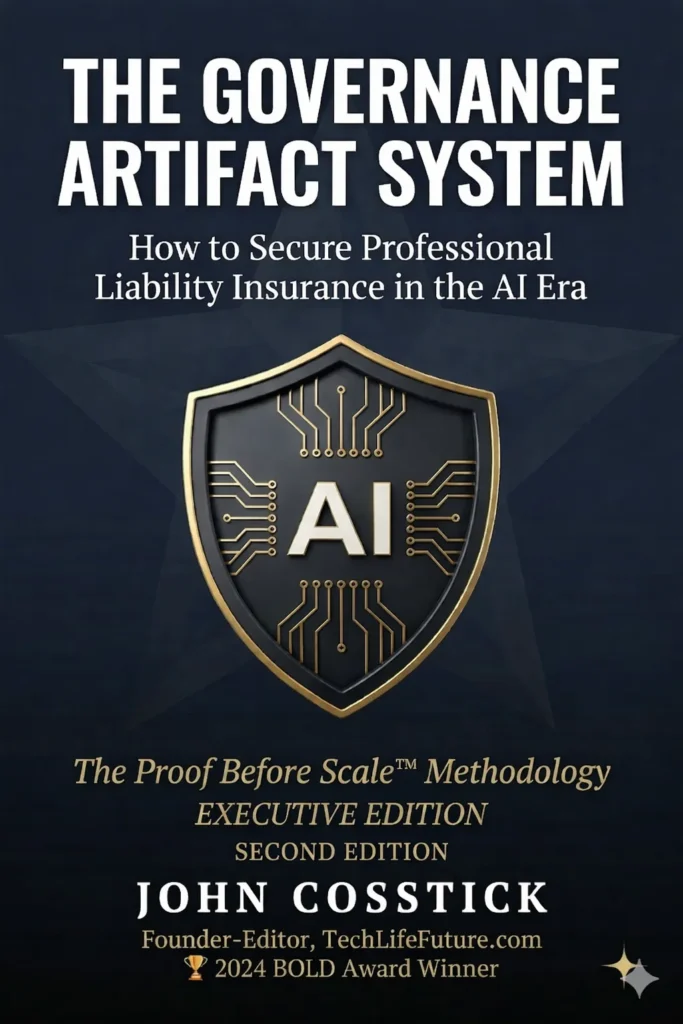
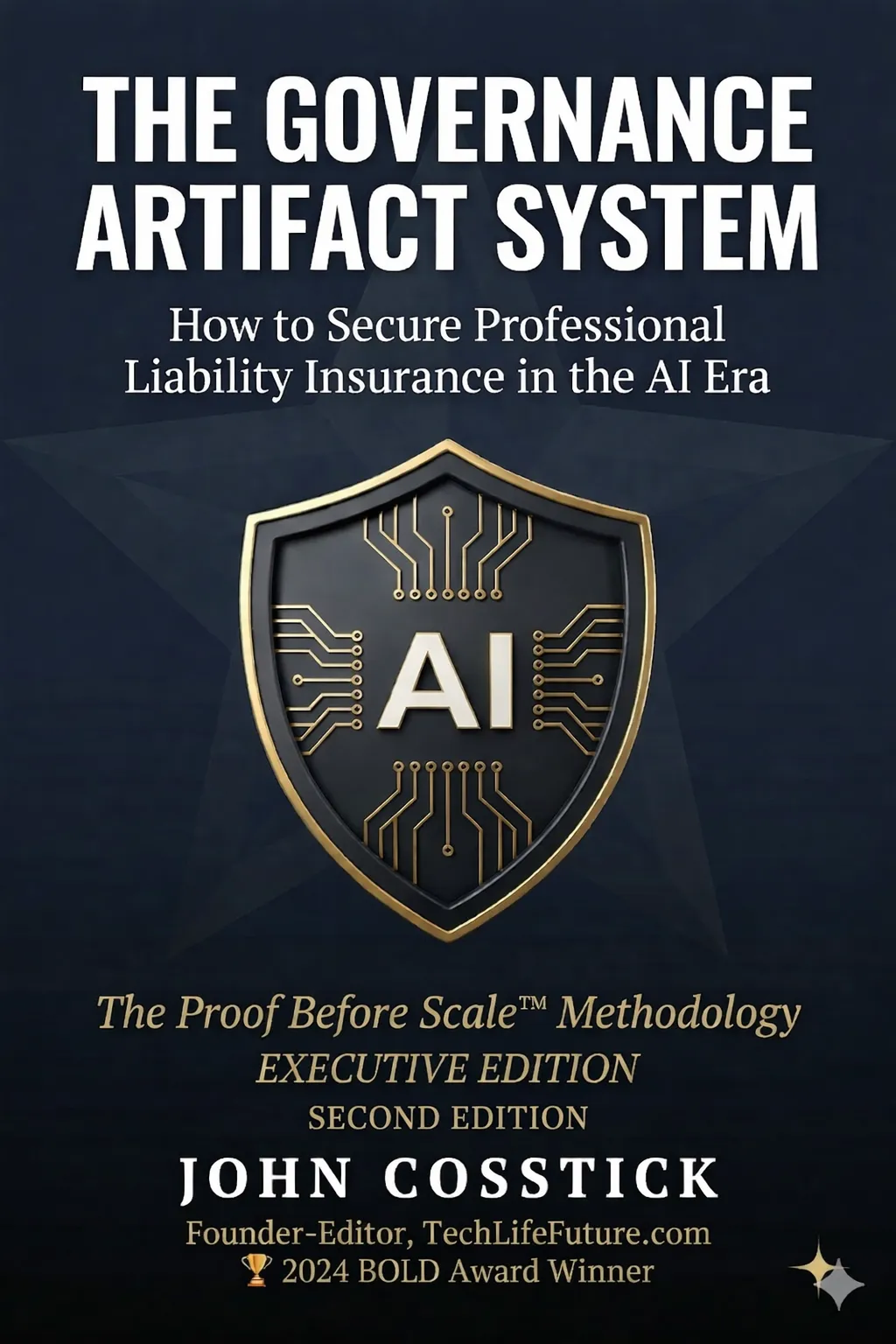
For a board-level treatment of the AI insurance transformation and governance architecture referenced throughout this article, see The Governance Artifact System — Executive Edition (Second Edition) by John Cosstick (TechLifeFuture.com, 2026; ISBN 978-0-6483326-5-7).
About the Author
John Cosstick is a writer, author and the Founder-Editor of TechLifeFuture.com, drawing on deep prior experience across banking, financial planning and accounting. A retired Certified Financial Planner and retired Fellow of the Institute of Public Accountants (FIPA), he is also a partner and minor shareholder in Mindhive.ai and holds a portfolio of technology patent applications pending before IP Australia and WIPO covering AI governance.
His work has been recognised internationally: in 2024 he won the BOLD Award for Open Innovation in Digital Industries, and in 2026 the BOLD Awards VII InsurTech category. Earlier in his career he served as a bank compliance manager and has since contributed to the UK Money and Pensions Service Debt Review and UN AI for Good initiatives.
Writing from Melbourne, Australia, John focuses on AI governance, professional liability and the insurability of AI-enabled professional services. A preview of his recent book, The Governance Artifact System — How to Secure Professional Liability Insurance in the AI Era, is available on Amazon: view the preview here.
Disclosure
This article reflects AI, regulatory, professional-services and insurance market practice as at 1 May 2026 (AEST). Readers should confirm whether subsequent guidance has been issued by their professional bodies, insurer, or APRA. Content on TechLifeFuture.com is for educational and informational purposes only and does not constitute legal, accounting, insurance, or financial advice.
The author is a retired Certified Financial Planner and a retired Fellow of the Institute of Public Accountants; this article reflects deeply researched current professional experience. Some links in this article may be affiliate or referral links (including Educative.io and Mindhive.ai). If you purchase through these links, TechLifeFuture.com may earn a small commission at no extra cost to you.
This article was prepared under TechLifeFuture’s citation-verification and EEAT-aligned editorial process. Portions were AI-assisted and human-edited for accuracy, currency and compliance. All legal and regulatory citations were verified at the date stated above.
© 2026 TechLifeFuture.com │ Creative Commons BY-NC 4.0