A cornerstone AI-governance feature connecting five TechLifeFuture threads: AI governance, human–AI collaboration, AI for Good, the future workforce, and evidence-based implementation.

Nearly every country now has an AI strategy. Investment, infrastructure, regulation, education, innovation – the pillars are broadly consistent from capital to capital. Yet one question is rarely asked in any of them:
Who will lead AI over the next twenty years – and who will make sure they lead it well?
Most national strategies are built to produce AI capability. Very few are built to produce AI leadership. That gap – between having powerful tools and having people equipped to govern them wisely – is the missing layer this article is about. It is also, we argue, the layer that will separate countries that merely adopt AI from those that shape it responsibly.
At TechLifeFuture, we have a settled view on this: capability without governance is not progress; it is exposure. Our “Proof Before Scale” principle applies as much to the people who will steer AI as it does to the systems themselves.
The AI Race Is Not Only About Technology
The public conversation about national AI competitiveness is dominated by hardware and models: who has the most compute, the largest data centres, the strongest domestic models. These things matter. But they are inputs, not outcomes.

National success will ultimately depend on people – and, in particular, on young people who will spend their entire careers inside an AI-saturated economy. Chips depreciate. Models are superseded. A generation of capable, ethically grounded AI leaders compounds in value for decades.
The strategic question is therefore less “how much compute can we build?” and more “who will be capable of directing it toward public benefit – and accountable when it goes wrong?”
Using AI Is Not The Same As Leading AI
Most national strategies discuss AI skills. Far fewer discuss AI leadership. The distinction is not pedantic.

Using AI is a technical competence: prompting, building, deploying, integrating. It can be taught in a semester.
Leading AI is a governance competence. It asks harder questions:
- Should this be built?
- Who is accountable if it fails?
- Whose interests does it serve?
- What evidence do we have that it works?
- Where is the human oversight?
A country can produce a large cohort of confident AI users and still lack anyone trained to weigh ethics, public benefit and responsibility at the point where decisions are actually made. Skills answer “can we?” Leadership answers “should we, and on whose authority?”
A Working Model Already Exists: The Young AI Leaders Community
An International Model for Youth-Led AI Collaboration
This is not a theoretical proposal. A model already exists at the international level. Through its AI for Good initiative, the International Telecommunication Union (ITU) – a United Nations agency – launched the Young AI Leaders (YAIL) Community in January 2025.

It is worth being precise about what YAIL is. It is a global network of young people who work together, using AI, to address real community problems mapped against the United Nations Sustainable Development Goals.
On our reading of the Community Charter, its design places it closer to a community of practice than to the coding clubs, robotics competitions and hackathons that dominate youth-technology programming – the emphasis falls on sustained membership, annual projects and impact reporting rather than on one-off events.
How the Young AI Leaders Community Is Structured
According to the Community Charter, the community operates through local hubs, each with a leadership team comprising a Hub Leader, a Regional Lead and an Impact Lead. Members are expected to attend monthly hub meetings, complete at least one hub project and one AI for Good project each year, and collaborate with at least one other hub inside or outside their region. Each hub elects its own leadership team, and hubs are encouraged to refresh that team every two years.
The emphasis is deliberately cross-disciplinary and cross-border: engineering sits alongside ethics, and a hub in one country learns from a hub in another.
Governance, Accountability and Lessons for National AI Strategies
Two design choices are especially instructive for policymakers. First, the community foregrounds impact measurement – there is a dedicated Impact Lead in every hub, responsible for setting KPIs, gathering data and submitting an annual impact report. Second, decision rights are explicitly allocated. A Global Leadership Council operates strictly in an advisory and non-executive capacity, with binding decisions on policy and structural matters reserved to the AI for Good Young AI Leaders Programme Manager and the ITU AI for Good Secretariat.
Equally instructive is what ITU declines to do. The Charter is explicit that ITU’s role is facilitative: it provides platforms, guidance and resources, but does not manage, control, govern or monitor hub activities, does not participate in hub policy or leadership elections, and provides no project funding. Hubs are self-governing.
That combination – youthful energy, real projects, measured impact, and decision rights stated in writing rather than assumed – is instructive for national strategies. It also exposes the limit of the model. Because accountability below the Secretariat level is devolved to each hub, the quality of local governance is whatever the host community builds, which is precisely the argument of this article.
Australia Has An Opportunity, Not A Disadvantage
As at 21 July 2026, a search of the Young AI Leaders member and hub directory returns no listed Australian hub, in a network that now spans more than one hundred hubs worldwide. Australia does appear elsewhere in the AI for Good ecosystem – an Innovation Factory local chapter operates here – but the youth leadership community itself has no Australian presence.

Framed correctly, this is not a gap to be embarrassed about. It is an opening. A country without an established hub has a clean slate on which to build a model that suits its own institutions – and to do so with governance designed in from the start rather than retrofitted later.
Australia is unusually well placed to host such a model. Potential hosts already exist in every community:
- universities and TAFEs
- schools
- public libraries
- innovation and start-up hubs
- councils and community centres
- churches and faith-based organisations
- co-working spaces
The point is not the building. It is the community around it.
Leadership Without Governance Is Just Enthusiasm
This is where TechLifeFuture’s position differs from most commentary on youth and AI. Many articles would end at “let’s inspire young leaders.” We think that is where the hard part begins.
Without governance, AI leadership is enthusiasm. With governance, it becomes sustainable – and safe.
Any serious youth AI-leadership model needs the same governance scaffolding we advocate for professional and organisational AI use:
- Human oversight – a person, not a system, is accountable for decisions.
- Safeguarding – appropriate protections when the participants are young.
- Transparency – clear disclosure of how AI is used in each project.
- Ethical review – a lightweight but real check before projects scale.
- Evidence – claims of impact backed by data, not anecdote.
- Measurable outcomes – success defined in advance, then tested.
Safeguarding deserves particular emphasis. A model built around minors carries duties of care that a start-up accelerator does not. Governance here is not bureaucracy; it is the condition that makes the whole thing responsible enough to grow.
A New Model Of Mentorship
If the hosting institution is the venue, mentorship is the engine. And the most valuable mentorship model is not a lecture series – it is a community of practice.
Imagine young AI leaders learning not only from AI researchers, but from engineers, teachers, lawyers, accountants, health professionals, entrepreneurs, community workers – and, importantly, from retired professionals with decades of judgment to pass on. This is the human side of the human–AI partnership: technology supplies capability, experienced people supply wisdom about how and when to use it.
This is exactly the terrain of TechLifeFuture’s human–AI collaboration work. The best outcomes come not from AI replacing human judgment, but from structured collaboration in which each does what it does best.
Measuring Success: How Would We Know A Hub Worked?
A governance-led model must be able to answer a simple question: how do we know it succeeded? Vanity metrics – attendance, social media reach – are not enough. Candidate indicators include:
- number of young leaders actively engaged
- projects completed and communities served
- mentors engaged and hours contributed
- ethics and governance workshops delivered
- governance maturity of each project over time
- SDGs meaningfully addressed
- evidence and case studies produced
This links directly to our emerging work on a Global AI Implementation Success Index – the same discipline of defining success in advance and measuring against it, applied to youth AI leadership rather than enterprise deployment.
From AI Literacy To AI Citizenship
Schools teach digital literacy. Universities teach AI. But society now needs something further: AI citizenship.
An AI citizen understands not only how to use these tools, but their rights and responsibilities in relation to them – the ethics, the governance implications, and the public interest at stake. Literacy is knowing how the tool works. Citizenship is knowing what you owe others when you use it.
This is the shift a national leadership layer is designed to produce: not just capable users, but a generation fluent in the responsibilities that come with the capability.
The Framework: National AI Leadership Infrastructure (NALI)
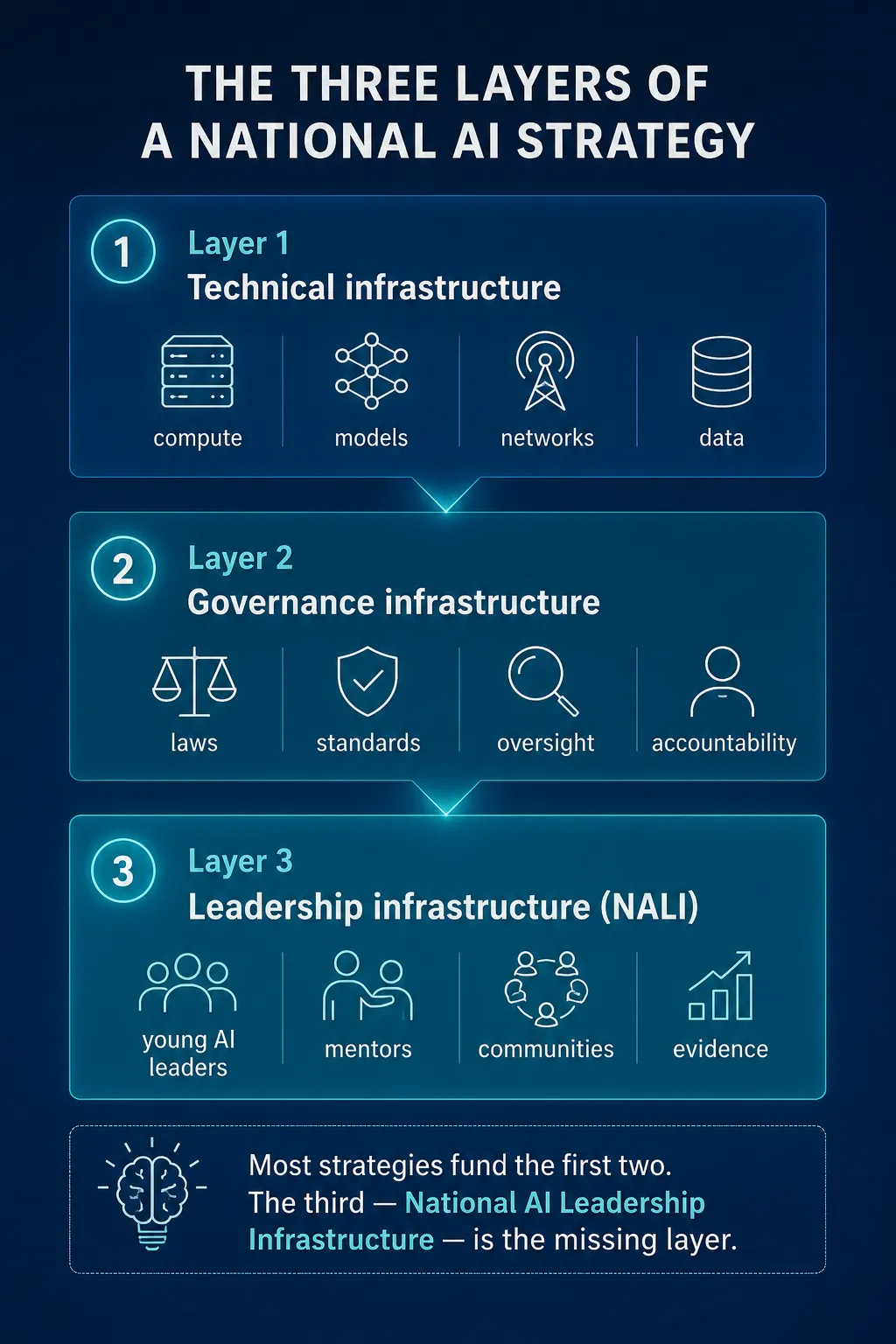
If national AI strategy is to close this gap, it helps to name what is missing. We propose that a complete national AI strategy rests on three complementary layers of infrastructure – not one.
-
Technical infrastructure – compute, models, networks and data. The layer every strategy already funds.
-
Governance infrastructure – laws, standards, oversight and accountability. The layer maturing rapidly worldwide.
-
Leadership infrastructure – the young AI leaders, mentors, host communities and evidence-based practices that will actually run and steward the other two. The layer almost no strategy names.
We call this third layer National AI Leadership Infrastructure (NALI). A country can fund the first two layers generously and still fail, because infrastructure and rules do not govern themselves – people do. NALI is the human capacity that turns compute and regulation into responsible outcomes.
Framed this way, youth AI leadership stops being a “nice-to-have” education initiative and becomes what it actually is: critical national infrastructure. And like any infrastructure, it should be designed, governed and measured – not left to chance.
FAQ: National AI Leadership and the Young AI Leaders Community
Q1: What is the Young AI Leaders (YAIL) Community?
A: YAIL is a global network of young people, officially launched by the ITU’s AI for Good initiative in January 2025, who use AI to tackle real community problems mapped to the UN Sustainable Development Goals. It operates through self-governing local hubs, each electing a Hub Leader, Regional Lead and Impact Lead.
Source: ITU AI for Good
Q2: Is YAIL a coding club or hackathon?
A: Not in the usual sense. The Charter does not use those terms, but the model it describes – monthly meetings, annual hub and AI for Good projects, cross-hub collaboration and annual impact reporting – is one of sustained community practice rather than one-off competition. This characterisation is TechLifeFuture’s, based on the Charter’s stated requirements.
Source: ITU AI for Good Community Charter (membership expectations)
Q3: What is National AI Leadership Infrastructure (NALI)?
A: NALI is TechLifeFuture’s proposed third layer of national AI strategy – alongside technical and governance infrastructure – covering the young leaders, mentors, host communities and evidence-based practices needed to steward AI responsibly.
Source: this article, TechLifeFuture.
Q4: Does Australia have a YAIL hub?
A: As at 21 July 2026, the publicly listed YAIL hub directory returns no Australian hub, which this article frames as an opportunity rather than a gap. Hub listings change; readers should check the live directory.
Source: ITU AI for Good hub directory
Q5: What is the difference between using AI and leading AI?
A: Using AI is a technical competence (prompting, building, deploying). Leading AI is a governance competence – deciding whether something should be built, who is accountable, and where human oversight sits.
Source: this article, TechLifeFuture.
Q6: How is success measured in a YAIL hub or similar youth AI-leadership model?
A: Beyond vanity metrics like attendance, candidate indicators include projects completed, mentors engaged, governance workshops delivered, SDGs addressed and evidence produced – echoing YAIL’s own Impact Lead role.
Conclusion: The Investment That Compounds
The future of AI will not be determined solely by governments, technology companies or universities. It will also be shaped by the young people who choose to use AI to improve their communities – and by whether anyone thought to prepare them to lead it responsibly.
The question is no longer whether nations should invest in AI. It is whether they will invest in the people who will govern it.
Perhaps the greatest investment any country can make is not another data centre. It is helping the next generation become wise AI leaders – and building the National AI Leadership Infrastructure to make that leadership durable.
About the Author
John Cosstick is a writer, author, and the Founder-Editor of TechLifeFuture.com, drawing on deep prior experience across banking, financial planning, and accounting. A Retired Certified Financial Planner and retired Fellow of the Institute of Public Accountants (FIPA), he holds a minority shareholding in Mindhive.ai and maintains a portfolio of patent applications pending before IP Australia and the World Intellectual Property Organization (WIPO) covering AI governance, cryptographic verification and insurability frameworks. His work has been recognised internationally: in 2024, he won the BOLD Award for Open Innovation in Digital Industries, and in 2026, the BOLD Awards VII InsurTech category for AIMS Governance.
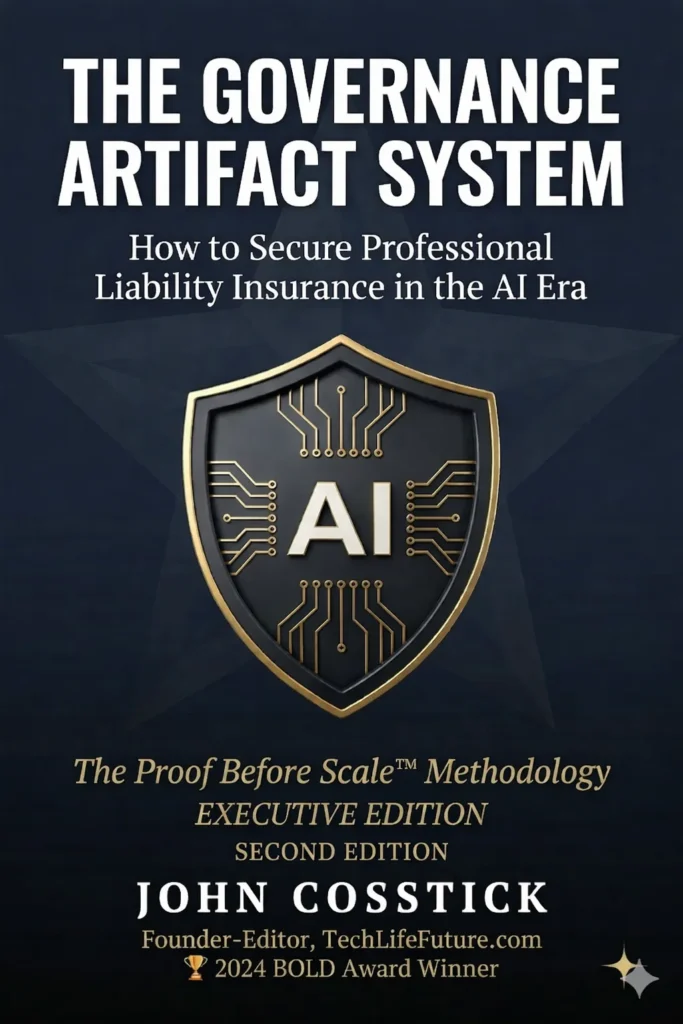
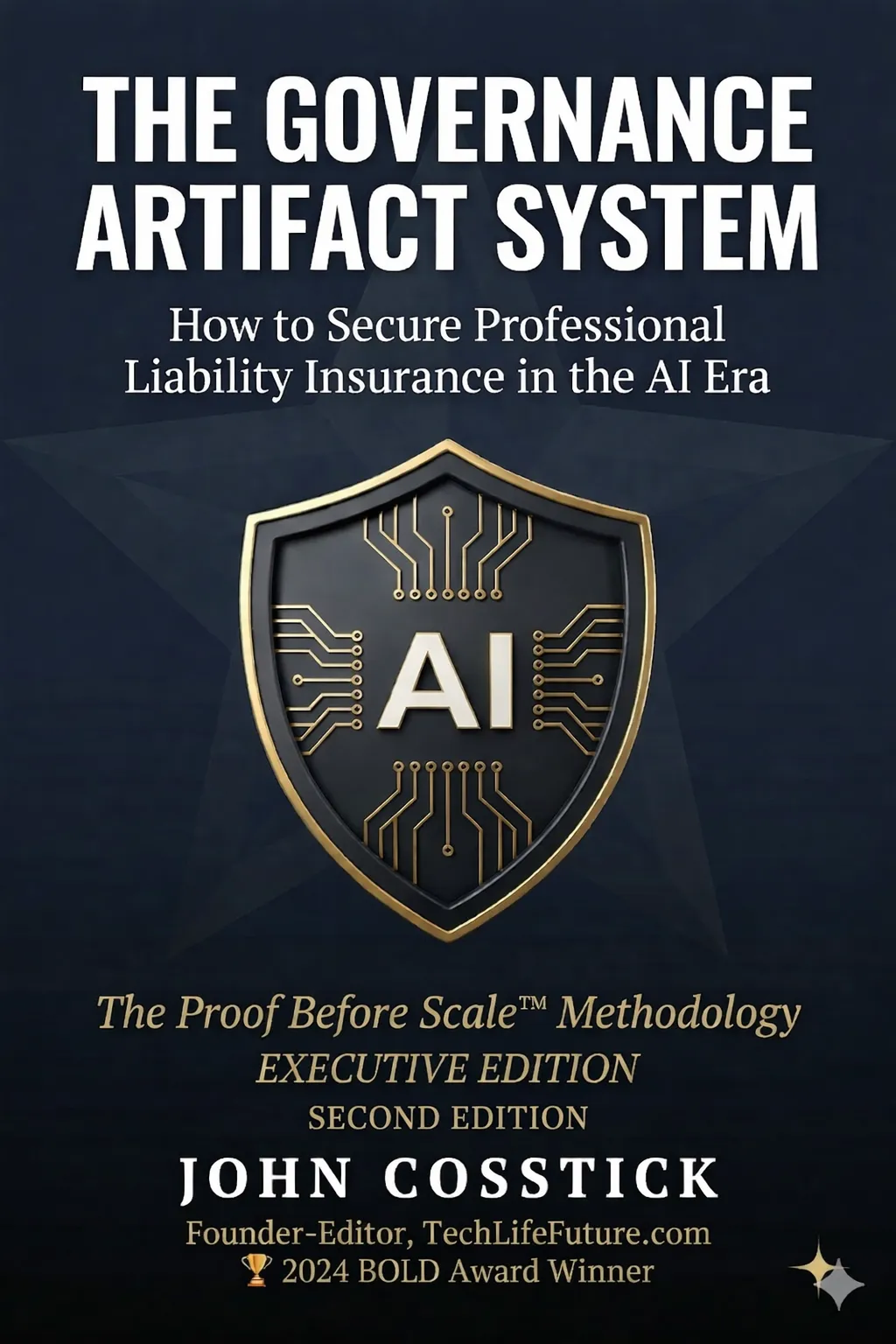
Earlier in his career, he served as a bank compliance manager and has since contributed to the UK Money and Pensions Service Debt Review and UN AI for Good initiatives. Writing from Melbourne, Australia, John focuses on AI governance, professional liability and the insurability of AI-enabled professional services. A preview of his recent book, The Governance Artifact System – How to Secure Professional Liability Insurance in the AI Era, is available on Amazon: view the preview here.
Mandatory Disclosure Block
This article reflects AI, regulatory, insurance, and professional services practices as of 21 July 2026 (AEST). Readers should confirm whether subsequent guidance has been issued by their regulators, professional bodies, insurers, or standard-setting organisations.
Content on TechLifeFuture.com is for educational and informational purposes only and does not constitute legal, accounting, financial, credit, or insurance advice. It is not a substitute for tailored professional advice in your jurisdiction.
Some links on this page may be affiliate or referral links (including, where relevant, Educative.io, Mindhive.ai, or other partners). If you purchase through these links, TechLifeFuture.com may earn a small commission at no extra cost to you.
The author is developing a proposal for a community-hosted Young AI Leaders hub in Melbourne, Australia. He holds no position with, and receives no funding from, the ITU or the AI for Good initiative. This article is independent commentary and is not endorsed by the ITU.
Conflict-of-interest and IP disclosure: The author, John Richard Cosstick, is the named inventor on the following pending patent applications related to concepts discussed in this article:
- Verifiable Human Contribution (VHC): Australian patent application pending 2025220863, international application number PCT/IB2025/058808
- AI Management Systems (AIMS): Australian patent application pending 2025271387, international application number PCT/AU2025/051428
This article does not discuss VHC or AIMS directly. These interests are disclosed because the author’s patent portfolio concerns AI governance generally, and readers are entitled to weigh that when assessing the governance positions argued here.
This article was reviewed under TechLifeFuture’s citation-verification and EEAT-aligned editorial process. Portions were AI-assisted and human-edited for accuracy, clarity, and compliance with professional publishing standards.
© 2026 TechLifeFuture.com | Creative Commons BY-NC 4.0