Here is the challenge that most firms are not yet facing squarely. AI governance built entirely on human oversight will fail — not because humans are careless, but because the volume and velocity of agentic AI far exceeds what any team can supervise in real time.
And AI governance that relies on the system auditing itself will fail equally, for reasons that are as old as auditing itself. Genuine human–AI collaboration is not a philosophical preference. It is the only architecture that produces evidence robust enough to satisfy a regulator, an insurer, or a court.
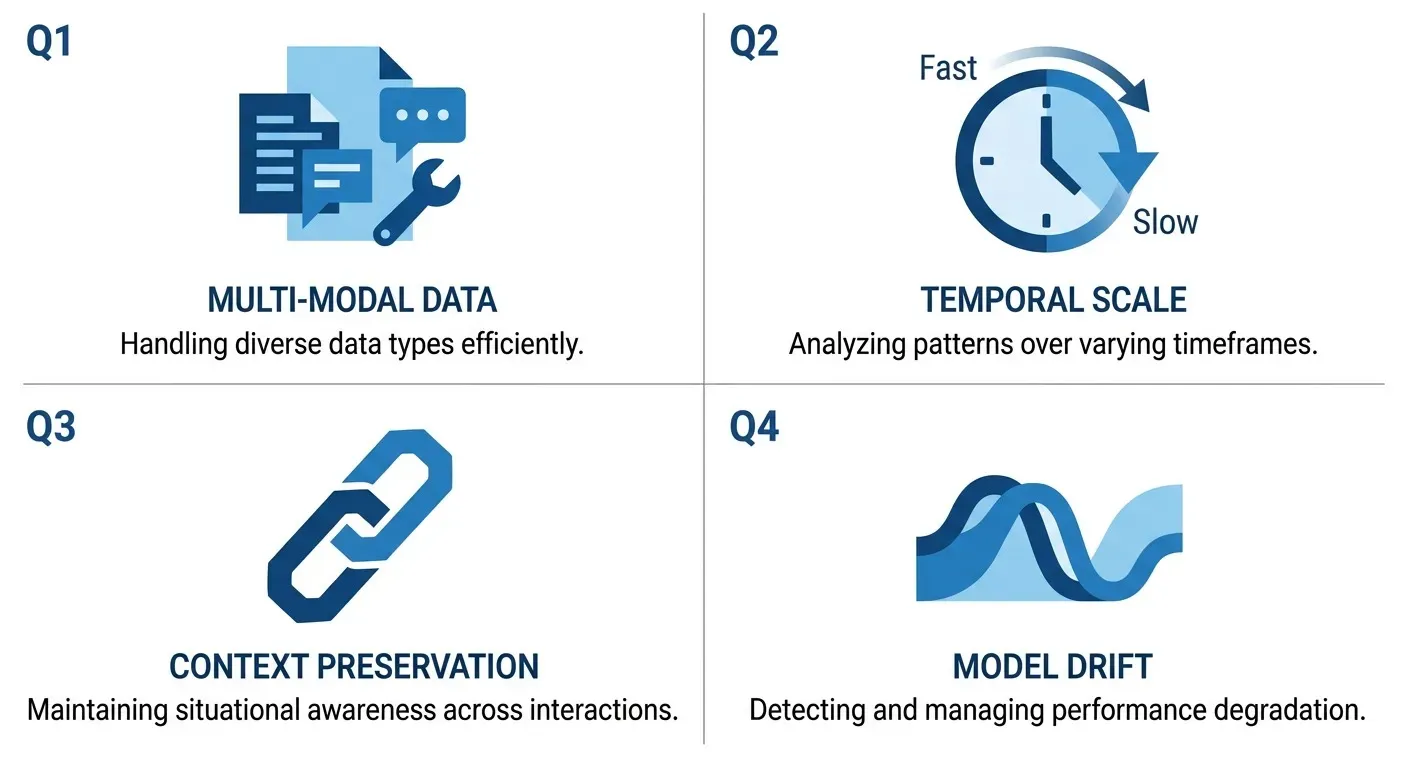
QUICK ANSWER — WHY IS AI TELEMETRY SO COMPLEX? AI telemetry is complex because it must capture events across multiple data modalities — prompts, retrievals, tool calls, outputs, and downstream actions — on timescales ranging from milliseconds to days, while preserving enough context to make each logged event forensically useful. Add model drift and privacy constraints, and neither humans nor AI alone can govern it reliably.
For principals of professional services firms facing PI renewal in 2026, this is not an abstract architecture question. It is a practical one. What does your firm’s AI evidence look like? And if a claim or regulatory inquiry landed tomorrow, could you produce it? This article builds the case that AI accountability at that standard requires both parties — and that getting the partnership right this year is the work that matters.
This is Article 4 in the TLF Governance Artifact System series. If you are arriving here directly, the earlier piece AI Telemetry: The Missing Layer in AI Governance, Liability, and Insurability provides the foundational context. Start there if you need the ‘why telemetry at all’ argument. This piece picks up the harder question: why is co-production not optional?
What Makes AI Telemetry So Complex?
The phrase “capture what the AI did” sounds straightforward until you try to define what “what” actually means. In a modern agentic system, a single client interaction may involve a dozen distinct computational events — and each one matters for governance.
Multi-Modal Data
Every AI workflow generates multiple, distinct data streams: the user prompt, the retrieval corpus queried, the tool calls executed, the raw model output, and the downstream action triggered by that output. Governance-grade telemetry must capture and correlate all of them. Capturing only the final output — which is what most vendor dashboards actually record — is the equivalent of a flight data recorder that only captures the moment of landing. Forensically, it is close to useless.
The Temporal Problem
AI systems operate across vastly different time horizons simultaneously. A retrieval step takes milliseconds. A multi-document analysis takes seconds. An agentic workflow that drafts a client email, checks a compliance database, schedules a follow-up, and flags an exception might span minutes to hours. And the downstream consequence of that advice — the client’s financial decision, the regulatory disclosure, the legal position — plays out over days, months, or years. Telemetry must be able to correlate events at every horizon.
Context Preservation
A logged output stripped of its context is forensically useless. Knowing that a model produced a particular recommendation at 2:47 pm on a Tuesday tells you almost nothing without the prompt it received, the retrieval context it drew on, the system state at that moment, and the version of the model in use. Context preservation is expensive — it multiplies storage requirements significantly — but without it, the telemetry record cannot be interrogated meaningfully under audit conditions.
Model Drift and Emergent Behaviour
AI systems are not static. Model versions change. Retrieval corpora are updated. Fine-tuning shifts behaviour in ways that may not be immediately visible. A telemetry baseline established for a model in January may not characterise the same model in April. Governance systems that do not account for drift are producing evidence that silently degrades over time — a liability, not an asset.
Privacy and Proportionality
Capturing too little is governance theatre. Capturing too much is its own liability — privacy law, data minimisation obligations under the Australian Privacy Act, and equivalent EU and UK frameworks all impose constraints on retention. The telemetry architecture must be scoped to governance requirements, not to what is technically possible to log. That scoping judgment cannot be made by the AI itself — it requires human decision-making from the outset.
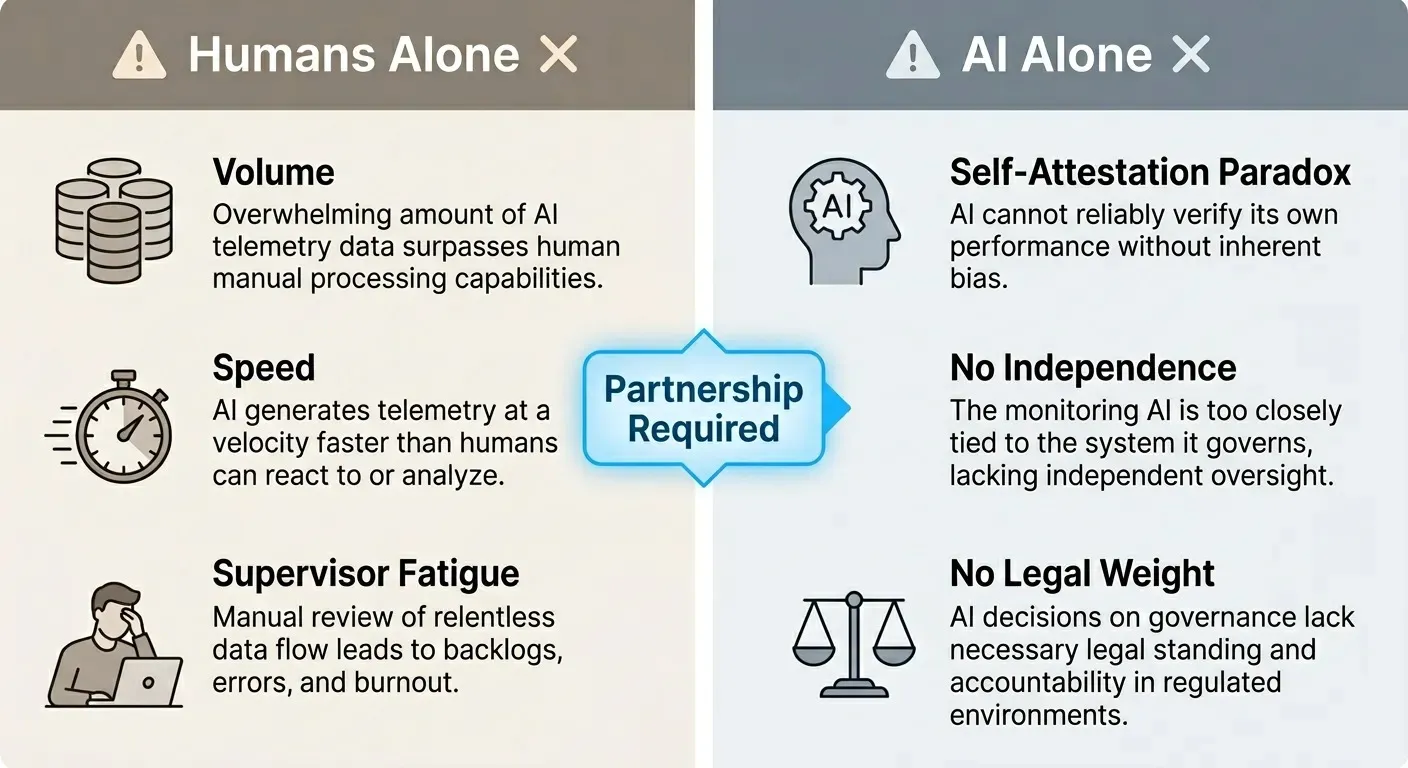
Why Humans Alone Cannot Govern AI at Scale
There is a version of AI governance that sounds perfectly reasonable: keep a person in the loop, have someone review every output, make the human responsible. Firms that have tried to implement this version of oversight discover its limits quickly.
The Volume Problem
A small advisory firm running AI through email triage, document summarisation, and meeting note generation will produce tens of thousands of AI-assisted decision points per week. A principal who reviews them all has no time left to serve clients. A principal who spot-checks them has no basis for claiming systematic oversight — and an insurer or regulator reviewing that claim will know it.
Speed and Agentic Chains
Agentic AI systems chain actions in fractions of a second. A prompt triggers a retrieval, which informs a draft, which populates a template, which queues a send — all before a human reviewer has opened the task. Supervision of every step is not just operationally impossible; it defeats the efficiency argument for AI deployment. The answer is not to slow the AI down to human speed. The answer is to design telemetry that runs at machine speed and surfaces exceptions for human review.
Pattern Recognition at Scale
Humans are excellent at detecting anomalies in individual cases. They are poor at detecting systemic drift across thousands of cases. If an AI system’s advice quality degrades gradually across 800 client interactions over three months, no individual reviewer is likely to catch it. Only a telemetry layer capable of running statistical analysis across the full corpus can surface that pattern. Human oversight is still essential — but it operates on the signal that telemetry surfaces, not on the raw event stream.
Cognitive Cost and Supervisor Fatigue
Decades of research in aviation safety, healthcare, and process control document the same finding: supervisory vigilance collapses as volume increases and the signal-to-noise ratio drops. A reviewer who has checked 200 routine AI outputs in a day will not bring the same scrutiny to the 201st as to the first — even if the 201st is the one that matters. Governance systems that depend on sustained human alertness without telemetric support are not governance systems. They are liability programmes that have not been tested yet.
The governance failure mode is not humans choosing to ignore AI. It is humans being structurally unable to supervise AI at the volume and speed at which it operates — even when they are trying.
For a detailed account of what goes wrong when telemetry is absent from governance frameworks, the TLF piece The Seven Governance Sins documents the failure patterns we see repeatedly across professional services firms.
Why AI Alone Cannot Govern Its Own Telemetry
If humans alone cannot supervise AI at scale, the obvious counter-proposal is to let the AI supervise itself. Automate the audit function. Run a second model over the first model’s outputs. Build a self-monitoring layer. It sounds efficient. It fails on first principles — and those principles are not new.
The Self-Attestation Paradox
The foundational requirement of independent assurance — established across accounting, legal practice, and professional auditing — is that the party being audited cannot be the auditor. A system that generates its own evidence of compliance fails this test regardless of its technical sophistication. The records an AI produces about its own behaviour are not independent. They are subject to the same failure modes, biases, and gaps as the behaviour they purport to document.
Confidence Is Not Correctness
AI models are well-documented as overconfident in their own accuracy assessments. A model asked to rate the quality of its own output will typically rate it more highly than an independent evaluator would. The research on this is not contested — it is one of the more consistent findings in the field. Building governance on the outputs of that self-assessment compounds the problem: you are using an overconfident source to certify an overconfident output.
Vendor Conflict of Interest
Even setting aside model-level problems, vendor-provided telemetry faces a structural conflict. Vendors have commercial incentives that diverge from those of their licensees and the end clients those licensees serve. The vendor wants to demonstrate reliability. The licensee wants to demonstrate governance. The client wants to know whether the advice was sound. These interests do not always align, and a telemetry layer controlled by the vendor cannot be relied upon to surface evidence that disadvantages the vendor.
Insurance and Legal Precedent
Claims processes across professional indemnity, cyber liability, and general liability are increasingly declining to accept AI self-attestation as standalone evidence. Courts assessing AI-assisted advice have so far refused to treat an AI’s own confidence rating as a substitute for professional judgment attested by a named, credentialled human. The case law base is still developing — but the early indicators are consistent, and firms proceeding on the assumption that the AI’s internal logs alone will satisfy a claim assessor or a judge are accepting a litigation risk that has not been tested favourably.
Regulatory Direction
The EU AI Act Article 14 explicitly requires that high-risk AI systems include human oversight measures — not as a recommendation but as a legal obligation. Australia’s regulatory architecture, while not enacted as a standalone AI Act, applies the same principle through existing sector regulators and the National AI Centre’s Guidance for AI Adoption, which lists human oversight as one of its six essential practices. The regulatory direction is consistent across jurisdictions: human oversight of AI is not optional for high-risk applications, and it cannot be delegated back to the AI itself. The detail of how each regime applies in 2026 is covered later in this article.
The Human–AI Telemetry Partnership in Practice
The productive framing is not “how much do we constrain AI” or “how do we replace human oversight with automation.” It is: what does each party do best, and how do we design the boundary between them so that the combined output is stronger than either alone?
Architecture: AI Captures; Humans Curate
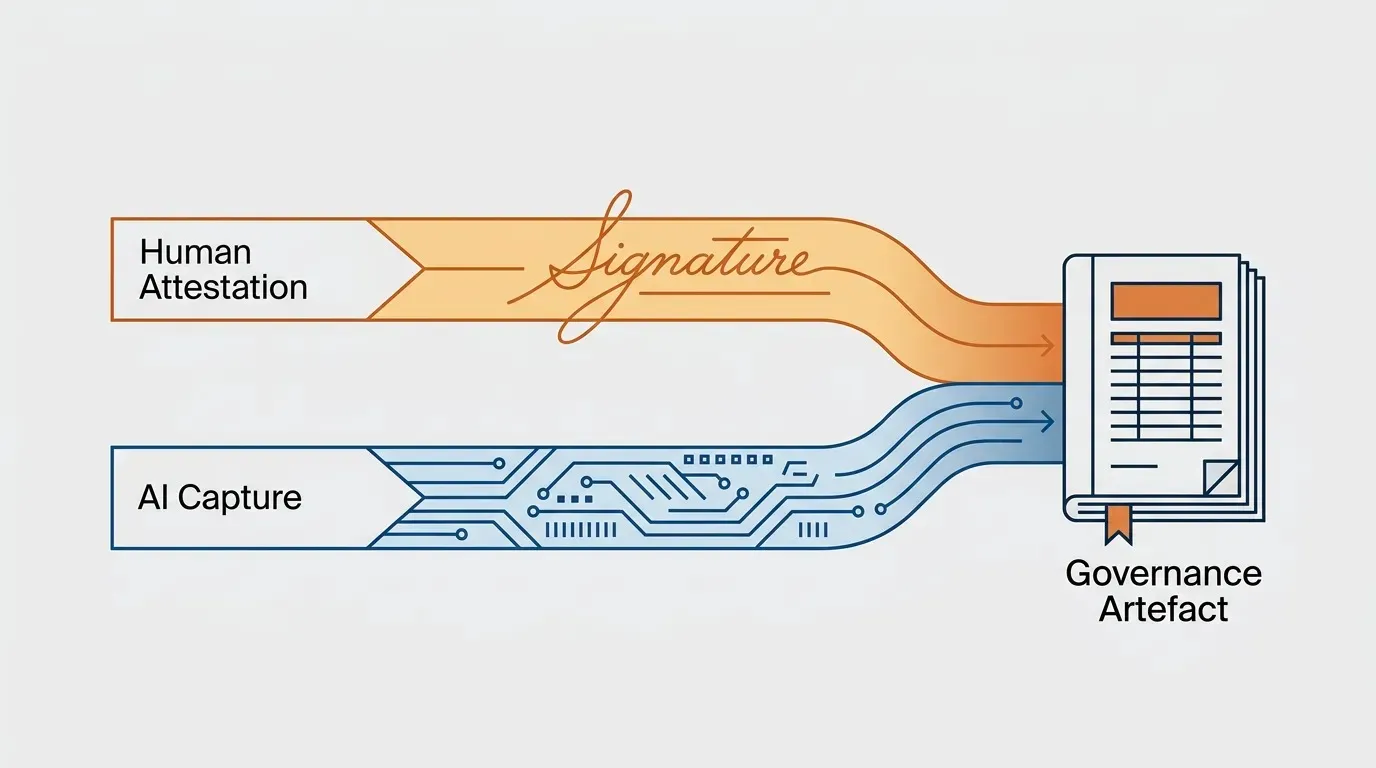
AI handles what it does at scale and speed: comprehensive event logging, contextual indexing, anomaly flagging, and pattern detection across the full data corpus. Humans handle what only humans can do: sign off on consequential decisions, attest to context, exercise judgment under uncertainty, and take professional responsibility for outcomes. The boundary between these two functions is not fixed — it shifts depending on the workflow, the risk level, and the regulatory environment — but the principle holds across contexts.
The technical layer captures everything. The governance layer determines what within that capture requires human attestation, at what threshold, and by whom. These are not the same question, and conflating them is one of the most common architecture errors in AI governance.
Verifiable Human Contribution as the Bridge
Verifiable Human Contribution (VHC) is the standard that converts ad-hoc human review into auditable evidence. Without VHC discipline, a firm may have a principal who genuinely reviewed an AI-drafted advice document — but no record of that review that would survive scrutiny under a PI claim or a regulatory investigation. With VHC, every material human decision is captured: who made it, when, with what context available to them, and what professional responsibility they attested to taking.
VHC is not simply a digital signature on a document. It is a structured attestation that correlates the human’s decision with the AI’s telemetry record at that moment — creating a complete, correlated, attested governance artefact. The Verifiable Human Contribution (VHC): The AI Evidence Standard article explores the mechanics in full.
Decision Points That Only Humans Can Verify
Some decisions simply cannot be automated, regardless of AI capability. Material client advice in a regulated context. A regulatory disclosure. A judgment call where the evidence is genuinely ambiguous. An override decision where the AI’s recommendation is being consciously set aside. Each of these is a point in the workflow where a named, credentialled human must be on record — not because of regulatory box-ticking, but because these are the moments where professional responsibility is exercised. They are the moments that will matter if something goes wrong later.
Audit-Grade Evidence: Three Properties
A governance artefact that would satisfy an insurer, a regulator, or a court has three properties. First, it is complete — there are no gaps in the event record that would allow an adversarial reviewer to argue that something happened in the unrecorded interval. Second, it is correlated — each event is linked to its context, adjacent events, and the human actions that accompanied it.
Third, it is attested — a named human with verifiable credentials has signed off on consequential decisions, and that attestation is captured in the record alongside the AI’s own telemetry. The detailed mechanics of what that artefact looks like in practice are explored in The Forensic Solution: How Governance Artefacts Restore Professional Insurability.
What This Looks Like in Professional Services
The architecture above is not theoretical. Firms in financial planning, accounting, and legal practice are already working through these questions — in some cases, because PI renewal made it urgent.
Financial Planning
In a financial planning practice, AI might draft an investment strategy document based on client data, a current portfolio, and a configured goal framework. The telemetry layer captures the prompt, the data sources queried, the model version, and the output. The human layer is where the planner attests: they have reviewed the strategy for suitability, they are satisfied the disclosure obligations are met, and they take professional responsibility for the advice as issued. Both the AI’s record and the planner’s attestation are captured, correlated, and retained.
Without the attestation, the AI’s record is just a log. With it, it becomes a governance artefact. The distinction matters enormously at PI renewal — and it matters even more if a claim is made. The TLF series piece on AI in Financial Planning covers implementation specifics for that context.
Accounting and Audit
An accounting firm using AI for variance analysis faces a different version of the same challenge. The AI flags anomalies across the client’s accounts. The accountant’s job is to attest on materiality — to say, with professional judgment, which anomalies matter and how they should be treated. The partner’s sign-off on the audit opinion is then correlated with the full AI event chain that led to the flagging.
The governance artefact connects the AI’s analysis to the professional judgment layered over it. That connection is not automatic. It requires deliberate architecture. Firms that assume the AI’s output log and the partner’s sign-off on the opinion are the same thing — or that one substitutes for the other — will not have audit-grade evidence when they need it.
Legal Practice
Legal practice presents the clearest case for mandatory human attestation. AI can surface precedents, synthesise case law, and draft legal memoranda at a standard that saves significant time. But the advice that goes to a client must come from an admitted lawyer. The AI must never appear as the source of legal advice in any document the client receives — not even implicitly, through language that implies the research was machine-generated.
The admitted lawyer attests that they have reviewed the AI’s research, applied independent legal judgment, and take professional responsibility for the advice. This is not an optional convention. It is a professional obligation under every legal practice framework in Australia, the UK, and the EU. The governance artefact must make it legible. See AI in Courts: Human Judgment, Machine Scale and Who’s Liable When Your AI Gives Bad Advice? for the legal dimension of this question.
The 2026 Regulatory and Insurance Reality
The case for human–AI telemetry partnership is not just architectural. It is increasingly regulatory and commercial. The external environment in 2026 is pushing firms toward governed AI — not by persuasion but by consequence.
EU AI Act
The EU AI Act entered into force on 1 August 2024 and enters its main application phase on 2 August 2026. Under Article 14, high-risk AI systems must be designed and developed to be effectively overseen by natural persons; under Article 12, providers must maintain logs that allow for traceability of the system’s functioning throughout its lifecycle. The Commission’s Digital Omnibus proposal (political agreement reached 7 May 2026) would postpone the Annex III high-risk obligations to 2 December 2027 for standalone systems and 2 August 2028 for systems embedded in regulated products, contingent on the availability of harmonised standards.
The precise commencement date is moving; the architectural direction is not. Australian professional services firms with EU clients or EU-facing practice should treat human oversight, logging, and post-market monitoring as live design requirements rather than future obligations.
Australian Regulatory Direction
Australia’s regulatory posture shifted twice during 2025. The National AI Centre’s October 2025 Guidance for AI Adoption (GfAA) superseded the 2024 Voluntary AI Safety Standard, consolidating the original ten guardrails into six essential practices (“AI6”) covering human oversight, accountability, transparency, contestability, fairness, and ongoing risk management. The December 2025 National AI Plan then confirmed that Australia will rely on existing laws and sector regulators rather than introduce a standalone AI Act or mandatory guardrails.
The most consequential supervisory development came on 30 April 2026, when APRA wrote to all regulated entities, warning that “governance, risk management, assurance and operational resilience practices are not sufficiently keeping pace with the scale, speed, and complexity of AI adoption.” The letter sets published minimum expectations across AI lifecycle ownership, board literacy, supplier risk, and continuous assurance — and makes clear that existing standards, including CPS 220, CPS 230, and CPS 234, already apply to AI risk. CPS 230 has been in force since 1 July 2025, with its contractual transition window for pre-existing service-provider arrangements closing 1 July 2026; together with ASIC’s ongoing engagement on AI in financial services, the operative pressure on Australian firms is no longer waiting on a hypothetical mandatory standard. The supervisory expectations are published, and they are testable.
The Insurance Market in 2026
The insurance market is moving on two fronts simultaneously. Verisk released general liability AI exclusion endorsements with a 1 January 2026 effective date, giving carriers the contractual machinery to exclude generative AI exposures from standard cover. At Lloyd’s of London, Armilla AI was admitted as a dedicated AI coverholder, with its standalone AI Liability Policy expanded in early 2026 to up to USD 25 million per insured for hallucinations, model drift, inaccurate outputs, and AI regulatory violations — risks that traditional Errors & Omissions and Professional Indemnity wordings are being amended to exclude.
The Lloyd’s Market Association has separately published guidance for underwriters on assessing AI exposure in PI. The result is a bifurcating market: standard PI cover narrowing around AI risk, and affirmative AI cover emerging as a separately priced product. Firms coming to renewal without documented AI governance are increasingly facing one of three outcomes — narrower silent cover, an explicit AI exclusion endorsement, or a referral into affirmative AI cover at materially higher cost. Evidence of structured AI telemetry and human attestation is the artefact that determines which path a renewal takes.
The full picture of how that insurance pressure is playing out is covered in The AI Insurance Cliff, The Total Cost of Risk AI, and the broader TLF series piece Twenty Reasons Professional Advisors Must Understand AI Telemetry.
Building Your Human–AI Telemetry Capability in 90 Days
The architecture above can feel abstract until it is mapped to specific actions over a defined timeframe. The following 90-day structure is designed for a small-to-mid-size professional services firm deploying or already running AI in client-facing workflows. It is a starting point, not a prescription — but the sequence matters.
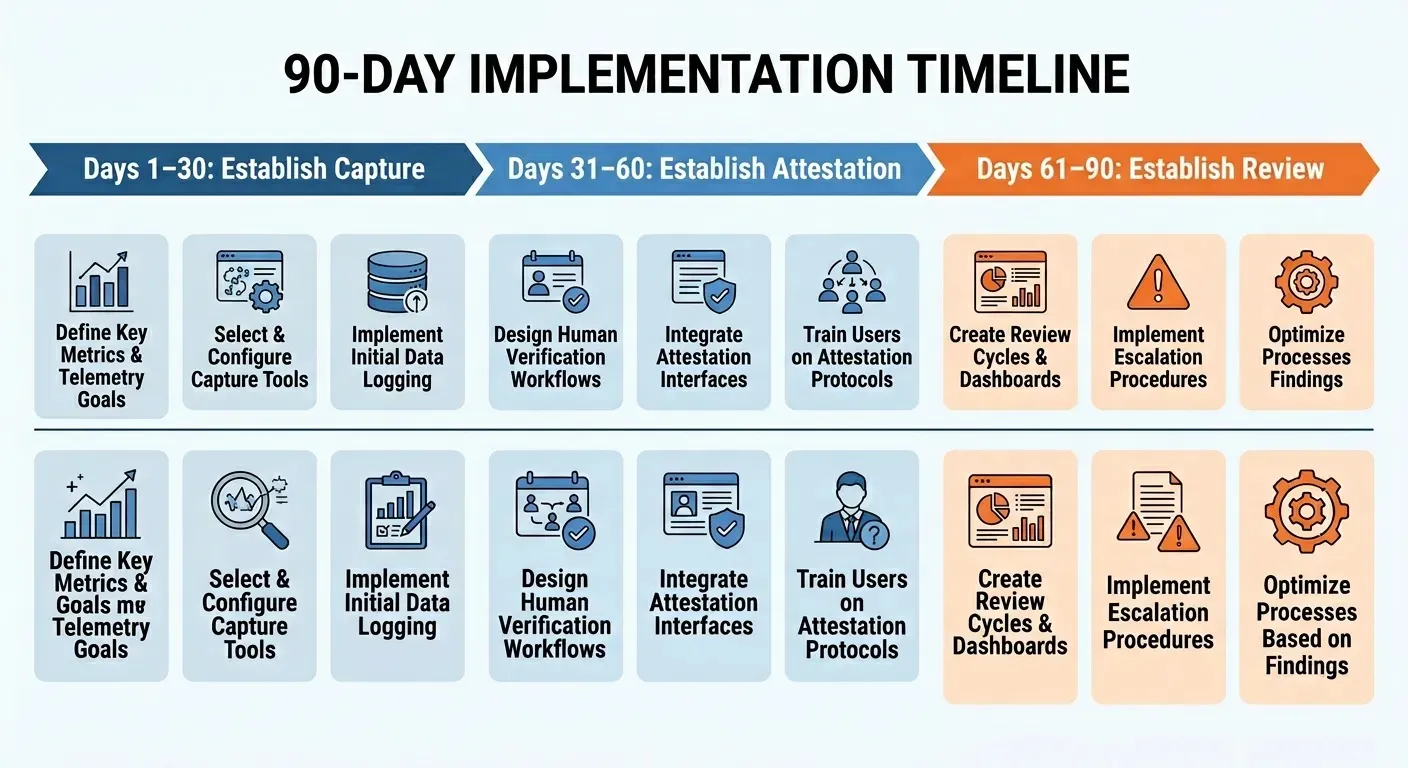
PHASE 1 · Days 1–30 — Establish Capture
- Inventory every AI touchpoint across the firm — client-facing, internal, and decision-support workflows.
- Choose a telemetry layer — vendor-provided or independent; understand what each captures and what it does not.
- Establish retention policies, access controls, and storage governance aligned to the Australian Privacy Act and relevant professional standards.
PHASE 2 · Days 31–60 — Establish Attestation
- Define which decision types require named human attestation — start with material client advice, regulatory disclosures, and override decisions.
- Train staff on VHC discipline — what attestation means, what it captures, and why it is not the same as a counter-signature on a document.
- Pilot the attestation workflow in one practice area; use the pilot to surface friction before firm-wide rollout.
PHASE 3 · Days 61–90 — Establish Review
- Run a weekly exception review — anomalies surfaced by the telemetry layer are reviewed by a named governance lead.
- Stand up a monthly governance committee — review the full artefact set for completeness, correlation, and attestation quality.
- Prepare the quarterly briefing pack for insurers and regulators — evidence that the programme is running and producing audit-grade output.
Each phase builds on the last. Attestation without capture produces nothing. A review without attestation has nothing to review. The sequence is not arbitrary — it reflects the dependency structure of the governance architecture itself.
A Better Future Requires Both
The conversation about AI governance has spent too long organised around a false binary. On one side: AI constrained by human oversight until it can barely function. On the other: AI operates freely, with humans accepting liability for whatever it produces. Neither of these is a governance model. They are failure modes dressed up as positions. The actual architecture that produces governed, insurable, trustworthy AI is a partnership.
AI provides what humans cannot — scale, speed, pattern detection, and comprehensive event capture. Humans provide what AI cannot — independent judgment, professional accountability, contextual attestation, and the legal standing that makes a governance record count for something. Telemetry is the artefact that makes the partnership legible. Without it, the AI’s contribution is invisible, the human’s contribution is undocumented, and the combined output is ungovernable. Without co-production — both parties contributing to a single, correlated, attested record — AI telemetry cannot serve its governance function.
And without governance function, AI cannot be insured, audited, or trusted at scale. The firms that get this right this year will find PI renewal more straightforward, regulatory conversations more confident, and client trust more durable. That is not a secondary benefit. In a market where AI is becoming table stakes and governance is becoming the differentiator, it may be the most important competitive advantage available.
This article is the fourth in the TLF Governance Artifact System series. The next piece operationalises the 90-day framework above into a standalone implementation guide for Australian professional services firms. Subscribe to the TLF newsletter to receive it when it publishes.
Frequently Asked Questions — Human–AI Collaboration
What is AI telemetry, in plain English?
AI telemetry is the continuous, structured capture of what an AI system does — every prompt it receives, every retrieval it performs, every output it generates, and every downstream action it triggers. Think of it as the black box flight recorder for AI: if something goes wrong, telemetry is the evidence trail that lets you reconstruct what happened, in what order, and why. Without it, AI governance is largely guesswork.
Why is AI telemetry considered so complex?
AI telemetry is complex because it must capture events across multiple modalities (text, retrieval, tool calls, actions), on timescales ranging from milliseconds to days, while preserving enough context to make each logged event forensically useful. Add model drift, privacy constraints, and the sheer volume of agentic systems, and single-party governance — by humans or by the AI itself — becomes technically and practically impossible.
Reference: NIST AI 600-1 — Artificial Intelligence Risk Management Framework: Generative AI Profile (2024).
What is the difference between AI logging and AI telemetry?
AI logging records that something happened. AI telemetry records what happened, when it happened, in what context, with what inputs and outputs, and correlates it with adjacent events in the same workflow. Logging is a narrow technical function. Telemetry is a governance function — it produces evidence, not just records. The distinction matters enormously when an insurer or regulator asks for proof of due diligence.
Reference: NIST AI 100-1 — AI Risk Management Framework (2023).
Can AI govern itself if it logs everything?
No. A system audited by the system being audited fails the first principle of independent assurance.
AI self-attestation is also unreliable: models are well documented as overconfident in their own accuracy. Regulatory frameworks, including the EU AI Act Article 14, explicitly require human oversight for high-risk applications, and insurers are increasingly declining to accept machine self-attestation as standalone evidence in claims processes — a position unlikely to soften as affirmative AI liability cover matures into a distinct product category.
Reference: EU AI Act — Regulation (EU) 2024/1689, Article 14 (Human Oversight).
What does ‘human in the loop’ actually mean in this context?
‘Human in the loop’ in AI telemetry means more than a person reviewing an output before it goes out. It means a named, credentialled human attesting that they reviewed a consequential decision, understood the AI’s contribution, and took professional responsibility for the outcome. That attestation — captured, timestamped, and correlated with the AI’s telemetry record — is what converts a workflow into a governance artefact.
Reference: ISO/IEC 42001:2023 — AI Management Systems Standard.
How does Verifiable Human Contribution (VHC) relate to telemetry?
Verifiable Human Contribution is the standard that converts ad-hoc human input into auditable evidence. Without VHC, you may have a human who reviewed something, but no record that survives scrutiny. With VHC, every material human decision is captured alongside the AI’s own telemetry — creating a correlated, complete, attested record that can satisfy an insurer, a regulator, or a court.
Reference: TLF — Verifiable Human Contribution (VHC): The AI Evidence Standard.
Why are insurers asking for AI evidence at renewal?
Professional indemnity insurers are increasingly adding AI-related exclusions or requiring evidence of AI governance as a condition of cover. They need to assess whether AI is being used in a governed or ungoverned way. Telemetry and human attestation records are the clearest form of that evidence. Firms without them face higher premiums, narrower cover, or outright exclusion from PI renewal.
Does the EU AI Act require human oversight of AI?
Yes. The EU AI Act explicitly requires that high-risk AI systems be subject to human oversight, that they allow for human intervention and override, and that relevant logs be maintained for a minimum period. Providers and deployers of high-risk AI systems in the EU — or serving EU clients — must demonstrate compliance with these obligations, and human oversight cannot be delegated to the AI itself.
Reference: EU AI Act — Regulation (EU) 2024/1689, Articles 9, 14, and 17.
Is there an Australian equivalent to the EU AI Act?
Australia has not enacted a standalone AI Act. The National AI Centre’s October 2025 Guidance for AI Adoption (GfAA) superseded the 2024 Voluntary AI Safety Standard, condensing the original ten guardrails into six essential practices, including human oversight. The December 2025 National AI Plan confirmed that Australia will rely on existing laws and sector regulators rather than introduce mandatory guardrails. Supervisory pressure is being applied through APRA (30 April 2026 letter to industry; CPS 230 in force since 1 July 2025, with the contractual transition window closing 1 July 2026) and ASIC’s ongoing focus on AI in financial services.
Reference: National AI Centre — Guidance for AI Adoption (October 2025); APRA — Letter to Industry on Artificial Intelligence (30 April 2026).
How much telemetry should a small professional services firm capture?
Capture comprehensively at the system level — every AI interaction — but apply proportional human attestation. Not every AI-assisted email draft needs a principal’s signature. Material client advice, regulatory disclosures, and judgment calls under uncertainty do. The guiding principle: what would a regulator or insurer need to see if they were to investigate this workflow? Start there and work backwards.
Reference: OAIC — Australian Privacy Principles (data minimisation guidance).
Who in the firm should be responsible for AI telemetry?
Responsibility should sit with a named governance lead — ideally a principal or partner — with operational implementation delegated to a practice manager or compliance officer. The telemetry function itself can be vendor-provided or independent, but the governance sign-off cannot be outsourced. Someone in the firm must be accountable for what the AI does on the firm’s behalf, and their name must appear in the record.
Reference: ISO/IEC 42001:2023 — Roles and responsibilities in AI management systems.
What does an audit-grade governance artefact look like?
An audit-grade governance artefact has three properties: complete (no gaps in the event record), correlated (every event linkable to its context and adjacent events), and attested (a named human has signed off where required). In practice, it might look like a timestamped log of an AI-drafted advice document, the retrieval sources used, the planner’s attestation of suitability, and the disclosure sent to the client — all correlated and retained.
Reference: IAASB — International Standards on Auditing: Evidence requirements.
How do we start a human–AI telemetry programme in 90 days?
In days 1–30, inventory every AI touchpoint, choose a telemetry layer, and establish retention controls. In days 31–60, define which decisions require human attestation, train staff on VHC discipline, and pilot in one workflow. In days 61–90, run weekly exception reviews, stand up a monthly governance committee, and prepare a quarterly briefing pack for insurers and regulators. Each phase builds on the last — the sequence matters.
Reference: TLF — AI Telemetry: The Missing Layer in AI Governance.
What are the most common mistakes firms make with AI telemetry?
The most common mistakes: capturing outputs without context (forensically useless); treating vendor dashboards as independent governance (they are not); assuming human review is the same as human attestation (it is not); and failing to correlate AI events with human actions in a single record. A second tier of mistakes involves privacy overreach — capturing far more than governance requires, creating a secondary liability.
Reference: TLF — The Seven Governance Sins.
Will telemetry slow our AI deployment down?
A well-designed telemetry layer adds negligible latency to AI workflows — typically milliseconds at the capture stage. The real cost is governance discipline: defining attestation requirements, training staff, and building review cadences. That cost is real, but far smaller than the cost of an uninsured PI claim, a regulatory investigation, or a client dispute where you cannot demonstrate what your AI did and why.
Reference: National AI Centre — Guidance for AI Adoption (October 2025) — governance proportionality guidance.
Related TLF Articles
This article sits within the TLF Governance Artifact System series. The following pieces explore adjacent themes and provide additional context for readers working through AI governance, professional liability, and insurability questions.
The TLF Governance Artifact System series
For the foundational case on why telemetry is the missing layer in AI governance, start with AI Telemetry: The Missing Layer in AI Governance, Liability, and Insurability. For the evidentiary architecture that makes telemetry usable in a claim or regulatory inquiry, see Verifiable Human Contribution (VHC): The AI Evidence Standard. For the failure patterns that void AI cover, see The Seven Governance Sins and The Forensic Solution: How Governance Artefacts Restore Professional Insurability.
The 2026 insurance landscape
For the broader insurance and PI context, The AI Insurance Cliff explores the exclusion-clause architecture now appearing in standard cover; The Total Cost of Risk AI sets out the financial impact for professional services firms; and Twenty Reasons Professional Advisors Must Understand AI Telemetry provides a tighter, advisor-facing summary of the same arguments.
Sector-specific application
For sector-specific implementation guidance, AI in Financial Planning covers the financial planning context, while AI in Courts: Human Judgment, Machine Scale and Who’s Liable When Your AI Gives Bad Advice? address the legal practice and director-liability dimensions.
References
- Lwakatare, L. E., Raj, A., Bosch, J., Olsson, H. H., & Crnkovic, I. (2020). Large-scale machine learning systems in real-world industrial settings: A review of challenges and solutions with longitudinal study. Information and Software Technology, 127, 106368. https://doi.org/10.1016/j.infsof.2020.106368
- Gama, J., Žliobaitė, I., Bifet, A., Pechenizkiy, M., & Bouchachia, A. (2014). A survey on concept drift adaptation. ACM Computing Surveys, 46(4), 44. (Foundational; cited in AI drift literature through 2025.) https://doi.org/10.1145/2523813
- Office of the Australian Information Commissioner. (2024). Australian Privacy Principles: Data minimisation and retention guidance. Australian Government. https://www.oaic.gov.au/privacy/australian-privacy-principles
- PricewaterhouseCoopers Australia. (2024). Scaling AI risk management and governance. PwC Australia. https://www.pwc.com.au/services/artificial-intelligence/scaling-ai-risk-management.html
- Amershi, S., Begel, A., Bird, C., DeLine, R., Gall, H., Kamar, E., … Zimmermann, T. (2019). Software engineering for machine learning: A case study. Proceedings of the 41st International Conference on Software Engineering: Software Engineering in Practice, 291–300. IEEE. https://doi.org/10.1109/ICSE-SEIP.2019.00042
- Parasuraman, R., & Manzey, D. H. (2010). Complacency and bias in human use of automation: An attentional integration. Human Factors, 52(3), 381–410. https://doi.org/10.1177/0018720810376055
- Kadavath, S., Conerly, T., Askell, A., Henighan, T., Drain, D., Perez, E., … Anthropic. (2022). Language models (mostly) know what they know. arXiv, 2207.05221. https://arxiv.org/abs/2207.05221
- European Parliament and Council of the European Union. (2024). Regulation (EU) 2024/1689 of the European Parliament and of the Council — Artificial Intelligence Act. EUR-Lex. https://eur-lex.europa.eu/legal-content/EN/TXT/?uri=CELEX:32024R1689
- International Organization for Standardization. (2023). ISO/IEC 42001:2023 — Information technology: Artificial intelligence — Management system. ISO. https://www.iso.org/standard/81230.html
- Australian Prudential Regulation Authority. (2026, 30 April). Letter to industry on artificial intelligence (AI). APRA. https://www.apra.gov.au/apra-letter-to-industry-on-artificial-intelligence-ai
- Australian Prudential Regulation Authority. (2026, 30 April). Prudential Standard CPS 230 Operational Risk Management (final amendments). APRA. https://www.apra.gov.au/operational-risk-management
- European Commission. (2026, 7 May). Digital Omnibus political agreement on the AI Act implementation timeline. https://digital-strategy.ec.europa.eu/en/policies/regulatory-framework-ai
- National Institute of Standards and Technology. (2024, July). Artificial intelligence risk management framework: Generative artificial intelligence profile (NIST AI 600-1). U.S. Department of Commerce. https://doi.org/10.6028/NIST.AI.600-1
- Lloyd’s Market Association. (2025). Understanding artificial intelligence risk in insurance products: Underwriter guidance for professional indemnity. LMA. https://lmalloyds.com/understanding-artificial-intelligence-risk-in-insurance-products-the-challenges/
- Armilla AI. (2026). AI liability policy — Lloyd’s of London coverholder programme (expanded cover statement, March 2026). https://armilla.ai/
BLOCK 1 — CITATION ACCURACY & VERIFICATION STATEMENT (TLF EDITORIAL STANDARD V3, PHASE 1)
All citations in this article have been verified against their primary sources before publication. Every external link was tested to confirm it resolves to the cited content. Each statistic has been cross-checked against at least one independent authoritative source.
BLOCK 2 — AMAZON AFFILIATE DISCLOSURE
TechLifeFuture.com is a participant in the Amazon Services LLC Associates Programme, an affiliate advertising programme designed to provide a means for sites to earn advertising fees by advertising and linking to Amazon.com.au and associated international sites. Where product links appear in this article or on this site, TechLifeFuture may earn a small commission at no additional cost to you.
BLOCK 3 — GENERAL AFFILIATE DISCLOSURE
Some links on TechLifeFuture.com are affiliate links. If you click through and make a purchase or sign up for a service, TechLifeFuture may receive compensation. This does not influence editorial decisions or the content of our articles. We only reference products and services we believe are relevant and useful to our readers.
BLOCK 4 — LEGAL AND PROFESSIONAL DISCLAIMER
The content of this article is provided for general informational and educational purposes only. It does not constitute legal, financial, insurance, or professional advice. The author, John Cosstick, is a retired Certified Financial Planner (CFP) and a retired Fellow of the Institute of Public Accountants (FIPA) — he is not currently practising in either capacity. Readers should seek advice from a qualified, currently practising professional before making decisions based on the content of this article. TechLifeFuture.com and its contributors accept no liability for any action taken or not taken based on the information in this article.
Article Currency
This article reflects AI, regulatory, and professional services practices as at 20 May 2026 (AEST). The Australian and EU regulatory landscapes for AI are evolving rapidly; readers are advised to consult primary sources for the most current position before relying on any specific point of detail.
AI Assistance Disclosure
Portions of this article were AI-assisted in drafting and were subsequently human-reviewed and edited for accuracy, regulatory currency, and compliance with the TLF Editorial Standard v3 zero-fabrication requirement.
Copyright, Licence and Trademark Notice
© 2026 TechLifeFuture.com. Licensed under Creative Commons Attribution-NonCommercial 4.0 International (CC BY-NC 4.0). Nothing in this article or its Creative Commons license grants, by implication, estoppel, or otherwise, any licence to any patent, patent application, or pending claim of John Cosstick or TechLifeFuture.com. All patent rights are expressly reserved. Proprietary frameworks referenced in this article — the Governance Artifact System (GAS™), Verifiable Human Contribution (VHC™), AIMS Governance™, and Proof Before Scale™ — are trademarks of John Cosstick / TechLifeFuture and are used here with permission.
About the Author
John Cosstick is a writer, author and the Founder-Editor of TechLifeFuture.com, drawing on deep prior experience across banking, financial planning and accounting. A retired Certified Financial Planner and retired Fellow of the Institute of Public Accountants (FIPA), he is also a partner and minor shareholder in Mindhive.ai and holds a portfolio of technology patent applications pending before IP Australia and WIPO covering AI governance. His work has been recognised internationally: in 2024, he won the BOLD Award for Open Innovation in Digital Industries, and in 2026, the BOLD Awards VII InsurTech category.
Earlier in his career, he served as a bank compliance manager and has since contributed to the UK Money and Pensions Service Debt Review and UN AI for Good initiatives. Writing from Melbourne, Australia, John focuses on AI governance, professional liability and the insurability of AI-enabled professional services. A preview of his recent book, The Governance Artifact System — How to Secure Professional Liability Insurance in the AI Era, is available on Amazon.