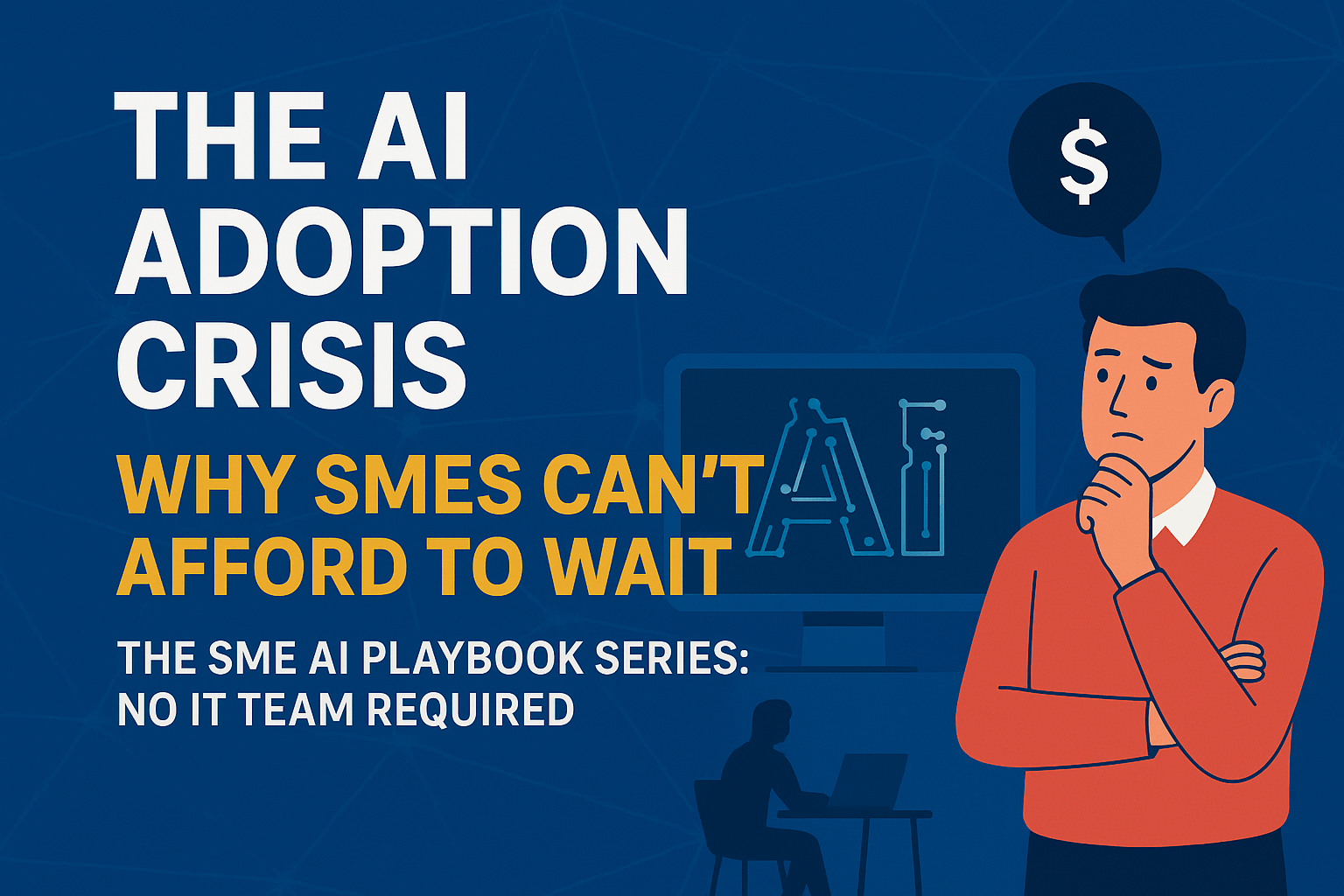
The Uncomfortable Truth About AI Adoption in 2025
Is your small business falling behind the AI curve? If you’re reading this with a knot in your stomach, wondering whether AI is still optional for your company—you’re not alone. But here’s the data point that should keep you up at night: the gap between AI leaders and laggards has widened by 60% in just three years[1].
This isn’t about embracing every shiny new technology. It’s about survival in an increasingly competitive marketplace where your rivals—including those you’ve never heard of yet—are leveraging AI to move faster, operate leaner, and serve customers better than ever before.
The question isn’t whether to adopt AI anymore. It’s whether you can afford to wait another quarter.
The Widening Chasm: Leaders Are Pulling Away Fast
Harvard Business School’s Karim Lakhani on practical AI for small businesses (CNBC Events).
The Data Doesn’t Lie
Between 2020 and 2023, digital and AI leaders pulled 60% farther ahead of lagging peers in maturity across industries, according to McKinsey’s latest research on digital transformation[1]. This isn’t a gradual drift—it’s an acceleration. Leaders who have invested in digital and AI capabilities now outperform laggards by 2–6× on total shareholder returns (TSR)[1].
The companies that started experimenting with AI three years ago are now compounding their advantages, while those still “watching and waiting” find themselves in an increasingly precarious position.
U.S. small business trajectory:
- 2023: 23% of small businesses using AI
- 2024: 40% of small businesses using AI (a 74% increase in one year)
- 2025: ~58% of U.S. small businesses report using AI
That curve tells a story: early adopters are seeing results, talking to their peers, and creating competitive pressure that’s forcing even the sceptics to reconsider. Adoption has more than doubled in two years, signalling a tipping point for U.S. SMEs[2].
AI investments are a sign of growth. Eighty-three percent of growing businesses say they’re adopting AI—compared to those experiencing declining revenue who plan to increase AI investment at lower rates. That gap is only going to widen.
— Kris Billmaier, EVP at Salesforce
Why This Matters for Your Bottom Line
These aren’t vanity metrics. SMEs actively using AI report measurably stronger performance:
- 91% of SMEs with AI say it boosts their revenue[4]
- Double-digit productivity gains in targeted workflows[5]
- 2–6× financial outperformance for AI leaders across industries[1]
Perhaps most telling: 82% of small businesses now agree that adopting AI is essential to stay competitive—no longer a luxury[6].
The Resource Paradox: Why You Think You Can’t (But Actually Can)
Here’s where most SME leaders get stuck: “We’d love to explore AI, but we don’t have a dedicated IT team, six-figure budgets, in-house data scientists, or time for 18-month implementations.” That’s the AI Resource Paradox: old adoption models over-index on resources most SMEs lack.
Good news: that model is outdated. Bad news: many leaders still believe it—keeping them paralysed while competitors move.
The Real Barriers (And How They’ve Changed)
1. Cost Perception
The assumption: AI requires heavy capex and specialists.
The reality: Based on industry consulting frameworks, cloud AI pilots for micro businesses (1–10 staff) typically range from $2,680–$13,400 over 3–6 months, focusing on off-the-shelf productivity tools with minimal integration[8]. (Converted at GBP→USD 1.34 on 21 Oct 2025.) Government-supported programs like the NIH Cloud Lab provide $500 in cloud credits for 90 days with spend limits—proving low-cost experimentation is possible[9].
2. Knowledge and Skills Gap
The assumption: you need data scientists.
The reality: Modern platforms (AWS SageMaker, Google Vertex AI, Azure ML) provide AutoML and pre-trained services for common tasks—no ML expertise required[10]. With focused enablement, individuals become productive in 4–16 weeks[8].
3. Privacy and Security Concerns
The assumption: experimenting with AI risks sensitive data.
The reality: Cloud labs isolate experiments from production. Major providers offer HIPAA-eligible/GDPR-supporting services—full compliance depends on configuration and usage[11].
Why perceptions lag reality: U.S. small-business AI usage more than doubled in a year[2], suggesting accessible tools are lowering real-world barriers faster than market perception.
The Paradigm Shift: Cloud Labs and Low-Risk Experimentation
Cloud labs: a safe, low-cost path to hands-on AI evaluation.
What Makes Cloud Labs Different
Think of a cloud lab as a secure playground where you can evaluate AI without risking core operations or over-spending. Instead of heavy upfront investments, you:
- Pay only for what you use (often pennies per hour)
- Access enterprise-grade AI tools with no maintenance burden
- Isolate experiments from production systems
- Scale instantly when something works—or shut down when it doesn’t
Managed cloud-lab services offer subscriptions as low as $6–$12 per lab user/month[12], making the economics compelling.
The Real Cost of Starting Small
Based on implementation frameworks[8], typical micro-business pilot costs are $2,680–$13,400 over 3–6 months with a 40-30-20-10 allocation:
- 40% Integration, data work, technical implementation
- 30% Software/infrastructure
- 20% Training & change management
- 10% Ongoing ops & improvement
The Business Case: Quantifiable Returns from AI Pilots
Accounts Payable Automation
- Before: ~$30 per invoice manually
- After: ~$5 per invoice with AI automation
- ROI: 100 invoices/month → ~$2,500/month saved
- Note: Vendor case study; independent benchmarks show manual $8.78–$15+ vs automation $1.77–$5[13]
Professional Services (Legal, Consulting)
- Impact: 42% report saving 1–5 hours/week with gen-AI
- Annual value: 5 hours/week ≈ 260 hours (32.5 working days) per person/year[14]
- Cost: Many tools <$100/user/month
Customer Service Operations
- Faster responses, measurable quality gains with AI chatbots
- 20+ hours/month reclaimed from repetitive enquiries (typical SME reports)
General Operational Efficiency
- Substantial process-automation gains reported by SMEs[16]
- Targeted workflows commonly see 10–30% cost reductions[15]
What we’re seeing is a strategic shift where small businesses recognize AI isn’t just a nice-to-have tool for saving time—it’s becoming essential for maintaining competitiveness in today’s market.
— Rhett Buttle, Public Private Strategies Institute
Why Starting Small Is Your Strategic Advantage
The Pilot-First Approach
The most successful SME AI adopters don’t boil the ocean[17]. They:
- Pick one high-pain, low-complexity task
- Run a time-boxed pilot (4–6 weeks to 3–6 months)
- Measure before/after
- Decide fast: scale, refine, or kill and try the next idea
Risk, managed: a $2,680–$13,400 pilot won’t sink the company if it fails; a $50k misstep might. Small pilots minimise organisational disruption and opportunity cost, while building confidence via visible wins[18].
The Cost of Waiting: What Delayed Adoption Really Means
If a competitor cuts response times 24h→2h, trims costs by 20%, and frees staff for higher-value work, customers notice. Research suggests the leader–laggard gap widens exponentially[1].
What Success Looks Like: The Path Forward
The First 90 Days (Micro-Business Example)
Weeks 1–2: Discovery & Planning
- Identify 2–3 high-pain repetitive tasks
- Define success metrics (time saved, errors reduced, costs cut)
- Select one use case for pilot
Weeks 3–12: Pilot Execution
- Set up cloud AI solution ($2,680–$13,400 range)
- Run in parallel with the current process; compare results
- Gather team feedback
Weeks 13–16: Decision & Action
- Analyse results vs baseline
- Go/No-Go; scale successful pilots
Reality check: not every pilot succeeds; many “failures” reflect scope/metrics issues. Successful implementations often deliver ~3.7× return per $1 invested when budgets prioritise people/process over tech alone[8][18].
Your Next Steps: From Insight to Action
If you’ve read this far, you’re likely in one of three camps:
1. “I’m convinced—where do I start?”
Perfect. In Article 2 we’ll show how to build lightweight AI infrastructure with cloud labs—platform picks, security, and cost control.
2. “I’m interested, but want tactical details first.”
That’s Article 3: a week-by-week implementation playbook with templates, decision gates, and troubleshooting.
3. “I’m sceptical this applies to my industry.”
Fair. The data suggests ~58% of U.S. small businesses already use AI in some form[2].
Continue Reading
→ Article 2: Building Your AI Foundation
Cloud Labs and Lightweight Stacks for Non-Technical Teams
→ Article 3: The Implementation Playbook
From Pilot to Profit (coming soon)
Key Takeaways
- Leaders have pulled 60% farther ahead (2020–2023) and outperform 2–6× on financial returns[1]
- U.S. small-business AI adoption is ~58% in 2025 (23% in 2023 → 40% in 2024 → 58% in 2025)[2]
- 82% of small businesses consider AI essential to stay competitive[6]
- Micro-business pilots commonly cost $2,680–$13,400 over 3–6 months and show measurable ROI[8]
- Concrete wins: AP automation savings (~$2,500/month at small volumes); 260 hours/year saved in legal workflows[13][14]
- Pilot-first approach minimises risk and builds organisational confidence[18]
License Notice
© TechLifeFuture.com, 2025. This article is licensed under
Creative Commons Attribution-NonCommercial 4.0 (CC BY-NC 4.0).
You may share/adapt for non-commercial purposes with clear credit and a link to the original.
Note: Third-party media (e.g., embedded YouTube videos) remain under their original licences.

Some rights reserved.
References
- McKinsey & Company. Rewired and running ahead: Digital and AI leaders are leaving the rest behind. 2023. 60% maturity-gap increase; 2–6× TSR outperformance. Link
- U.S. Chamber of Commerce C_TEC. Empowering Small Business (2023–2025). U.S. SMB AI adoption: 23% → 40% → ~58%. Link
- —
- Salesforce. New Research: SMBs with AI Adoption See Stronger Revenue Growth. (Aug–Sep 2024). 91% report revenue boost. Link
- OECD D4SME Initiative (speech). Boosting SME Competitiveness Through Digital and AI Adoption. Apr 2025. Double-digit productivity gains. Link
- PayPal Newsroom & Reimagine Main Street. Small Businesses Look to AI for Competitive Edge. Jun 10, 2025. 82% say AI is essential. Link
- —
- gigCMO. The Real Cost of AI Implementation for SMEs. 2024. Cost ranges; 40-30-20-10 budgeting. Link
- NIH STRIDES Initiative. NIH Cloud Lab. 2025. $500 credits, 90-day sandbox. Link
- MDPI Applied Sciences. AI Adoption in SMEs (TOE–DOI). Jun 2025. Drivers & barriers. Link
- AWS Compliance Docs. HIPAA/GDPR eligibility; configuration required. Link
- CloudLabs Docs. Pricing $6–$12 per user/month. Link
- CoreIntegrator. ROI of AP Automation—Case Study. Jul 2024. With IOFM benchmarks. Link
- Everlaw x ACEDS/ILTA. 2025 Ediscovery Innovation Report. Jul 2025. Time savings. Link
- ColorWhistle. AI Statistics for Small Business. 2025. Link
- Daijobu AI. SME AI Adoption in 2025: Key Insights. May 2025. Link
- BGF. How are SMEs approaching AI adoption? Nov 2024. Link
- Aquent. Create an AI pilot program that delivers results. Aug 2025. Link
- Scalevise. AI in SMEs: Cost Savings & Growth. Aug 2025. Link
- Salesforce. 35 Inspiring Quotes About AI. 2024. Benioff quote. Link
Methodology Note
Version 2 — Source Quality & Verification:
- Primary sources prioritised: McKinsey, U.S. Chamber C_TEC, Salesforce, PayPal/Reimagine Main Street, Everlaw, peer-reviewed journals
- Vendor/consulting clearly labelled: CoreIntegrator, gigCMO (heuristics)
- Language precision: no over-strong causality; jurisdiction labelled “U.S.” where applicable
- Assumptions shown: e.g., 8-hour days for annual hour calc
- Scope clarity: cross-industry vs SME-specific findings
About This Series
The SME AI Playbook is a three-part thought-leadership series helping SMEs adopt AI without enterprise budgets or dedicated IT teams.
Published: October 2025 | Reading Time: ~18 minutes | Part 1 of 3
Citation & Verification
TechLifeFuture articles undergo multi-step fact-checking aligned with EEAT principles. We verify technical claims against primary sources and authoritative publications.
Feedback: [email protected] (subject “Citation Feedback”).
Legal Disclaimer
Educational content only; not professional advice. Consult qualified engineers or legal experts for implementation decisions.
Financial Advice Disclaimer
This publication does not constitute financial advice. Readers should seek independent financial, tax, or investment guidance before making decisions.